Strike Price
The predetermined, contractually fixed price at which the owner of an option holds the legal right to purchase (for a call option) or sell (for a put option) the underlying asset upon exercise; also universally known as the Exercise Price.
What Is a Strike Price?
A strike price (synonymous in derivatives markets with exercise price) is the foundational anchor of any options contract. It is the agreed-upon price at which the underlying security, currency, or commodity must be delivered or cash-settled if the option buyer decides to exercise their contractual right.
The strike price is fixed at the inception of the contract and remains constant throughout the option’s lifespan, regardless of how violently the underlying asset’s market price fluctuates.
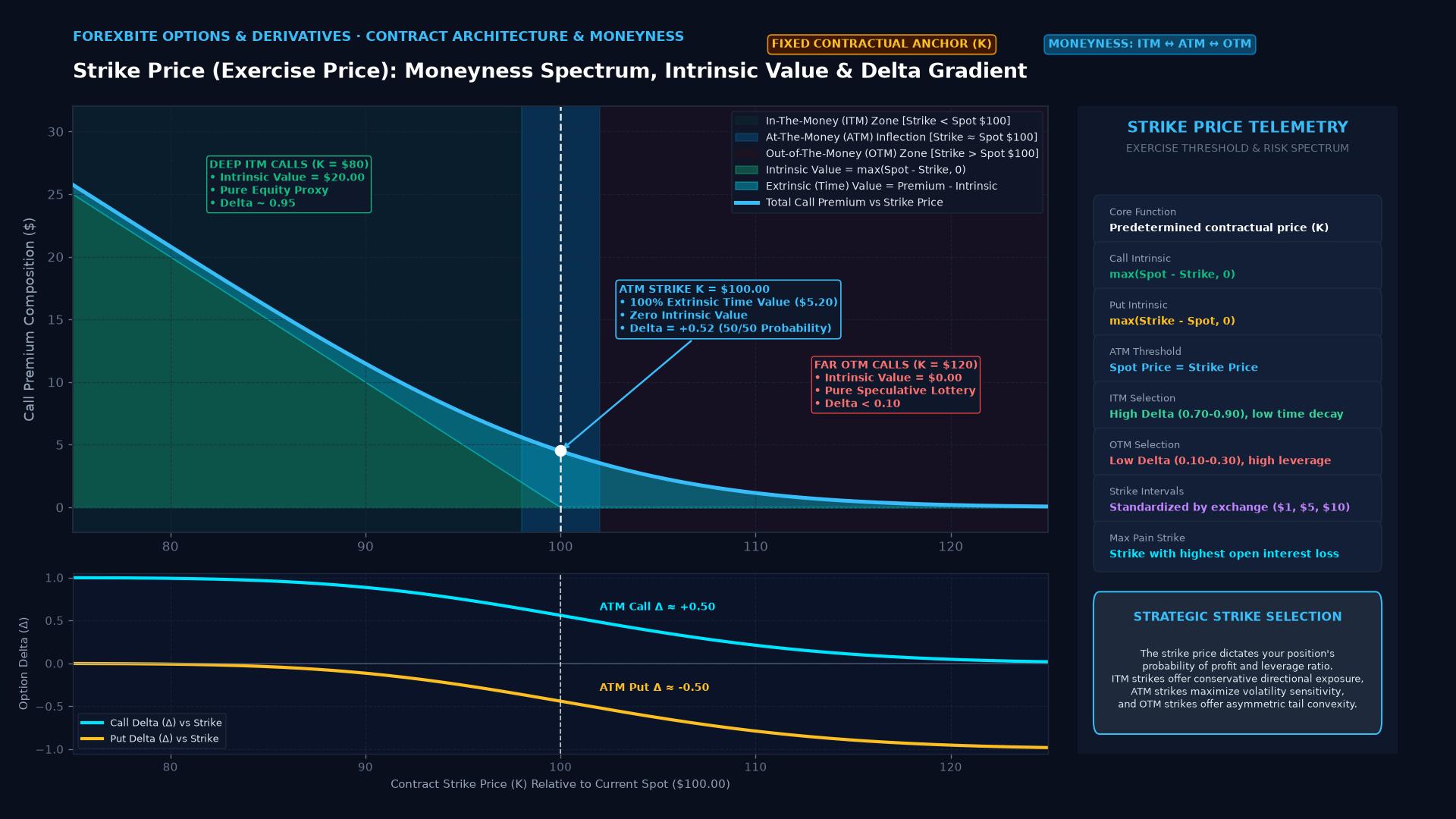
The relationship between the fixed strike price ($K$) and the constantly moving spot market price ($S$) establishes the option’s moneyness, dictating whether the contract possesses real intrinsic cash value or consists purely of extrinsic speculative time value.
Moneyness and Intrinsic Value Calculations
The strike price determines the division of an option’s market premium into intrinsic value and extrinsic (time) value:
$$\text{Option Premium} = \text{Intrinsic Value} + \text{Extrinsic (Time) Value}$$
1. Call Options
A call option grants the right to buy at the strike price ($K$):
$$\text{Call Intrinsic Value} = \max\left(S - K, ; 0\right)$$
- If Spot ($S = $115$) > Strike ($K = $100$), the call is In-The-Money (ITM) with $15.00 of intrinsic value.
- If Spot ($S = $90$) < Strike ($K = $100$), the call is Out-of-The-Money (OTM) with zero intrinsic value.
2. Put Options
A put option grants the right to sell at the strike price ($K$):
$$\text{Put Intrinsic Value} = \max\left(K - S, ; 0\right)$$
- If Spot ($S = $85$) < Strike ($K = $100$), the put is In-The-Money (ITM) with $15.00 of intrinsic value.
- If Spot ($S = $110$) > Strike ($K = $100$), the put is Out-of-The-Money (OTM) with zero intrinsic value.
How Strike Price Selection Governs Option Greeks
Choosing which strike price to trade fundamentally determines the risk and reward profile through the option Greeks:
               GREEK SENSITIVITIES ACROSS STRIKE INTERVALS

 Strike Status         Delta (Δ)               Gamma (Γ)        Vega (V)
 ────────────────────────────────────────────────────────────────────────────
 Deep In-The-Money     Approaches ±1.00        Low (Static)     Low
                       (Acts like spot stock)

 At-The-Money (ATM)    Near ±0.50              MAXIMUM          MAXIMUM
                       (Highest optionality)   (Explosive)      (IV Sensitive)

 Deep Out-of-The-Money Approaches 0.00         Low              Low
(Cheap lottery ticket)- Delta Distribution: Deep ITM strikes carry deltas near 1.0, tracking underlying price movements dollar-for-dollar. OTM strikes carry low deltas (0.10 to 0.25), requiring massive underlying trends to achieve profitability.
- Gamma Concentration: Gamma peaks precisely at the At-The-Money (ATM) strike price. This means delta changes most rapidly when the spot price crosses back and forth across the strike threshold.
Strike Price vs. Spot Price vs. Breakeven Price
| Parameter | Strike Price ($K$) | Spot Price ($S$) | Breakeven Price ($P_{\text{BE}}$) |
|---|---|---|---|
| Definition | The contractually agreed exercise rate | The prevailing real-time market price of the asset | The market price required at expiration to achieve $0 net P&L |
| Variability | Fixed throughout contract life | Fluctuates continuously thousands of times per day | Fixed at trade entry ($K \pm \text{Premium}$) |
| Who Dictates It? | Standardized by the options exchange | Interbank market supply and demand | Mathematical sum/difference of strike and premium paid |
| Example (Call) | $100.00 Strike | Trades at $102.50 | $$100.00 + $4.00 \text{ Premium} = \mathbf{$104.00}$ |
Real-World Institutional Case Study: Options “Pinning” on Expiration Friday (OpEx)
In equity and foreign exchange options markets, a well-documented phenomenon known as strike price pinning frequently unfolds on monthly options expiration dates (OpEx):
       STRIKE PRICE PINNING AT $150.00 (EXPIRATION FRIDAY)

 Spot Price
   │
   │            /\
152┼───────────/──\──────────────────────────────────────────────────────────
   │          /    \       /\           /\
150┼─ ─ ─ ─ ─/─ ─ ─ \─ ─ -/──\─ ─ ─ ─ -/──\─ ─ ─ [ HEAVY OI STRIKE: $150.00 ]
   │        /        \   /    \       /    \       Market pinned tightly at $150
148┼───────'          '-'      \     /      '-...
   │                            '-.-'
   └────────────────────────────────────────────────────────────────► Time
09:30 AM (Market Open) 12:00 PM 16:00 PM (Close)- The Institutional Imbalance: Large market makers sell thousands of call and put contracts to retail and institutional clients, creating massive Open Interest (OI) at a single round strike price (e.g., $150.00).
- The Delta-Hedging Mechanism: To remain delta-neutral, market makers must dynamically hedge:
- When the underlying price rises above $150, their net short calls become positive delta. Market makers must sell underlying stock/futures to neutralize risk, pushing prices back down toward $150.
- When the underlying price dips below $150, their net short puts become negative delta. Market makers must buy underlying stock/futures, pulling prices back up toward $150.
- The Outcome: This continuous automated hedging creates an artificial gravitational pull, “pinning” the underlying asset directly onto the $150 strike price at the 4:00 PM market close, causing the maximum number of long options contracts to expire completely worthless (the “Max Pain” effect).
Frequently Asked Questions
Can the strike price of an option ever be adjusted?
Under normal market operations, the strike price is completely fixed. However, options clearinghouses (such as the OCC) execute mandatory corporate action adjustments if the underlying company undergoes a stock split, reverse stock split, special cash dividend, or spin-off. For example, in a 2-for-1 stock split, a $100 strike price is automatically adjusted down to $50.00, while the contract size doubles from 100 to 200 shares.
How do derivatives exchanges choose strike price intervals?
Exchanges (such as Cboe or CME) establish strike intervals based on the price tier and liquidity of the underlying asset. For liquid mega-cap stocks or major currency futures, strikes are listed in $0.50 or $1.00 increments. For higher-priced equities ($500+), intervals widen to $5.00 or $10.00 to concentrate market liquidity.
Which strike price should a beginner option buyer choose?
Novice traders are frequently seduced by cheap Out-of-The-Money (OTM) strikes because of their low absolute dollar price. However, deep OTM strikes suffer from extremely low statistical probabilities of expiring in-the-money (often $< 15%$). Professional traders generally recommend purchasing At-The-Money (ATM) or slightly In-The-Money (ITM) strikes (with deltas between 0.50 and 0.70) to balance leverage against the risk of total capital loss.
Ready to trade forex?
Open a free demo account with a regulated broker. Practice with virtual funds before risking real money.