Take Profits
A conditional limit order or disciplined trading action configured to automatically liquidate an open winning position when the asset touches a predetermined price target, locking in paper gains and converting them into realized capital.
What Does “Take Profits” Mean?
In financial trading and investment management, take profits carries two complementary meanings:
- The Tactical Order Type (Take-Profit Order / TP): A pre-set limit order linked to an active trade that automatically closes the position once a specific, profitable price threshold is reached.
- The Portfolio Action: The deliberate, disciplined process of liquidating an asset that has accumulated significant unrealized gains, permanently converting mark-to-market paper profits into realized cash balances.
A take-profit order functions as the mirror image of a stop-loss order. While a stop-loss order establishes a defensive floor to restrict capital loss, a take-profit order establishes an objective upside ceiling where the trader intentionally exits the market, eliminating the risk that a subsequent market reversal will wipe out accumulated gains.
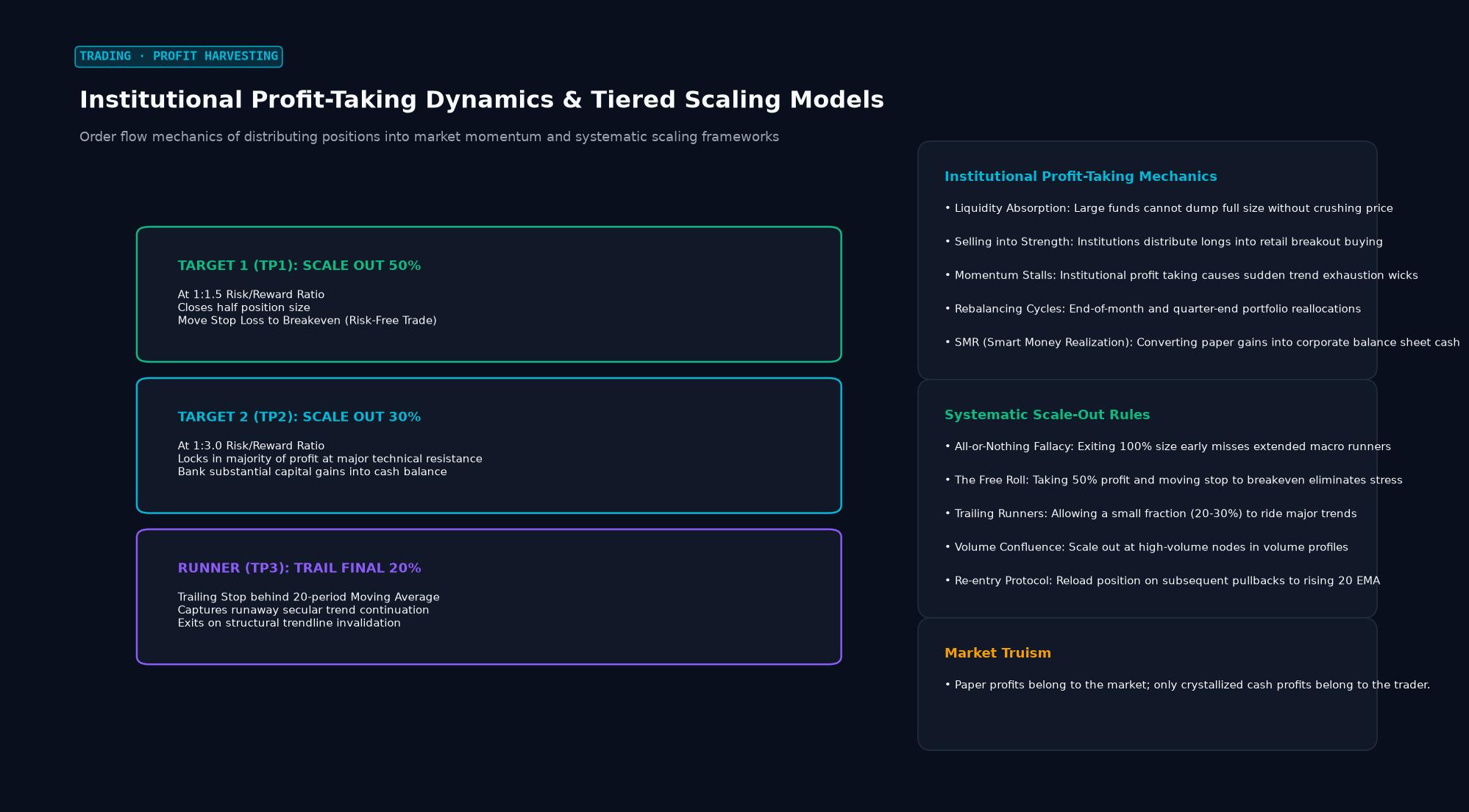 Figure: Order flow mechanics of distributing positions into market momentum and systematic scaling frameworks
The Mathematics of Profit Taking: Risk-to-Reward Ratio (RRR)
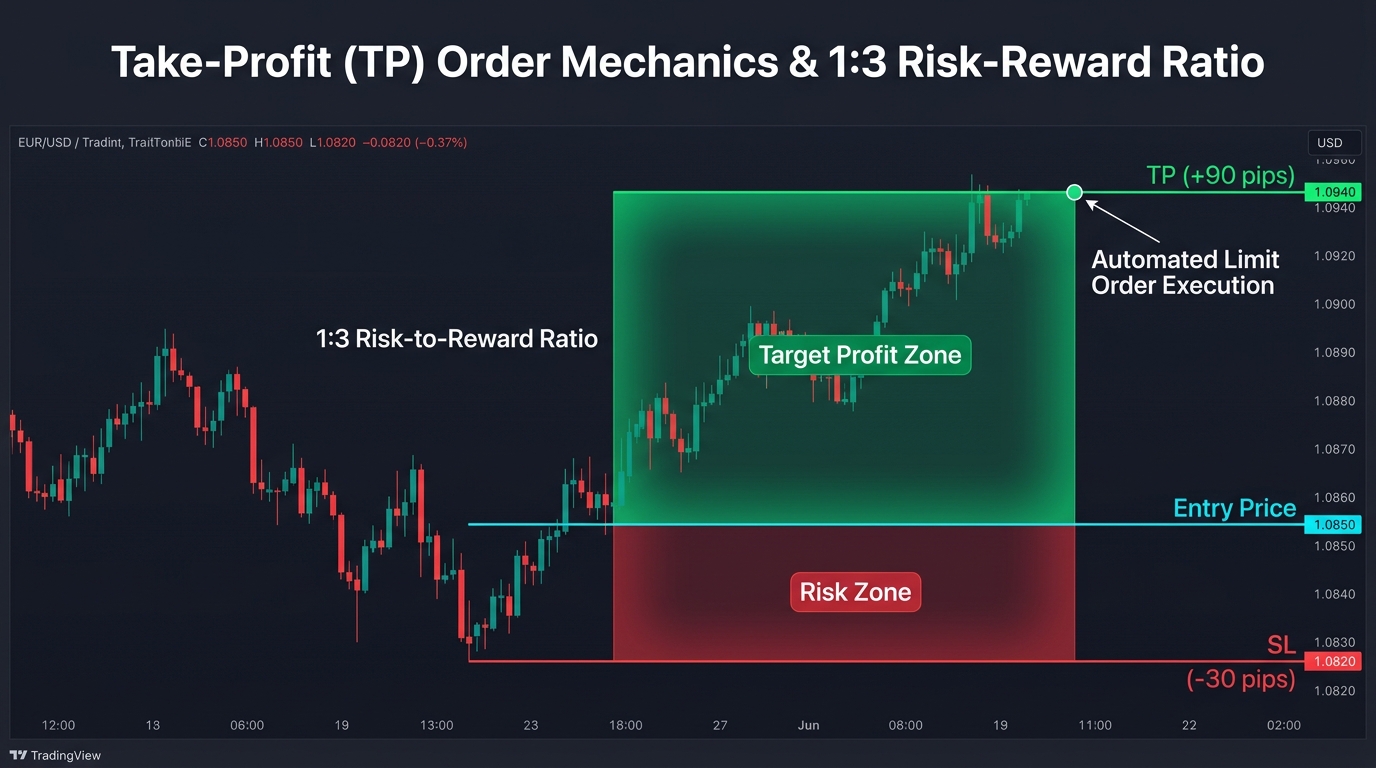
Professional trading systems never set arbitrary take-profit targets. Instead, take-profit levels are calculated systematically in relation to the initial stop-loss distance, establishing the trade’s Risk-to-Reward Ratio (RRR):
$$\text{Risk-to-Reward Ratio (RRR)} = \frac{|\text{Take-Profit Price} - \text{Entry Price}|}{|\text{Entry Price} - \text{Stop-Loss Price}|} = \frac{\text{Reward (R)}}{\text{Risk (R)}}$$
The Mathematical Win-Rate Breakeven
The required historical win rate ($W_{\min}$) necessary to achieve long-term statistical breakeven is a direct mathematical function of the Risk-to-Reward ratio:
$$W_{\min} = \frac{1}{1 + \text{RRR}}$$
| Planned Risk-to-Reward (RRR) | Required Win Rate to Break Even | Expected Advantage / System Resilience |
|---|---|---|
| $1 : 1$ ($1R$ Target) | 50.0% | Requires high accuracy; sensitive to spread and commission drag |
| $2 : 1$ ($2R$ Target) | 33.3% | Highly robust; trader can be wrong 60% of the time and remain profitable |
| $3 : 1$ ($3R$ Target) | 25.0% | Institutional trend-following baseline; captures large asymmetric moves |
| $5 : 1$ ($5R$ Target) | 16.7% | Macro breakout systems; tolerates long strings of minor losses |
Order Mechanics: Why Take-Profit Orders Avoid Negative Slippage
A critical technical advantage of a Take-Profit order is that it is submitted to the matching engine as a Limit Order, whereas a Stop-Loss is submitted as a Stop/Market Order.
                   LIMIT ORDER VS. STOP ORDER EXECUTION

  TAKE-PROFIT ORDER (LIMIT):                 STOP-LOSS ORDER (STOP/MARKET):
  - Rests as passive limit in order book     - Rests as dormant trigger on server
  - Must execute at limit price OR BETTER    - Converts to aggressive MARKET order
  - ZERO negative execution slippage         - Highly vulnerable to negative slippage
  - Often earns positive price improvement   - Sweeps multiple order book tiers in fast markets
Because a take-profit order instructs the broker to sell at your target price or higher (for a long trade), it cannot fill at a worse price. If the market gaps violently upward past your take-profit target during an economic data release, your order will execute at the higher gapped price, resulting in positive slippage (a larger profit than planned).
Strategic Methodologies for Taking Profits
Professional portfolio managers deploy three primary profit-taking frameworks:
1. Technical Invalidation (Structural Support and Resistance)
Placing the take-profit order 2 to 5 pips before a major psychological round number (e.g., EUR/USD 1.1000) or prior weekly swing high. Because heavy institutional selling clusters directly on major resistance barriers, setting the TP slightly in front of the barrier guarantees execution before the liquidity wall halts the advance.
2. Volatility Multiples (ATR Projection)
Using the Average True Range (ATR) to project realistic price extension targets:
$$\text{Take-Profit Target} = \text{Entry Price} + (k \times \text{ATR}_{14})$$
Where $k$ is standardly set to $2.0$ to $3.5$. This prevents setting profit targets beyond the mathematical volatility capacity of the trading session.
3. Scaling Out (Partial Profit Taking)
Rather than closing the entire position at a single price, institutional desks scale out in tranches:
- Tranche 1 (50% Volume): Liquidated at $1.5R$ to bank immediate cash and move the remaining stop-loss to breakeven (risk-free trade).
- Tranche 2 (30% Volume): Liquidated at a major daily structural resistance level ($3R$).
- Tranche 3 (20% “Runner”): Managed using a dynamic trailing stop to capture potential runaway secular trends.
Real-World Institutional Case Study: Institutional Profit-Taking Walls at USD/JPY 150.00
In late 2023 and early 2024, the currency pair USD/JPY provided a masterclass in institutional profit-taking dynamics:
       USD/JPY INSTITUTIONAL TAKE-PROFIT RESISTANCE WALL (150.00)

 152.00 ──┐                                         ┌─── Eventual 2024 Breakout
          │                                         │
 150.00 ──┼─-.._   _.-* [ MASSIVE TP WALL ]        /│
          │     `''    \                          / │
 148.00 ──┼             \                        /  │
          │              \                      /   │
 146.00 ──┼               \___ Retracement     /    │
          │                   \_______        /     │
 144.00 ──┴───────────────────────────`'----'───────┴─────────────────
Sep 2023 Nov 2023 Dec 2023 Mar 2024- The Setup: Following an aggressive 2,000-pip rally driven by U.S.-Japan interest rate differentials, USD/JPY approached the critical psychological round level of 150.00.
- The Profit-Taking Cascade: Global hedge funds and Japanese institutional exporters had accumulated billions in long positions from the 130.00–135.00 zone. Knowing that the Bank of Japan was contemplating currency intervention near 150.00, funds placed massive clusters of Take-Profit limit orders between 149.80 and 150.00.
- The Reaction: As price reached 150.15, the simultaneous automated execution of billions in take-profit sell orders flooded the order book, creating an impenetrable supply wall that halted the rally and triggered an immediate 500-pip retracement to 145.00.
Frequently Asked Questions
What is the biggest mistake retail traders make when taking profits?
The most damaging psychological error is taking profits too early (the disposition effect). Fearful of watching an open profit vanish, novice traders routinely close winning trades at $0.5R$ or $1R$, while allowing losing trades to run to $-2R$ or $-3R$. Over hundreds of trades, this negative mathematical asymmetry makes long-term profitability impossible.
Can a take-profit order trigger after the market has closed?
In foreign exchange, limit orders remain dormant over the weekend while markets are closed. If an asset opens Sunday evening with an upward price gap that jumps over your take-profit target, the order triggers immediately on the market open and fills at the higher open price, awarding you unexpected positive slippage.
Should I cancel my take-profit order if the market is trending powerfully?
Generally, no. Manually pulling a pre-planned take-profit order out of greed frequently results in watching the market hit your former target, reverse violently, and stop you out at breakeven. If you wish to participate in runaway trends, implement a systematic scaling-out strategy where you close a portion of the trade at your initial TP and trail the remainder.
Ready to trade forex?
Open a free demo account with a regulated broker. Practice with virtual funds before risking real money.