Limit Order
A limit order is an instruction to buy or sell a currency pair at a specific price or better. Unlike a market order, a limit order guarantees a specific price but not execution — it only fills if the market reaches the specified level. Limit orders are the primary tool for entering trades at planned price levels without watching the screen continuously.
The Case for Limit Orders
Most traders start with market orders — click buy, get in immediately. But as trading discipline develops, limit orders become central to the toolkit. Here’s the fundamental reason: a limit order lets you trade at the price you choose, rather than the price the market currently offers.
Consider EUR/USD at 1.0870, but you’ve identified a support zone at 1.0830 where you’d like to buy. You could watch the screen for hours waiting for price to reach 1.0830, or you can place a buy limit order at 1.0830 and go about your day. If price reaches 1.0830, you fill. If it doesn’t, nothing happens. Either way, you haven’t over-traded or impulsively entered at a worse level.
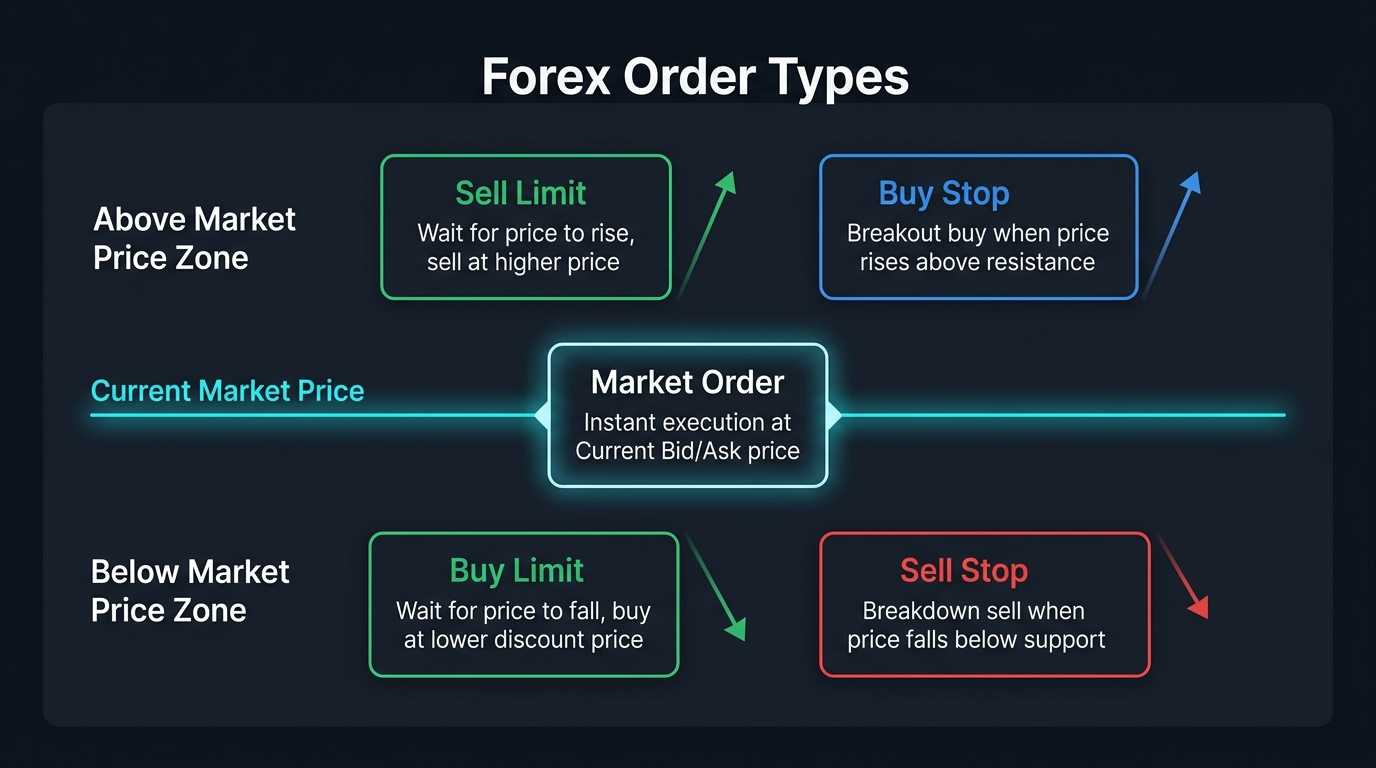
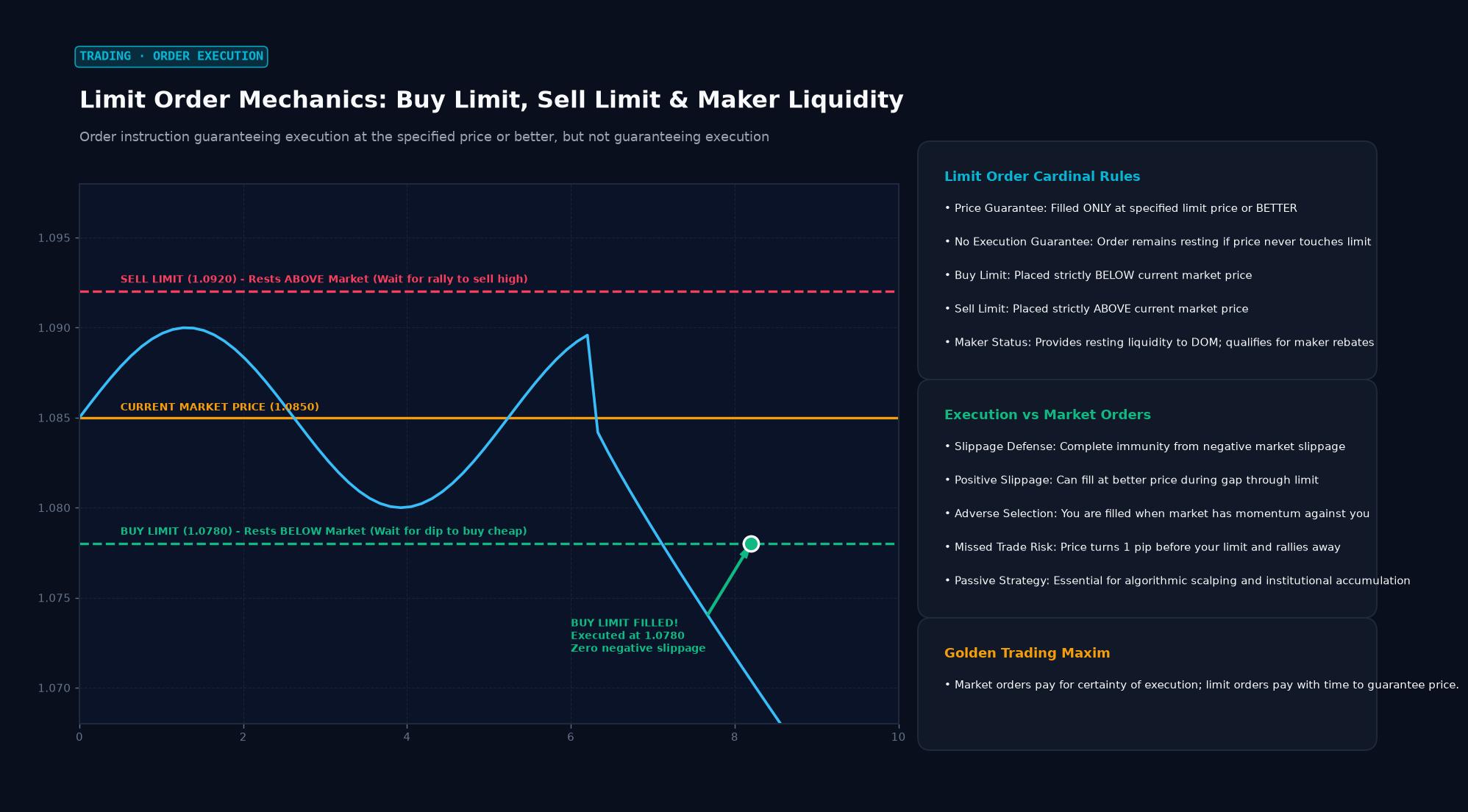 Figure: Order instruction guaranteeing execution at the specified price or better, but not guaranteeing execution
How Limit Orders Work
Buy limit order: Placed below the current market price. If EUR/USD is at 1.0870, a buy limit at 1.0830 sits 40 pips below current price and waits for a pullback. When price reaches 1.0830, the order fills at 1.0830 or better (sometimes with price improvement on ECN accounts).
Sell limit order: Placed above the current market price. If EUR/USD is at 1.0870, a sell limit at 1.0920 anticipates a rally to that resistance level before selling. The order waits for the market to come to you.
The “or better” clause matters: a buy limit at 1.0830 will fill at 1.0830 or lower if the market gaps down through that level. It will never fill at a worse price than 1.0830.
Limit Orders as Entry Strategy
The value of a limit entry versus a market entry is measurable in risk-reward terms. Compare two scenarios on the same GBP/USD trade:
Scenario A — Market entry at current price (1.2480):
- Entry: 1.2480
- Stop: 1.2430 (50-pip stop)
- Target: 1.2580 (100 pips)
- Risk-reward: 1:2
Scenario B — Limit entry at key support (1.2440):
- Entry: 1.2440
- Stop: 1.2415 (25-pip stop — same structural stop, closer to entry)
- Target: 1.2580 (140 pips)
- Risk-reward: 1:5.6
Same trade idea. Limit entry at support creates dramatically better risk-reward, tighter stop relative to structural level, and more room to breathe before the target is reached. The trade-off: the market might not pull back to 1.2440 and rally from 1.2480 instead, leaving you watching a winner without a position.
Time Conditions on Limit Orders
Good Till Cancelled (GTC): The order stays active until it fills or you cancel it. Standard for swing traders holding pending orders overnight or for several days.
Day Order: Automatically cancels at the end of the trading session if not filled. Useful if your analysis is session-specific.
Good Till Date (GTD): Active until a specific date and time. Available on some platforms.
Most retail traders use GTC by default for limit entries, which means the order persists through weekends and multiple sessions — important to remember, because a market gap at the Sunday open can fill a pending limit at a price set on Friday.
Limit Orders at Key Chart Levels
The most effective limit order placements stack the odds by positioning at levels where multiple factors align:
- Fibonacci retracement + horizontal support + 50 SMA: Three independent reasons price might hold at the same level
- The 61.8% retracement of a prior rally: The most reliable single Fibonacci level
- Prior resistance turned support: A level the market has already validated as significant
Placing limit orders where multiple signals converge — often called a “confluence zone” — produces higher fill-and-hold rates than placing them at arbitrary distances from current price.
The Risk of Limit Orders: Fills at the Wrong Time
The one genuine weakness of limit orders: they fill automatically when price reaches the level, regardless of what else is happening. A buy limit at support fills instantly — even if the market is gapping down on bad news, even if the fill happens in the middle of a flash crash, even if the candle that triggers it is an aggressive bearish move rather than a gentle test.
Mitigating this risk:
- Use reasonable position sizes so any single fill doesn’t create devastating exposure
- Check the economic calendar — avoid having open limit orders at key levels during high-impact news releases
- Review pending orders before weekend gaps
Key Takeaways
- Limit orders execute at a specific price or better — they guarantee price, not execution
- Buy limits go below current price; sell limits go above current price
- Limit entries typically produce better risk-reward ratios than market entries
- Use GTC to keep orders active across sessions; review before major news events
- Place limit orders at confluence zones (Fibonacci + support + MA) for highest reliability
FAQ
What happens if price gaps past my limit order? For buy limits, if price gaps below your level, you fill at your specified price (or potentially better). Unlike a stop-limit order, a buy limit doesn’t miss its fill due to a downward gap — it actually improves your entry price.
Can limit orders be used as take-profit levels? Yes. A sell limit above your long entry acts as a take-profit order. Most platforms allow you to place take-profit and stop-loss simultaneously with your entry order, creating a complete trade bracket.
Ready to trade forex?
Open a free demo account with a regulated broker. Practice with virtual funds before risking real money.