Realized Profit & Loss
Realized Profit & Loss (Realized P&L) is the definitive, settled cash gain or loss that is permanently locked into an investor's cash account balance upon executing a closing offsetting transaction, terminating all ongoing market exposure for that position.
What Is Realized Profit & Loss?
In financial trading, accounting, and tax compliance, Realized Profit & Loss (Realized P&L) is the actual, settled cash return generated from a trade once the position is closed.
While a trade remains open, its value fluctuates in real time as an unrealized (floating) gain or loss. Because market prices can reverse in seconds, floating profits are merely provisional “paper” numbers. Only when the market participant executes an offsetting transaction—selling an existing long or buying to cover an existing short—is the position terminated, the margin collateral unlocked, and the net cash difference officially booked as Realized P&L into the account’s permanent static balance.
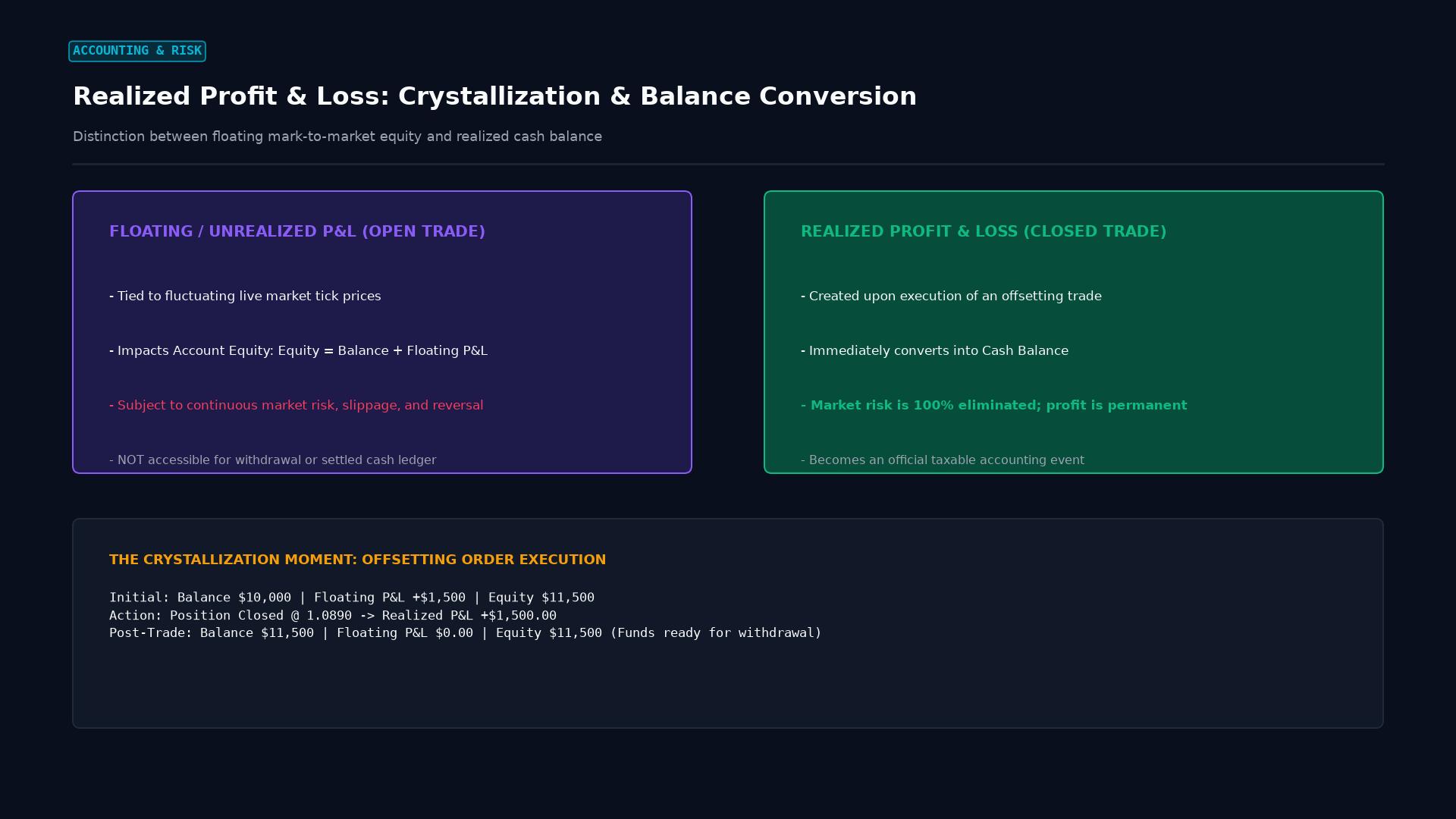 Figure: Accounting transition: floating mark-to-market unrealized P&L converting permanently into cash balance upon offsetting trade execution.
Mathematical Calculation of Realized P&L
The formula for calculating realized P&L depends on position direction and asset class:
1. For Long Positions (Bought First, Sold to Close)
$$\text{Realized P&L}_{\text{Long}} = (\text{Exit Price} - \text{Entry Price}) \times \text{Volume} - \text{Total Frictions}$$
2. For Short Positions (Sold First, Bought to Close)
$$\text{Realized P&L}_{\text{Short}} = (\text{Entry Price} - \text{Exit Price}) \times \text{Volume} - \text{Total Frictions}$$
Where $\text{Total Frictions} = \text{Broker Commissions} + \text{Cumulative Overnight Financing (Swaps)}$.
Real-World Forex Example
- Position: Short 3.0 standard lots ($300,000 notional) of USD/CAD.
- Entry Price: 1.3650
- Exit Price (Buy to Cover): 1.3520 (+130 pips gain)
- Overnight Swap Debits Accumulated: -$85.00 USD
- Broker Commission: -$21.00 USD ($7/lot round-turn)
- Calculation: $$\text{Gross P&L (CAD)} = (1.3650 - 1.3520) \times 300{,}000 = 0.0130 \times 300{,}000 = \mathbf{+3{,}900 \ \text{CAD}}$$ $$\text{Convert to USD at Exit Rate} = \frac{3{,}900 \ \text{CAD}}{1.3520} \approx \mathbf{+$2{,}884.62 \ \text{USD}}$$ $$\text{Net Realized P&L} = $2{,}884.62 - $85.00 - $21.00 = \mathbf{+$2{,}778.62 \ \text{USD}}$$
Realized P&L vs. Unrealized P&L: Structural Comparison
The operational and legal distinctions between realized and unrealized performance are stark:
| Operational Feature | Unrealized P&L (Floating) | Realized P&L (Closed) |
|---|---|---|
| Balance Sheet Location | Fluctuates inside Account Equity. | Credited/debited directly to Cash Balance. |
| Market Risk | Active; fully exposed to price, liquidity, and gap risk. | Zero: Position is closed; risk is completely neutralized. |
| Withdrawal Eligibility | Cannot be withdrawn as cash from the broker. | Fully withdrawable or deployable into new trades. |
| Financing Charges | Continues to accrue daily overnight swap fees. | Financing charges cease permanently. |
| Tax Status | Tax-deferred in most cash jurisdictions until realized. | Statutory Tax Event: Must be reported on annual tax filings. |
Tax Lot Accounting Methods: Realizing Capital Gains
When an investor accumulates multiple tranches of the same asset over time at different prices and then sells a portion of their holdings, the tax lot accounting method used determines the exact Realized P&L for tax purposes:
- FIFO (First-In, First-Out): The oldest open lot is closed first. (Mandatory for retail forex under US NFA Compliance Rule 2-43b).
- LIFO (Last-In, First-Out): The most recently acquired lot is closed first, widely used in corporate inventory accounting.
- Specific Identification (SpecID): The investor manually chooses the exact purchased lot to close, enabling strategic tax-loss harvesting.
- Average Cost Basis: Blends the total purchase prices into a single weighted average cost per unit, standard in mutual fund holdings.
The Behavioral Trap: The Disposition Effect
In behavioral finance, the boundary between realized and unrealized P&L is the source of the Disposition Effect—one of the most destructive psychological biases in retail trading:
$$\text{Disposition Effect} \implies \begin{cases} \text{Realizing winners too early} & \text{(To lock in emotional dopamine)} \ \text{Refusing to realize losers} & \text{(To avoid the emotional pain of being wrong)} \end{cases}$$
Retail traders frequently execute closing orders on winning trades after gaining only 10 or 15 pips to “bank the realized profit.” Conversely, when a trade goes underwater by 100 pips, they refuse to close it, rationalizing that “it’s only a paper loss until I realize it.” The position often deteriorates further, eventually triggering a catastrophic margin call stop-out that wipes out months of accumulated small realized gains.
                   THE DISPOSITION EFFECT SPIRAL

  Winning Trade (+20 pips) ---> Closes Immediately! ("Bank the Realized Gain!")
                                         vs.
  Losing Trade (-150 pips) ---> Refuses to Close! ("It's only paper loss, it will come back!")
                                         |
                                         v
                               Margin Call / Stop-Out
                               (Massive Realized Loss wipes out 10 small wins!)
Real-World Case Study: Tax-Loss Harvesting via Realized Losses
In December 2022, an equity and macro portfolio manager held a substantial realized capital gain of $250,000 USD from successful long-dollar currency trades and commodity futures. Under standard tax rules, this gain would be subject to a 20% federal capital gains tax ($50,000 tax liability).
- The Portfolio Situation: In the manager’s equity portfolio, a long position in a speculative technology stock purchased for $150,000 had collapsed to $50,000 (an unrealized floating loss of -$100,000).
- The Strategy (Tax-Loss Harvesting): Prior to the December 31 tax cutoff, the manager intentionally executed an offsetting sell order, liquidating the tech stock to convert the floating paper loss into a formal Realized Loss of -$100,000.
- The Tax Offset: $$\text{Net Taxable Capital Gains} = $250{,}000 \ \text{Realized Gain} - $100{,}000 \ \text{Realized Loss} = \mathbf{$150{,}000}$$ $$\text{New Tax Liability} = $150{,}000 \times 20% = \mathbf{$30{,}000}$$
- Result: Realizing the loss permanently reduced the fund’s tax bill by $20,000 USD, illustrating how institutional capital actively manages realized P&L for fiscal efficiency.
Frequently Asked Questions
Can a broker change a realized P&L after the trade is closed?
Under standard regulatory rules, a realized P&L is permanent and immutable. However, in extraordinary cases of technical server malfunction, verified “off-market” erroneous bad ticks, or regulatory trade cancellations, a broker’s compliance department may issue an official balance adjustment.
Does a realized profit immediately increase my margin for new trades?
Yes. The moment an offsetting order executes, the realized profit is credited to your cash balance and equity, and the margin previously locked by that trade is returned to your Free Margin, immediately expanding your available purchasing power for new positions.
What is the wash-sale rule and how does it affect realized losses?
In the United States (under IRS rules), the wash-sale rule dictates that if you sell a security at a realized loss and repurchase the same or a “substantially identical” security within 30 days before or after the sale, you cannot claim the realized loss for tax deductions. The loss is added to the cost basis of the newly purchased shares.
Ready to trade forex?
Open a free demo account with a regulated broker. Practice with virtual funds before risking real money.