Ticker
A standardized, unique alphanumeric code assigned to a financial asset for exchange identification and routing, or the continuous electronic data feed (ticker tape) broadcasting real-time trade prices, volume, and bid-ask quotations.
What Is a Ticker?
In financial market terminology, the word ticker encompasses two interconnected concepts:
- The Ticker Symbol: A unique, standardized alphanumeric identifier assigned to a specific publicly traded asset (e.g.,
AAPLfor Apple Inc.,EURUSDfor the Euro/US Dollar pair, orESfor E-mini S&P 500 futures) to facilitate accurate electronic order routing, quote dissemination, and clearinghouse settlement. - The Ticker Tape (Electronic Ticker Feed): The continuous, streaming digital display that broadcasts real-time execution prints—displaying the asset’s ticker symbol, the most recent cleared trade price, the net price change, and the volume of shares or contracts executed.
The terminology dates back to 1867, when Edward Calahan invented the mechanical stock ticker machine. Operating over telegraph lines, the machine utilized a vibrating print wheel that stamped price quotes onto continuous narrow ribbons of paper. The rapid mechanical hammering of the wheel against the paper generated a distinct, rhythmic “tick-tick-tick” sound, giving birth to the universal name “ticker.”
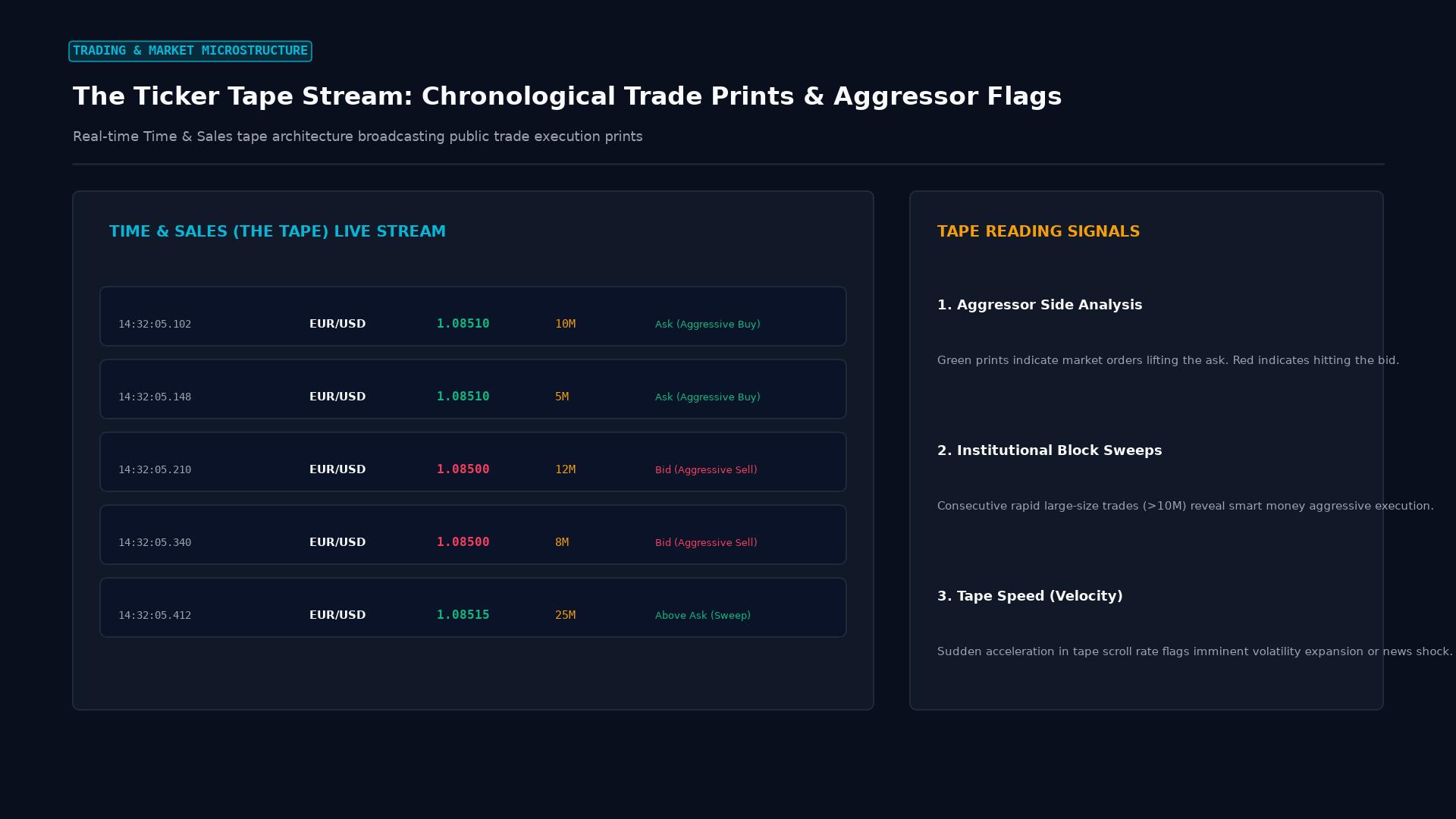 Figure: Time & sales feed architecture: real-time tick-by-tick transaction logs displaying timestamp, volume, executed price, and aggressive buy/sell side.
Ticker Symbology Across Global Asset Classes
To eliminate operational confusion in high-speed algorithmic matching engines, exchanges enforce strict symbology conventions across different asset classes:
1. Foreign Exchange (ISO 4217 Currency Standards)
Forex tickers are standardized under the International Organization for Standardization (ISO 4217). Every currency pair is constructed as a six-character string combining two three-letter country codes:
- First three characters: Base Currency (e.g.,
GBP= Great Britain Pound). - Last three characters: Quote Currency (e.g.,
USD= United States Dollar). - Common interbank formatting:
GBPUSD,EUR/USD, orUSD.JPY.
2. Equity Markets (Exchange Conventions)
- New York Stock Exchange (NYSE): Historically utilized 1 to 3 letters (e.g.,
Cfor Citigroup,Ffor Ford,JNJfor Johnson & Johnson). - Nasdaq Stock Market: Historically utilized 4 or 5 letters (e.g.,
MSFTfor Microsoft,AMZNfor Amazon). - Share Classes: Represented by suffixes or dots (e.g.,
BRK.AandBRK.Bfor Berkshire Hathaway Class A and B shares;GOOGLwith voting rights vs.GOOGwithout voting rights).
3. Futures and Commodity Markets
Futures tickers combine the underlying commodity root, an expiration month code, and the year:
$$\mathbf{C}\mathbf{L} ; \mathbf{Z} ; \mathbf{2}\mathbf{4}$$
    CL                 Z                  24
 ┌──────┐          ┌──────┐            ┌──────┐
 │ Root │          │ Month│            │ Year │
 └──────┘          └──────┘            └──────┘
 Crude Oil         December              2024
 (WTI Light Sweet) (Standard Month Code)
Standard Futures Month Codes:
F (Jan), G (Feb), H (Mar), J (Apr), K (May), M (Jun), N (Jul), Q (Aug), U (Sep), V (Oct), X (Nov), Z (Dec).
Market Data Tiers: How Ticker Data Is Broadcast
In modern electronic trading, ticker data is disseminated through centralized clearing utilities across three discrete data tiers:
| Market Data Tier | Information Broadcast | Latency / Frequency | Typical Users |
|---|---|---|---|
| Level 1 (Top of Book) | Best Bid, Best Offer (NBBO), Last Traded Price, Session High/Low | Millisecond streaming updates | Retail traders, web widgets, financial news channels |
| Level 2 (Market Depth) | Top 5 to 20 price tiers of resting limit bids and asks with exact order volumes | High-speed algorithmic push | Active day traders, proprietary scalpers, broker execution desks |
| Level 3 (Total View / Full Depth) | Complete order-by-order central limit book, including institutional hidden orders | Microsecond direct market data feed (via colocation cross-connects) | High-frequency trading (HFT) firms, market makers, quantitative hedge funds |
In the United States equity markets, Level 1 ticker data is consolidated into a single public feed known as the Securities Information Processor (SIP) by the Consolidated Tape Association.
Real-World Institutional Case Study: Ticker Confusion and Algorithmic Misallocations
In modern high-frequency trading, automated news-scraping algorithms execute trades within microseconds of a headline breaking. This hyper-speed environment has triggered notorious algorithmic errors driven by ticker symbol confusion:
       THE TWITTER VS. TWEETER TICKER FIASCO (OCTOBER 2013)

 The Event:
 - On October 3, 2013, social media giant Twitter filed its public S-1 registration
   statement to conduct an IPO, announcing it would trade under the ticker "TWTR".

 The Algorithmic Glitch:
 - Twitter was not yet publicly tradable on an exchange.
 - High-frequency sentiment algorithms detected breaking headlines containing
   "Twitter" and "IPO", immediately firing aggressive market buy orders for
   the closest existing symbol: "TWTRQ".

 The Tragicomic Reality:
 - "TWTRQ" was the ticker for Tweeter Home Entertainment Group—a bankrupt, defunct
   specialty consumer electronics retailer trading on the penny-stock pink sheets.
 - In under two hours, TWTRQ surged by an astronomical 1,500% (from $0.05 to $0.73)
   on over 14 million shares of volume before FINRA halted trading.
Similar algorithmic confusion occurred in March 2019 when video conferencing giant Zoom Video Communications (ZM) debuted, causing shares of completely unrelated penny stock Zoom Technologies (ZOOM) to surge 56,000%.
Frequently Asked Questions
What does a green or red print signify on a modern electronic ticker?
On a streaming ticker feed, colors convey directional momentum (the tick):
- Green (or Blue): Represents an uptick—the transaction cleared at a price higher than the immediately preceding trade, or printed at the current Ask price.
- Red: Represents a downtick—the transaction cleared at a price lower than the prior trade, or printed at the current Bid price.
What happens to a stock ticker if a company is acquired or goes bankrupt?
If a company is acquired or merged, its ticker symbol is officially delisted and retired by the exchange. If a company files for Chapter 11 bankruptcy, major exchanges (NYSE, Nasdaq) delist the stock. The shares typically migrate to the Over-The-Counter (OTC) Pink Open Market, where a fifth letter (traditionally “Q”) is appended to the ticker to warn investors of active bankruptcy proceedings.
Can two different companies share the exact same ticker symbol?
On the same financial exchange, no; ticker symbols must be completely unique to ensure unambiguous clearing. However, two companies can share an identical ticker if they trade on completely different international exchanges in separate sovereign jurisdictions (e.g., a stock trading as ABC on the Toronto Stock Exchange and an unrelated company trading as ABC on the Australian Securities Exchange).
Ready to trade forex?
Open a free demo account with a regulated broker. Practice with virtual funds before risking real money.