Depth of Market
Depth of Market (DOM), also known as Level 2 market data or the order book ladder, is a real-time display showing the volume of resting limit buy (bid) and limit sell (ask) orders queued at varying price levels for a financial instrument, revealing market liquidity and supply-demand imbalances.
What Is Depth of Market (DOM)?
In electronic financial trading, the Depth of Market (DOM)—frequently referred to as Level 2 data, the order book, or the price ladder—is a real-time visual measurement of the resting liquidity available in a financial market.
While a standard candlestick chart or basic quote feed (known as Level 1 data) displays only the single highest price a buyer is currently willing to pay (the Best Bid) and the single lowest price a seller is willing to accept (the Best Ask), the Depth of Market reveals the entire visible queue of pending limit orders stacked above and below current market prices.
By examining the DOM, traders can see not only where the price is trading right now, but also how many contracts, shares, or lots are waiting to be transacted at subsequent price increments. It acts as an open x-ray of real-time supply and demand, providing short-term scalpers, day traders, and institutional algorithmic systems with critical insight into market liquidity, absorption, and potential price resistance.
How the DOM Ladder Is Structured
On modern trading platforms (such as cTrader, NinjaTrader, or MetaTrader 5), the DOM is typically presented as a vertical price ladder:
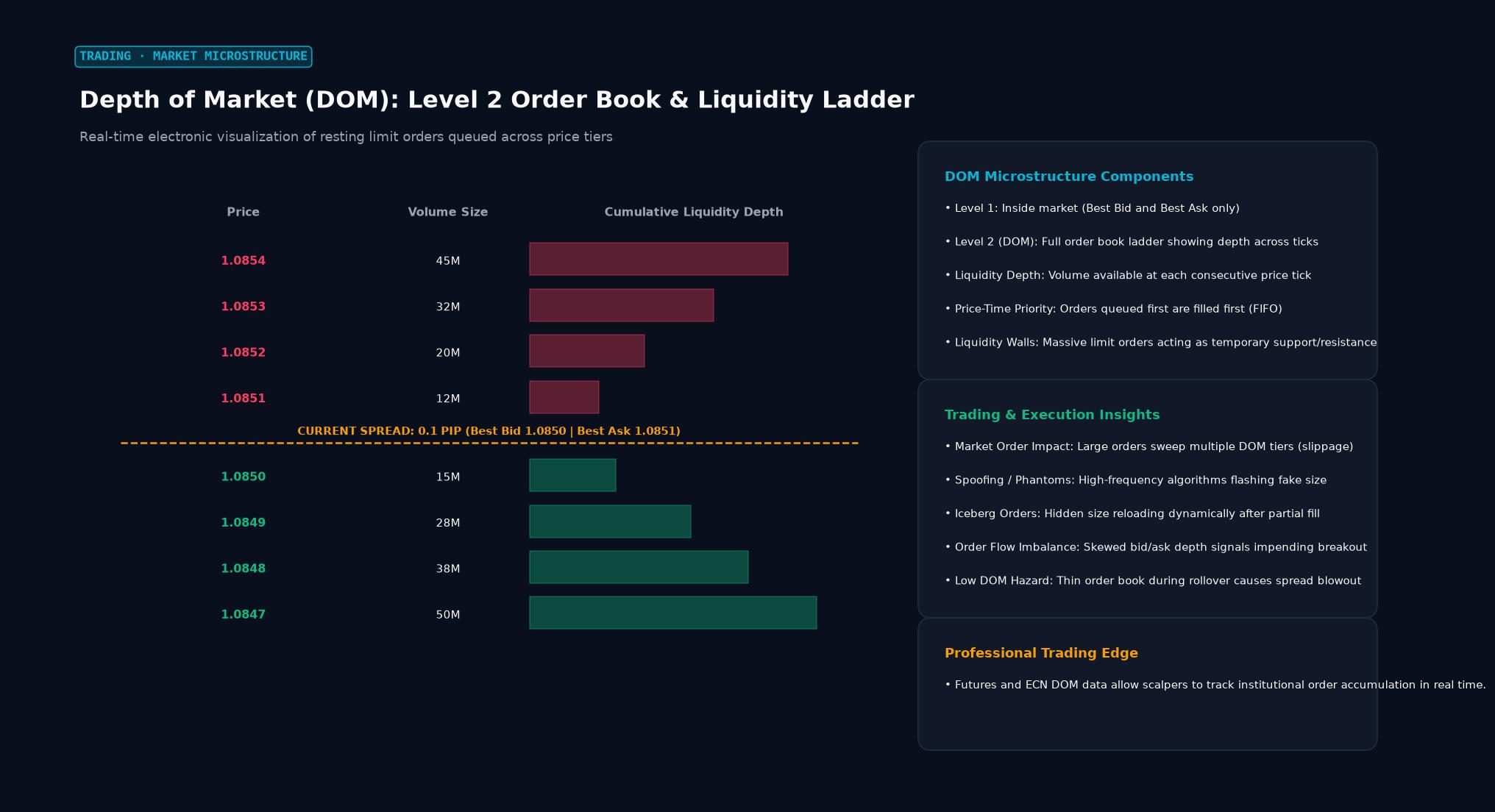 Figure: Real-time electronic visualization of resting limit orders queued across price tiers
In this vertical structure:
- Price Column (Center): Displays consecutive tick price levels in descending order.
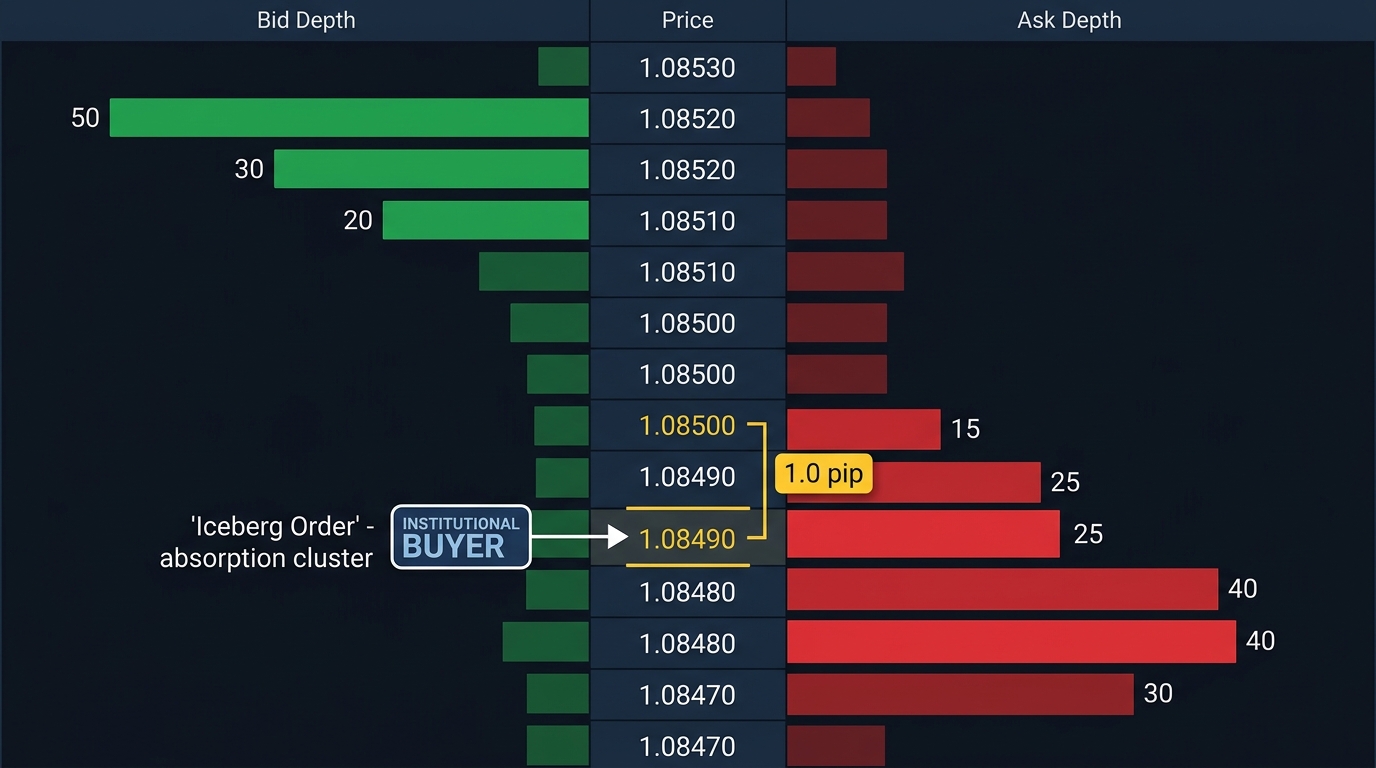
- Bid Column (Left): Displays the cumulative volume of Buy Limit orders waiting to be filled at prices below the current market. These buyers provide downside market support.
- Ask Column (Right): Displays the cumulative volume of Sell Limit orders waiting to be filled at prices above the current market. These sellers provide upside market resistance.
- The Spread: The price gap between the top bid (1.08490) and the top ask (1.08500) represents the current bid-ask spread (1.0 pip).
Market Orders vs. Limit Orders in the DOM
To interpret the DOM accurately, a trader must understand the fundamental interaction between order types:
- Limit Orders Create the DOM (Liquidity Providers): When a trader submits a buy limit or sell limit order, their order enters the queue on the DOM ladder. These orders do not move the market; they sit passively as available liquidity, waiting for someone else to trade with them.
- Market Orders Consume the DOM (Liquidity Takers): When a trader submits an immediate market buy order, the order sweeps into the DOM and matches against the available volume resting at the best ask price. If an aggressive market order is larger than the available volume at the top of the book, it consumes all available lots at that price and sweeps higher into the ladder, filling remaining units at worse prices—a phenomenon known as slippage.
DOM in Centralized Exchanges vs. Decentralized Spot Forex
A vital structural distinction exists in how Depth of Market functions across different asset classes:
Centralized Exchanges (Futures and Equities)
On regulated, centralized exchanges like the Chicago Mercantile Exchange (CME) or the New York Stock Exchange (NYSE), 100% of global transactions and resting orders flow through a single, central electronic matching engine. The DOM displayed on CME Euro FX futures is complete, absolute, and authoritative—it represents the entire global order book for that instrument.
Decentralized Spot Foreign Exchange (OTC)
The spot forex market has no central clearinghouse or single consolidated order book. Global interbank trading is fragmented across dozens of primary institutional matching networks (such as EBS Market, Refinitiv Matching, Currenex, and FastMatch) and individual tier-1 investment bank dealing desks.
Consequently, the DOM displayed inside a retail forex terminal (such as cTrader or MT5) is localized: it reflects only the liquidity aggregated by that specific broker from its own connected liquidity providers and retail clients. While it offers valuable insight into immediate broker liquidity depth, it does not represent the entire multi-trillion-dollar global forex universe.
Reading Order Flow: Key DOM Dynamics
Professional order flow traders analyze the DOM ladder for specific microstructure patterns:
1. Order Book Imbalance
When the volume of resting limit bids significantly exceeds resting limit asks (e.g., 200 lots of bids vs. 30 lots of asks), strong institutional buying support is present. The market will struggle to drop because aggressive sellers must consume 200 lots of liquidity to push price down a single tick.
2. Absorption
Absorption occurs when a high volume of aggressive market orders hits a specific price level on the DOM, but the price refuses to move because a large passive institutional participant continuously refills their resting limit orders at that exact price. When the aggressive selling exhausts itself against the wall of passive buying, price reverses sharply upward.
3. Iceberg Orders
Institutional participants rarely place massive 500-lot orders visibly on the DOM because other participants would front-run the level. Instead, institutional algorithms deploy iceberg orders—special order types that display only a tiny fraction (e.g., 5 lots) on the public DOM ladder while hiding the remaining 495 lots in reserve. As each 5-lot slice is filled, the algorithm instantly replenishes it until the full order is completed.
4. Spoofing and “Phantom Liquidity”
Traders must be cautious of deceptive order placement. Unscrupulous algorithmic actors occasionally place massive limit orders on the DOM to create a false impression of heavy support or resistance, only to cancel them milliseconds before the price reaches the level. Regulated exchanges strictly penalize spoofing as illegal market manipulation.
Practical Scalping Example Using the DOM
Consider an intraday scalper trading CME Euro FX currency futures during the active New York session:
- Identifying Support: The scalper notices a persistent cluster of 180 contracts resting at the bid price of 1.0840, compared to typical thin depth of only 15 to 25 contracts at adjacent price levels.
- Monitoring Absorption: Price declines toward 1.0840. The time-and-sales tape shows rapid red prints as 120 aggressive market sell contracts hit 1.0840, but the bid price refuses to drop—an institutional buyer is absorbing all incoming market orders.
- Execution: Recognizing strong institutional absorption, the scalper immediately places a buy limit order at 1.0841, just one tick above the large bid wall.
- Risk Management: The stop-loss is placed at 1.0838 (3 ticks below the institutional wall).
- The Reaction: The remaining market sellers give up, and aggressive buyers step in. As buying momentum sweeps through the thin ask orders above, price surges 12 ticks to 1.0853. The scalper exits on the DOM for a +12 tick profit, risking only 3 ticks.
Key Takeaways
- Depth of Market (DOM), or Level 2 data, displays the queue of pending limit buy and sell orders across multiple price levels.
- Limit orders provide passive liquidity on the DOM; market orders consume resting DOM liquidity.
- In centralized futures markets, the DOM is 100% comprehensive, whereas in OTC spot forex, the DOM reflects localized broker liquidity pools.
- Order flow traders utilize the DOM to identify order book imbalances, institutional absorption, and iceberg orders.
- Large orders on the DOM can be illusory due to algorithmic spoofing and rapid order cancellations.
FAQ
Can I see the Depth of Market on MetaTrader 4? No. MetaTrader 4 was designed exclusively for Level 1 pricing and does not natively support Depth of Market ladders. However, its successor, MetaTrader 5 (MT5), and platforms like cTrader feature full DOM ladders if supported by your broker’s liquidity feed.
What is the difference between Level 1, Level 2, and Level 3 data? Level 1 data displays only the current best bid and ask prices. Level 2 data (DOM) displays queued limit order volumes across multiple price tiers above and below the market. Level 3 data is reserved for registered market makers, allowing them to enter, modify, and manage quotes directly inside the exchange matching engine.
Does Depth of Market guarantee that my order will fill? Not necessarily. In fast-moving markets, other market orders may consume resting liquidity before your order arrives, or the participant offering the limit order may cancel it milliseconds before execution.
Ready to trade forex?
Open a free demo account with a regulated broker. Practice with virtual funds before risking real money.