Quote
A quote (or two-way price quotation) is an active, real-time price indication provided by a market maker, broker, or electronic exchange specifying the highest price at which they are willing to buy (Bid) and the lowest price at which they are willing to sell (Offer/Ask) a financial instrument.
What Is a Quote?
In financial market microstructure, a quote (short for quotation) is the fundamental price message transmitted across electronic communications networks (ECNs), interbank dealing platforms, and broker terminals. It informs market participants of the immediate terms under which transactions can take place.
In modern continuous electronic markets, a quote is universally presented as a two-way price quotation:
$$\text{Two-Way Quote} = \text{Bid Price} \ / \ \text{Ask (Offer) Price}$$
- The Bid Price: The highest price that an institutional dealer, liquidity provider, or resting buyer is willing to pay to purchase the asset from you. (The price you receive when you click “Sell”).
- The Ask / Offer Price: The lowest price that a dealer or resting seller is willing to accept to sell the asset to you. (The price you pay when you click “Buy”).
- The Spread: The difference between the Ask and Bid ($\text{Spread} = \text{Ask} - \text{Bid}$), representing the dealer’s compensation and the trader’s immediate execution cost.
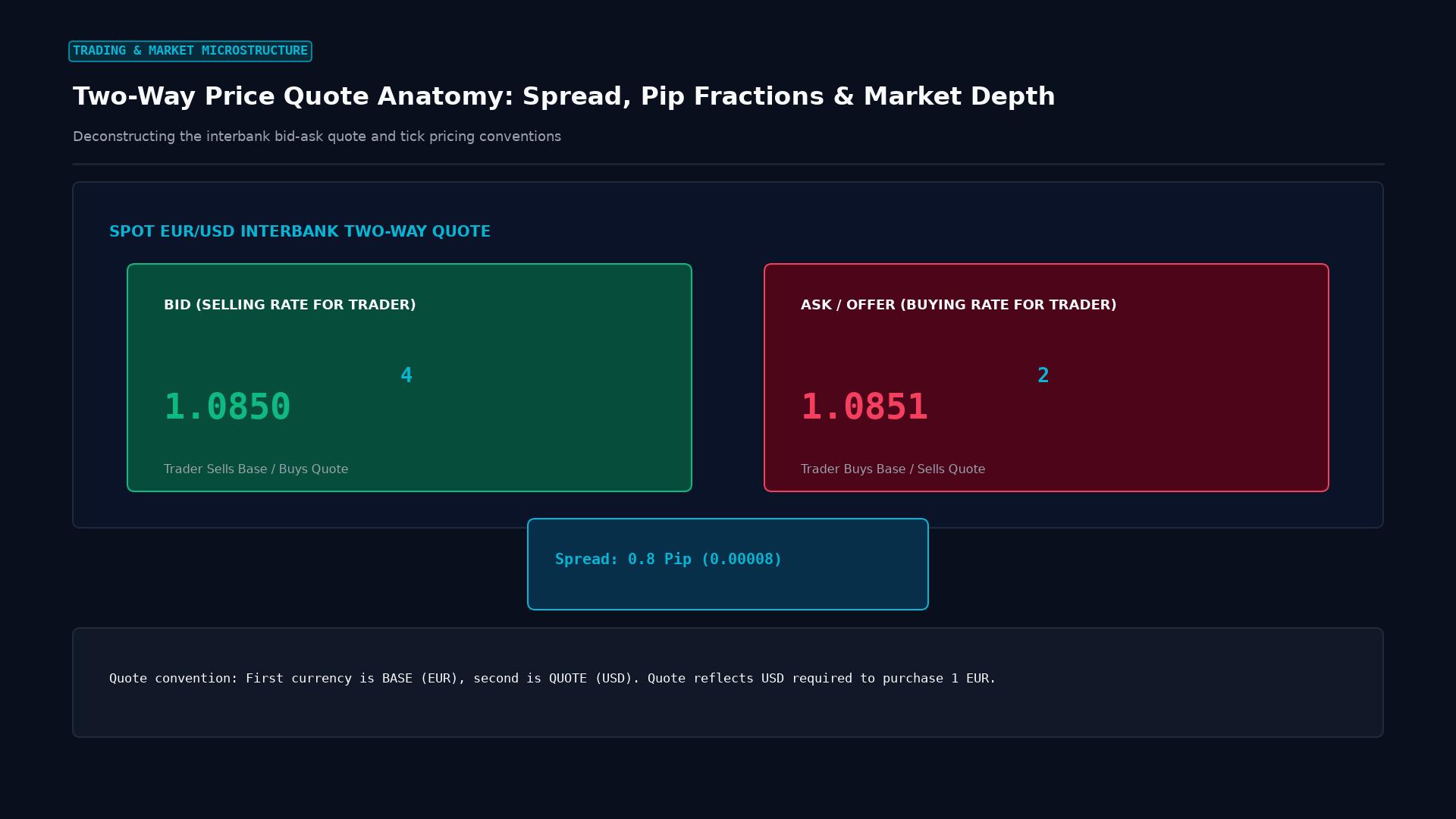 Figure: Deconstructed interbank quote: base vs quote currency, two-way bid and ask pricing, fractional pipettes, and spread capture.
Direct vs. Indirect Quotations
In international foreign exchange, quotes follow standardized market conventions established by the International Organization for Standardization (ISO 4217):
1. Direct Quotation
A direct quote expresses the price of one unit of a foreign currency in terms of variable units of domestic currency.
- For a US resident: EUR/USD = 1.0850 is a direct quote (1 Euro costs $1.0850 US Dollars).
2. Indirect Quotation
An indirect quote expresses the price of one unit of the domestic currency in terms of variable units of foreign currency.
- For a US resident: USD/JPY = 150.25 is an indirect quote ($1.00 US Dollar purchases 150.25 Japanese Yen).
Firm Quotes vs. Indicative Quotes
Not all quotes appearing on financial screens carry the same legal and transactional validity:
| Quotation Type | Legal Commitment | Execution Reliability | Typical Market Environment |
|---|---|---|---|
| Firm (Executable) Quote | Legally binding: The market maker is contractually obligated to fill incoming orders up to the quoted volume. | Immediate sub-second execution without requotes. | Central Limit Order Books (CLOBs), ECNs (EBS, Currenex), modern STP/ECN retail brokers. |
| Indicative Quote | Non-binding: Merely an informational price estimate; no obligation to transact. | High likelihood of requotes, dealer rejections, or “Last Look” slippage. | Financial news terminals (Bloomberg/Reuters ticker widgets), weekend screens, exotic OTC markets. |
| Request for Quote (RFQ) | Bilateral customized price generated upon specific institutional client request. | Firm for a designated time window (e.g., 5 to 10 seconds). | Large block institutional trades, corporate FX forwards, illiquid municipal bonds. |
Microstructure: Pips, Pipettes, and 5-Digit Quoting
Historically, major spot currency pairs were quoted to 4 decimal places (e.g., EUR/USD 1.2540), where the fourth decimal place represented a pip (percentage in point): $$\text{1 Pip} = 0.0001$$
With the advent of electronic aggregation and algorithmic market making in the mid-2000s, brokers introduced fractional pip pricing (5-digit quoting): $$\text{1 Pipette (Fractional Pip)} = 0.00001 \ (0.1 \ \text{Pip})$$
                   MODERN 5-DIGIT QUOTATION READING

                       1 . 0 8 5 0 2
                       | | | | | |
                       | | | | | +----> 2 Fractional Pipettes (0.2 pip)
                       | | | | +------> 0 Single Pip
                       | | | +--------> 5 Ten Pips (The "Big Figure")
                       | | +----------> 8 Hundreds
The introduction of fractional pip quotes allowed institutional market makers to compete aggressively on price, narrowing retail EUR/USD spreads from 2–3 pips down to fractional spreads as tight as 0.1 to 0.4 pips.
Quote Latency and “Last Look” Practices
In high-frequency electronic foreign exchange, the time delay between when an institutional dealer generates a quote and when a client order reaches the dealer’s matching engine is known as quote latency.
Because latency exposes market makers to latency arbitrage (predatory algorithms picking off stale quotes after news breaks), many institutional liquidity providers enforce a controversial practice called “Last Look”:
- When a client clicks an executable quote, the dealer holds the order in a buffer for 10 to 100 milliseconds.
- If the broader interbank market has moved against the dealer during that brief window, the dealer exercises “Last Look” to reject the trade or requote at a worse price.
- Under the modern FX Global Code, regulators have restricted Last Look abuses, requiring transparency and pre-hedging disclosures.
Real-World Case Study: The 2010 “Stale Quote” Latency Arbitrage
In 2010, quantitative high-frequency trading firms discovered that certain retail and regional bank platforms were slow to update their EUR/USD and GBP/USD price quotes compared to the primary EBS interbank matching engine in New York and London:
- The Mechanism: An HFT algorithm colocated near the EBS matching engine detected an instantaneous 5-pip price jump in EUR/USD following an unexpected Federal Reserve announcement.
- The Exploitation: The algorithm instantly fired buy orders into secondary regional brokers whose quote engines were lagging behind EBS by 150 milliseconds.
- The Execution: The algorithm purchased EUR/USD at the stale quote of 1.3410 and simultaneously sold on EBS at the live quote of 1.3416, capturing a riskless 0.6-pip ($60 per lot) profit within milliseconds.
- The Industry Response: The multi-million-dollar losses suffered by lagging brokers forced the entire global forex industry to invest hundreds of millions in microwave transmission networks, fiber-optic cross-connects, and automated quote-cancellation algorithms.
Frequently Asked Questions
What does the “Big Figure” mean in forex quoting?
In dealing room jargon, the “Big Figure” refers to the whole integer and first two decimal places of a quote (e.g., the “1.08” in 1.0850). In fast-paced interbank phone trading, dealers frequently omit the big figure to save time, quoting only the last two pips (e.g., shouting “50-52” instead of “1.0850 / 1.0852”).
Why do quotes differ slightly between different brokers?
Because spot forex is a decentralized over-the-counter (OTC) market, there is no single centralized exchange setting a universal price. Each broker aggregates liquidity from its own unique consortium of prime brokers, hedge funds, and Tier-1 commercial banks, resulting in minor differences of a fraction of a pip between platform feeds.
What is a “requote”?
A requote occurs in dealing-desk (instant execution) brokerages when you attempt to execute a trade at a specific quoted price, but the market moves before the broker fills the order. The broker rejects your original transaction and presents a new quote reflecting the current, typically less favorable, market price.
Ready to trade forex?
Open a free demo account with a regulated broker. Practice with virtual funds before risking real money.