TWD
The ISO 4217 currency code for the New Taiwan Dollar, the official legal tender of Taiwan (Republic of China), issued and managed by the Central Bank of the Republic of China (Taiwan).
TWD (New Taiwan Dollar)
The New Taiwan Dollar (ISO code: TWD, symbol: NT$) is the official currency of Taiwan (Republic of China). Subdivided into 100 cents, the currency is issued, supervised, and defended by the Central Bank of the Republic of China (Taiwan), commonly known as the Central Bank of China (CBC).
In international macroeconomics, technology supply chain economics, and global foreign exchange trading, the New Taiwan Dollar occupies an indispensable role. Taiwan is the indisputable epicenter of the global advanced semiconductor foundry industry, anchored by giants such as Taiwan Semiconductor Manufacturing Company (TSMC), MediaTek, and ASE Technology. Consequently, the TWD is backed by one of the largest structural current account surpluses on Earth, immense sovereign foreign exchange reserves, and a domestic institutional life insurance industry that manages vast overseas foreign currency investment portfolios.
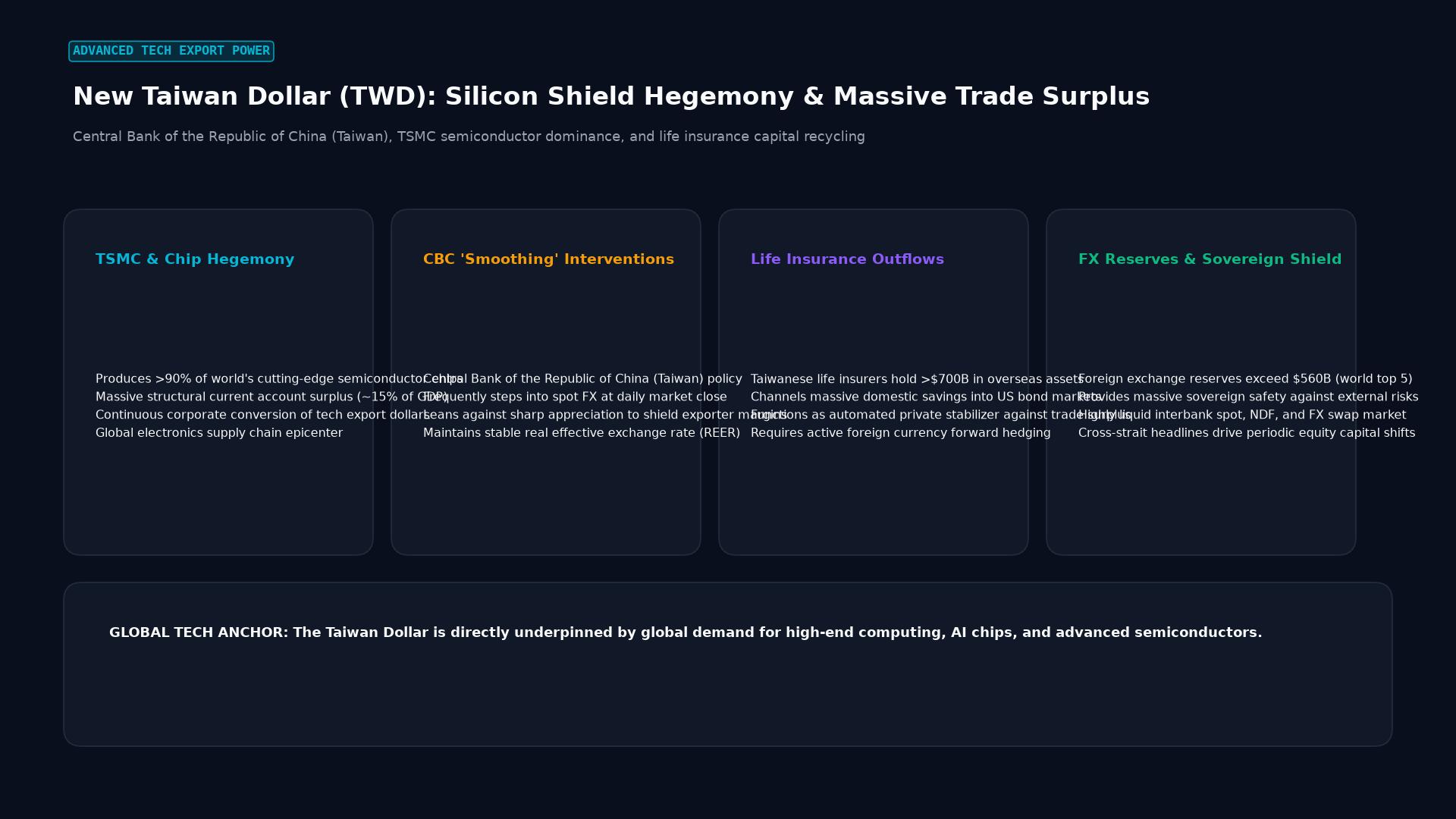 Figure: Central Bank of the Republic of China (Taiwan), TSMC semiconductor dominance, and life insurance capital recycling
Historical Genesis: From Hyperinflation to the “New” Dollar
The modern monetary framework of Taiwan was forged in the crucible of post-World War II hyperinflation:
- The Old Taiwan Dollar (1946–1949): Following the end of the Japanese colonial era in 1945, the Bank of Taiwan issued the Old Taiwan Dollar to replace the Japanese yen. However, the Chinese Civil War on the mainland resulted in economic collapse, supply bottlenecks, and aggressive monetary printing. Inflation surged to astronomical levels; by early 1949, prices doubled multiple times per month.
- Monetary Reform of June 15, 1949: The government enacted historic monetary reform, introducing the New Taiwan Dollar (NT$) at a redenomination ratio of: $$1 \text{ New Taiwan Dollar (TWD)} = 40,000 \text{ Old Taiwan Dollars}$$ The reform was anchored by strict statutory gold backing, the establishment of independent credit controls, and fiscal stabilization programs supported by US economic assistance during the early Cold War era.
- The Taiwanese Economic Miracle: Over subsequent decades, Taiwan transitioned from an agrarian economy into an export manufacturing titan. The CBC maintained an administrative peg against the US dollar (historically around NT$ 40 per USD in the 1950s–1970s), gradually moving toward managed flexibility in the late 1980s as trade surpluses expanded.
Monetary Policy Framework of the CBC
The Central Bank of China (Taiwan) operates under a statutory mandate to promote financial stability, guide sound banking operations, maintain domestic price stability, and foster economic growth within the scope of price and financial stability.
The FX Policy Regime: Managed Float with “Dynamic Smoothing”
The CBC officially characterizes the TWD exchange rate as market-determined. However, because Taiwan is a small, highly open economy heavily reliant on external trade, the CBC practices active dynamic smoothing:
- Limiting Excess Volatility: The CBC frequently steps into the interbank foreign exchange market toward the market close to smooth out sharp intraday fluctuations that could disadvantage domestic exporters.
- Export Competitiveness: Because Taiwan competes directly with South Korea (KRW) and Japan (JPY) in high-technology exports, the CBC monitors the Real Effective Exchange Rate (REER) closely, working to ensure the TWD does not appreciate disproportionately against competitor currencies.
- Enormous Reserve Accumulation: As a consequence of decades of persistent export surpluses and central bank interventions, Taiwan holds over $560 billion in foreign exchange reserves, ranking consistently among the top five largest sovereign reserve holders globally alongside China, Japan, Switzerland, and India.
       Taiwan Foreign Reserve Mechanics:

       Delta FX_Reserves = (Exports_Tech - Imports_Energy) + Net_FDI - Domestic_Capital_Outflows + CBC_Intervention

       With Tech Surpluses consistently outpacing Energy Imports:
       Underlying Upward Pressure on TWD -> Offset by Life Insurer Overseas Investments + CBC Reserves
Macroeconomic Pillars and Market Dynamics
1. The Semiconductor and Silicon Shield
Taiwan’s economic prosperity is inextricably linked to advanced technology hardware:
- Foundry fabrication of microchips (especially 3nm, 5nm, and 7nm chips used in high-performance computing, artificial intelligence, and mobile devices) represents a dominant share of total exports.
- Global demand surges for AI infrastructure (such as graphics processing units, AI server motherboards, and advanced packaging) translate into immediate commercial demand for TWD to fund domestic capital expenditures, fab construction, and engineer salaries.
2. The Life Insurance Hedging Channel
One of the most unique institutional features of the Taiwanese financial market is the massive domestic life insurance industry (including giants like Cathay Life, Fubon Life, and Nan Shan Life):
- Domestic savings rates in Taiwan are exceptionally high, but domestic bond yields are relatively low.
- To achieve sufficient investment returns to meet guaranteed policyholder obligations, Taiwanese life insurers have deployed hundreds of billions of dollars into higher-yielding foreign assets, particularly US investment-grade corporate bonds.
- The FX Hedging Challenge: To protect these massive USD assets against TWD appreciation, insurers utilize cross-currency swaps, foreign exchange swaps, and offshore Non-Deliverable Forwards (NDFs). The ebb and flow of insurance hedging demand can drive swings in swap spreads and cross-currency basis markets.
+------------------------------------------------------------------------+
|           Comparison of Major Asian Export-Driven Currencies           |
+------------------------------------------------------------------------+
| Currency | Country | Core Export Driver         | Primary Hedging Tool |
| TWD      | Taiwan  | Semiconductors & AI Servers| Offshore NDF / CSWAP |
| KRW      | S. Korea| Memory Chips, Autos, Ships | Offshore NDF / Onshore|
| SGD      | Singapore| Financial, Biotech, Refined| MAS NEER Policy Band|
| JPY      | Japan   | Autos, Precision Machinery | Global Liquid OTC/CME|
+------------------------------------------------------------------------+
Trading Mechanics: Onshore Market vs. Offshore NDF Market
Due to regulatory measures designed to prevent speculative capital from destabilizing the domestic economy, the foreign exchange market for the New Taiwan Dollar is structurally split:
1. Onshore Market (Taipei Forex Inc. / Cosmos)
- Participant Access: Restricted primarily to domestic institutions, multinational corporations with physical operations in Taiwan, and registered Qualified Foreign Institutional Investors (QFII).
- Physical Delivery: Trades are physically delivered through local commercial banks, requiring underlying trade documentation, equity custody proof, or verified commercial invoices.
- Reporting Requirements: Large transactions must be reported to the CBC foreign exchange department.
2. Offshore Non-Deliverable Forward (NDF) Market
- Hub Locations: Traded actively in Singapore, Hong Kong, London, and New York.
- Cash Settlement in USD: Because non-resident speculators cannot freely access domestic TWD clearing lines, NDF contracts settle net cash differences strictly in US dollars based on the fixing rate published by the Taipei Forex market.
- NDF Pricing Formula: $$\text{Net Settlement Amount} = \text{Notional USD} \times \left(\frac{F_{\text{contract}} - S_{\text{fixing}}}{S_{\text{fixing}}}\right)$$ Where $F_{\text{contract}}$ is the agreed NDF forward rate and $S_{\text{fixing}}$ is the official Taipei spot fixing rate on the maturity determination date.
Applied Hedging Case Study: Semiconductor Assembly Facility
Consider Pacific Micro Devices (PMD), a fabless semiconductor design firm based in California that contracts chip fabrication to TSMC in Hsinchu Science Park.
Commercial Exposure
- Contract Obligation: PMD must pay TSMC TWD 600,000,000 in 180 days for a finished wafer production run.
- Current Spot Rate: USD/TWD = 30.00 $$\text{Base Cost in USD} = \frac{\text{TWD } 600,000,000}{30.00} = $20,000,000$$
Market Expectations
Market forecasts indicate rising global AI hardware demand will accelerate Taiwan’s trade surplus, causing the New Taiwan Dollar to appreciate significantly over the next six months. PMD risks paying substantially more in USD if the TWD strengthens.
NDF Hedging Strategy
To eliminate currency volatility, PMD executes a 6-month USD/TWD Non-Deliverable Forward with its investment bank:
- Contract Terms:
- Notional: $20,000,000 equivalent.
- Agreed NDF Forward Rate: 29.70 USD/TWD.
Scenario Analysis at Maturity
Six months later, heavy export revenues and institutional inflows push the spot fixing rate to 28.50 USD/TWD (strong appreciation of the TWD):
- Spot Purchase Cost: $$\text{Actual Spot Cost} = \frac{\text{TWD } 600,000,000}{28.50} = $21,052,632$$ Unhedged cost increase = +$1,052,632.
- NDF Settlement Gain Paid to PMD: $$\text{Gain} = $20,000,000 \times \left(\frac{29.70 - 28.50}{28.50}\right) = $20,000,000 \times 0.042105 = $842,105$$
- Effective Net Hedged Cost: $$$21,052,632 - $842,105 = $20,210,527$$ PMD successfully neutralized the vast majority of the adverse foreign exchange shock, preserving the operating margin of its semiconductor product launch.
Frequently Asked Questions
Why is the currency called the “New” Taiwan Dollar?
The currency is called the “New” Taiwan Dollar because it was introduced in June 1949 to replace the hyperinflated “Old” Taiwan Dollar at a redenomination ratio of 40,000 to 1. The prefix “New” (Xin Tai Bi) remains its formal legal name to distinguish it from the pre-1949 currency.
How does the Central Bank of China (Taiwan) manage TWD volatility?
The CBC utilizes dynamic smoothing interventions, particularly during the late-afternoon interbank trading window. It absorbs excess US dollar inflows during periods of aggressive trade surpluses and provides foreign currency liquidity during global market sell-offs, keeping the real effective exchange rate aligned with Taiwan’s key export rivals.
Can international retail traders trade TWD directly?
International retail traders rarely have direct access to onshore deliverable TWD accounts. Instead, retail forex platforms and institutional investment managers access exposure to the New Taiwan Dollar through offshore Non-Deliverable Forwards (NDFs) or exchange-traded funds (ETFs) and equities listed on global exchanges that mirror the Taiwanese technology sector.
Ready to trade forex?
Open a free demo account with a regulated broker. Practice with virtual funds before risking real money.