Whipsaw
A whipsaw is an aggressive market pattern in which a price makes a sudden, misleading move in one direction—often triggering breakout entries—followed immediately by a violent reversal in the opposite direction that traps traders and sweeps stop-loss orders.
In financial market terminology, a whipsaw—derived from the push-and-pull motion of a lumberjack’s two-man saw—describes a treacherous price action pattern characterized by rapid, erratic changes in direction. A whipsaw typically begins when an exchange rate generates a strong directional surge or apparent breakout from a consolidation zone, enticing traders to enter in that direction, only to immediately reverse course with severe velocity.
Whipsaws are among the most emotionally and financially damaging events for retail currency traders. They frequently trigger severe slippage, double stop-outs (getting stopped out on both a long and a subsequent short), and account blowouts during volatile market regimes.
Anatomy of a Classic Whipsaw
A standard whipsaw unfolds in three distinct behavioral phases:
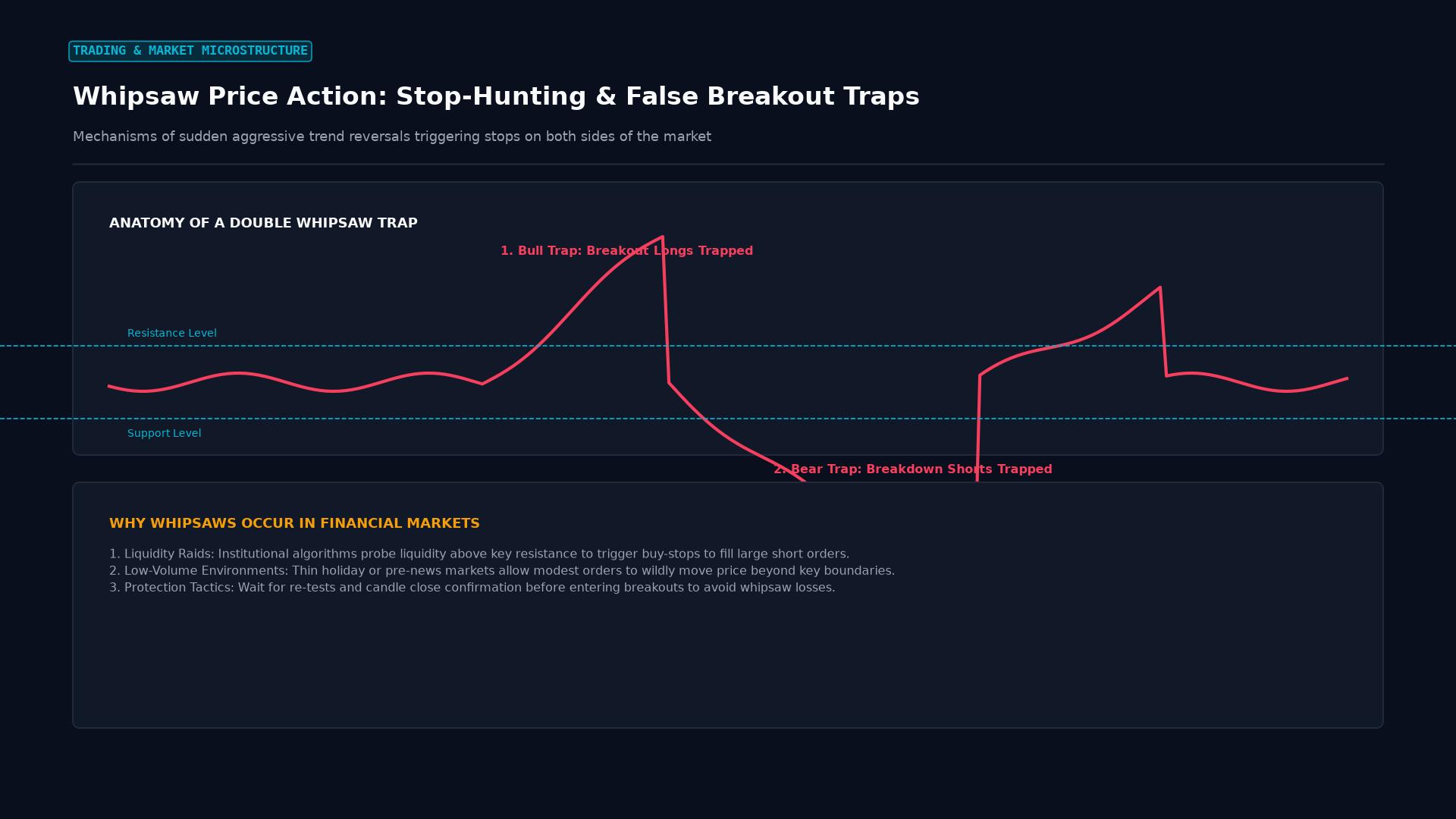 Figure: Microstructure traps: false breakout bull traps above resistance followed by sudden breakdown bear traps below support, sweeping retail stops.
- The Setup (Phase 1): A currency pair consolidates tightly beneath a well-defined resistance ceiling or above a major support floor. Retail traders place pending breakout buy orders just above the level.
- The Bait / False Breakout (Phase 2): Price spikes sharply beyond the barrier. Trend-following algorithms and retail breakout traders jump into long positions, convinced an explosive new trend has begun.
- The Trap & Liquidation (Phase 3): Institutional selling overwhelms the breakout. As smart money uses the surge of buy liquidity to execute massive short orders, the price reverses violently. Trapped buyers are forced to liquidate, and their cascading stop-loss orders accelerate the downward plunge, driving price well below the initial consolidation floor.
Primary Catalysts Behind Forex Whipsaws
Whipsaws do not occur randomly; they are concentrated around specific market microstructure conditions:
| Market Condition | Whipsaw Mechanism | Typical Scenario |
|---|---|---|
| Tier-1 Economic Releases (NFP, CPI, Central Bank Decisions) | Knee-jerk reaction based on headline number, followed by rapid reversal once full data or press conference details are digested. | A 30-pip spike upward in the first 15 seconds, followed by a 120-pip collapse two minutes later. |
| Institutional Liquidity Sweeps (“Stop Hunts”) | Large market participants intentionally push prices just beyond obvious swing highs or swing lows to absorb resting liquidity before reversing. | Piercing an obvious double-top resistance by 8 pips to collect resting stop-losses before initiating a sell-off. |
| Illiquid Trading Windows | Low market depth during holiday sessions or the 5:00 PM EST daily rollover window allows small order blocks to trigger erratic price swings. | Sudden 40-pip erratic gaps during the quiet pre-Tokyo Asian session on no fundamental news. |
| Trend Exhaustion Climax | Final speculative retail capitulation at the end of a multi-week trend, immediately met by institutional profit-taking. | Parabolic blow-off candle that leaves a massive upper wick on the daily chart. |
Proven Tactics to Protect Against Whipsaw Losses
While no trading system can eliminate whipsaws entirely, disciplined technical rules mitigate their destructive impact:
1. Require Candle Close Confirmation
Never enter a breakout trade simply because price intrusively pierced a horizontal resistance level on an intraday wick. Wait for the candlestick to officially close beyond the level on a higher timeframe (such as the 1-hour or 4-hour chart). Whipsaws predominantly leave long rejection shadows (wicks) that close back inside the original range.
2. The “Five-Minute Rule” on News Releases
Avoid placing market or pending orders directly ahead of tier-1 macroeconomic releases like U.S. Non-Farm Payrolls. Give the market at least five to fifteen minutes for the initial emotional knee-jerk whipsaw to settle before evaluating true institutional direction.
3. Add Volatility Buffers to Stop-Loss Orders
Placing stop-losses exactly at obvious round numbers or swing extremes makes your position an easy target for institutional liquidity sweeps. Use the Average True Range (ATR) to place defensive stops 1.0 to 1.5 ATRs beyond market structure, providing breathing room against brief false breakouts.
Practical Example: The Post-CPI Whipsaw on EUR/USD
Consider EUR/USD coiling in a narrow 25-pip range between 1.0850 and 1.0875 ahead of a highly anticipated U.S. Consumer Price Index report:
- The News Release (8:30 AM EST): Headline CPI prints slightly softer than expected.
- The Whipsaw Trap (8:30:15 AM): Automated retail bots aggressively buy EUR/USD. The exchange rate explodes from 1.0875 to 1.0925 within thirty seconds, breaking through daily resistance. Novice retail traders rush to buy at 1.0920.
- The Institutional Shift (8:32:00 AM): Institutional desks analyze the underlying report details, observing that core services inflation remains stubbornly elevated, guaranteeing that the Federal Reserve will maintain high interest rates.
- The Violent Reversal: Institutional selling hits the market. Within three minutes, EUR/USD collapses from 1.0925 down to 1.0810—a brutal 115-pip reversal.
- The Damage: Retail traders who bought the breakout at 1.0920 suffer catastrophic losses as their stops at 1.0870 are swept, while short-sellers who waited for the whipsaw exhaustion enter with high-probability risk-reward profiles.
Key Takeaways
- The Double-Cross Pattern: A whipsaw tricks market participants into entering on an apparent breakout, only to immediately reverse and trigger stops.
- Microstructure Driven: Whipsaws occur when institutional market makers sweep resting liquidity pools above obvious swing highs or below swing lows.
- News Release Vulnerability: High-impact economic news reports regularly produce severe two-sided whipsaws within the first several minutes.
- Candle Close Filter: Waiting for higher-timeframe candlestick closes prevents entering on false wick breakouts.
- Dynamic Buffering: Employing ATR-based stop-loss placement protects trades from being prematurely closed during temporary market volatility spikes.
Frequently Asked Questions
What is the difference between a whipsaw and a fakeout?
The terms are often used interchangeably. A “fakeout” or “false breakout” describes the technical event where price briefly breaks a level and fails. A “whipsaw” emphasizes the violent, rapid two-sided price motion that inflicts financial damage on traders in both directions.
Can an automated trading system survive whipsaw markets?
Standard trend-following algorithms suffer severe drawdowns during whipsaw regimes because they repeatedly buy near highs and sell near lows. Robust quantitative strategies incorporate trend-strength filters (such as ADX > 25) to disable trend-following logic during erratic, non-trending consolidations.
Why do market makers hunt stop-losses during a whipsaw?
Institutional orders require immense liquidity to execute without excessive slippage. Obvious swing highs and lows contain dense clusters of retail stop-loss orders and breakout buy/sell orders. Large players push prices into these liquidity pools to fill their massive multi-million-dollar positions before directing the market the other way.
Ready to trade forex?
Open a free demo account with a regulated broker. Practice with virtual funds before risking real money.