XFO
The historical ISO 4217 currency code for the Gold Franc, a specialized international unit of account based on a fixed weight of fine gold, utilized by the Bank for International Settlements (BIS) and international treaty organizations until 2003.
XFO (Gold Franc - Historical BIS Settlement Unit)
The currency code XFO represents the Gold Franc (franc-or), a specialized synthetic international unit of account and settlement currency historically utilized by the Bank for International Settlements (BIS) in Basel, Switzerland, and various supranational convention bodies. Defined with mathematical precision as 9/31 of a gram (approximately 0.29032258 grams) of fine gold, the gold franc provided an unvarying, supranational monetary benchmark insulated from the domestic inflation, devaluations, and legal jurisdictions of individual sovereign states.
From its institutional adoption following the founding of the BIS in 1930 until its formal retirement in March 2003 in favor of the Special Drawing Right (XDR), the XFO served as the definitive balance-sheet accounting unit for central bank reserve clearings, postal and telecommunications treaty indemnities, and international maritime reparations.
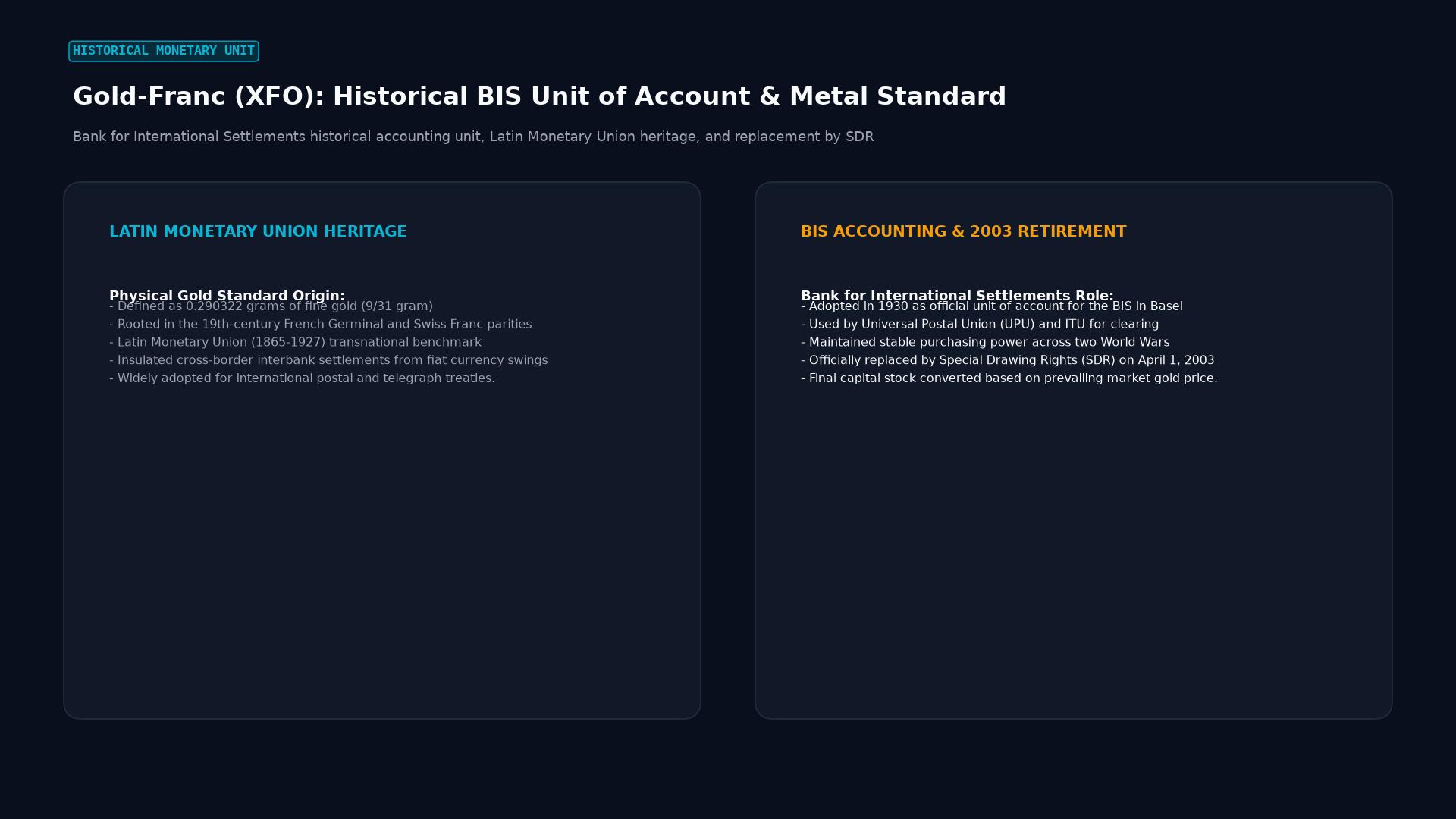 Figure: Bank for International Settlements historical accounting unit, Latin Monetary Union heritage, and replacement by SDR
Historical Origins: The Germinal and Latin Monetary Union Heritage
The physical definition of the gold franc was not invented by the BIS, but inherited from 19th-century European monetary history:
- The Franc Germinal (1803): Established during the French Consulate under Napoleon Bonaparte by the Law of 7 Germinal Year XI (March 28, 1803), the franc germinal defined the monetary unit as 5 grams of silver (90% pure) or 290.32 milligrams of fine gold (a bimetallic ratio of 15.5:1).
- The Latin Monetary Union (LMU, 1865–1927): France, Belgium, Italy, and Switzerland formed the LMU, standardizing their sovereign coinages on the Germinal gold standard (0.290322 grams of pure gold per franc or lira). Even after the effective collapse of the LMU during World War I and the widespread suspension of gold convertibility, international treaties retained the stable LMU gold franc definition as a contract unit of account to prevent contracting parties from paying cross-border damages in debased paper money.
- The Hague Agreements and the Birth of the BIS (1930): Following the Young Plan negotiations regarding German World War I reparations, the Bank for International Settlements was established in Basel. To protect the institution’s balance sheet against competitive currency devaluations during the Great Depression, Article 4 of the original BIS Statutes declared that the bank’s capital was expressed in Swiss gold francs containing 0.29032258 grams of fine gold.
Technical Specifications and Valuation Mechanics
Unlike commercial fiat currencies, the XFO had no circulating physical paper banknotes or everyday metallic coins. It existed as a ledger accounting entry representing pure gold weight:
1. Mathematical Gold Equivalence
$$\text{Weight of 1 XFO} = \frac{9}{31} \text{ grams of fine gold} \approx 0.2903225806 \text{ g}$$
Because one troy ounce equals exactly 31.1034768 grams, the relationship between one troy ounce of gold and the XFO is derived as: $$\text{XFO per Troy Ounce} = \frac{31.1034768}{0.2903225806} \approx 107.134 \text{ XFO}$$ $$\text{Value of 1 XFO in USD} = \frac{\text{Market Price of Gold per Troy Ounce (USD)}}{107.134}$$
2. Concrete Valuation Example
- If gold trades on the London bullion market at $35.00 per ounce (the official Bretton Woods parity): $$\text{Value of 1 XFO} = \frac{$35.00}{107.134} \approx $0.32669 \text{ USD}$$
- If gold trades at $400.00 per ounce (as seen during the late 1990s): $$\text{Value of 1 XFO} = \frac{$400.00}{107.134} \approx $3.7336 \text{ USD}$$
+------------------------------------------------------------------------+
|           Historical Valuation of 1 XFO at Various Gold Benchmarks     |
+------------------------------------------------------------------------+
| Gold Price ($/oz)   | Valuation Basis / Historical Context | Value (USD) |
| $20.67              | Pre-1934 Classical US Gold Standard  | $0.1929     |
| $35.00              | 1944–1971 Bretton Woods Official Peg | $0.3267     |
| $300.00             | Circa 1995 Bullion Market Average    | $2.8002     |
| $2,400.00           | Modern Bullion Valuation Reference   | $22.4018    |
+------------------------------------------------------------------------+
Operational Role of the XFO at the Bank for International Settlements
For over seven decades, the Bank for International Settlements operated its internal financial statements strictly in gold francs:
1. Central Bank Asset Protection
When European and global central banks deposited gold or foreign exchange reserves with the BIS, the transactions were accounted for in gold francs. Because the BIS balance sheet did not rely on national currencies like the British pound, French franc, or US dollar, the institution was immune to balance-sheet insolvency caused by sudden devaluations of its constituent member currencies.
2. Separation from the Swiss Domestic Franc
Although the BIS is located in Basel, Switzerland, the “BIS gold franc” (XFO) was completely separate from the domestic Swiss franc (CHF). The Swiss franc was legal tender in the Swiss Confederation managed by the Swiss National Bank (SNB), whereas the gold franc was an international asset unit immune to Swiss domestic taxation and monetary legislation.
3. Dual Gold Weight System in Treaties: Franc Poincaré vs. Franc Germinal
International maritime and aviation law historically recognized two distinct gold franc definitions:
- Franc Germinal (XFO): Contained 0.29032 grams of fine gold (90% pure). Used primarily by the BIS and the Universal Postal Union.
- Franc Poincaré: Introduced in France by Raymond Poincaré in 1928, containing 65.5 milligrams of gold of millesimal fineness 900 (roughly 58.95 milligrams of pure gold, or approximately one-fifth of a Germinal franc). Used in the Warsaw Convention (1929) to calculate international passenger and air cargo liability limits.
The 2003 Transition from XFO to XDR
By the late 1990s, maintaining balance sheets in a gold-weight unit presented growing accounting and operational challenges:
- Gold Price Volatility: Following the termination of Bretton Woods and the free floating of gold, bullion prices fluctuated widely, introducing artificial balance-sheet volatility that did not reflect the underlying yield of central bank reserve placements.
- Global Disintermediation of Gold: Modern central banks increasingly held reserves in liquid sovereign government bonds (US Treasuries, German Bunds, Japanese JGBs) and currency swap arrangements rather than physical gold bars.
- Harmonization with the IMF: On April 1, 2003, the Bank for International Settlements formally amended its statutes, retiring the Gold Franc (XFO) and replacing it with the International Monetary Fund’s Special Drawing Right (SDR / XDR) as its official balance-sheet unit of account. At the conversion date, 1 gold franc was exchanged on the BIS books at an established asset parity into SDRs.
Practical Case Study: Central Bank Reserve Clearing via XFO
Consider the historical operational clearing between the Bank of England (BoE) and the Banque de France conducted through the BIS in Basel in 1965.
Transaction Parameters
- Under a bilateral interbank agreement, the Banque de France held surplus British pound claims equivalent to £10,000,000.
- Fearing an impending devaluation of sterling (which ultimately occurred in November 1967), the Banque de France requested the BIS convert these sterling claims into neutral gold-denominated claims.
- Exchange Parameters:
- Gold parity: $35.00 per troy ounce.
- Official conversion: £1 = $2.80 USD.
- Value of £10,000,000 in USD = $28,000,000.
- Value of 1 XFO at $35 gold: $0.326693 USD.
Ledger Booking at the BIS
$$\text{Gold Franc Credit} = \frac{$28,000,000}{$0.326693} \approx 85,707,370 \text{ XFO}$$
- The BIS credited the Banque de France’s institutional ledger account with 85,707,370 XFO, backed by earmarked physical bullion held in BIS custody vaults.
- When sterling subsequently devalued by 14.3% in November 1967 from $2.80 to $2.40, the French reserve balance in Basel remained completely protected, as its value was tied strictly to physical gold weight rather than British paper currency.
Frequently Asked Questions
Was the XFO ever minted as physical cash coins for public use?
No. While its underlying standard was derived from historical 19th-century French and Swiss gold 20-franc coins (Napoléons and Vrenelis), the XFO itself was strictly a non-circulating, book-entry unit of account utilized by the Bank for International Settlements, postal agencies, and international treaty secretariats.
Why did the BIS wait until 2003 to replace the Gold Franc?
The BIS retained the gold franc for decades after the 1971 Nixon Shock because its original 1930 charter was structured as an international treaty that protected the bank from national expropriation by basing its equity on gold. Amending the BIS Statutes required extensive legal coordination among dozens of member central banks, which was completed in 2003 to align accounting with modern International Financial Reporting Standards (IFRS) and the IMF’s SDR.
What is the difference between the XFO and the XDR?
The XFO (Gold Franc) was a unit of account defined exclusively by a fixed weight of physical gold (0.290322 grams), meaning its fiat value fluctuated directly with global gold market prices. The XDR (Special Drawing Right) is an IMF reserve asset valued on a weighted basket of five major floating fiat currencies (USD, EUR, CNY, JPY, GBP), providing broad macroeconomic stability based on global trade and interest rates rather than commodity prices.
Ready to trade forex?
Open a free demo account with a regulated broker. Practice with virtual funds before risking real money.