XDR
The ISO 4217 currency code for Special Drawing Rights (SDR), an international supplementary reserve asset created by the International Monetary Fund (IMF) and valued based on a basket of five major global currencies.
XDR (Special Drawing Rights - SDR)
The currency code XDR is the official ISO 4217 alphanumeric designation for Special Drawing Rights (commonly abbreviated as SDR), an international reserve asset created by the International Monetary Fund (IMF) in 1969. The SDR is not a physical currency, nor is it a direct legal claim on the IMF itself. Instead, it is a potential claim on the freely usable currencies of IMF member states, serving as a supplementary foreign exchange reserve asset, an international unit of account, and a global financial stabilizing instrument.
In international macroeconomics, global central banking, and treaty jurisprudence, the XDR occupies a unique institutional status. Its value is determined daily by the IMF based on a market-weighted basket of five dominant global currencies: the US Dollar (USD), the Euro (EUR), the Chinese Renminbi (CNY), the Japanese Yen (JPY), and the British Pound (GBP). As an official international accounting unit, the SDR anchors international treaties, sovereign IMF loan facilities, civil aviation liability limits, and cross-border telecommunications settlements.
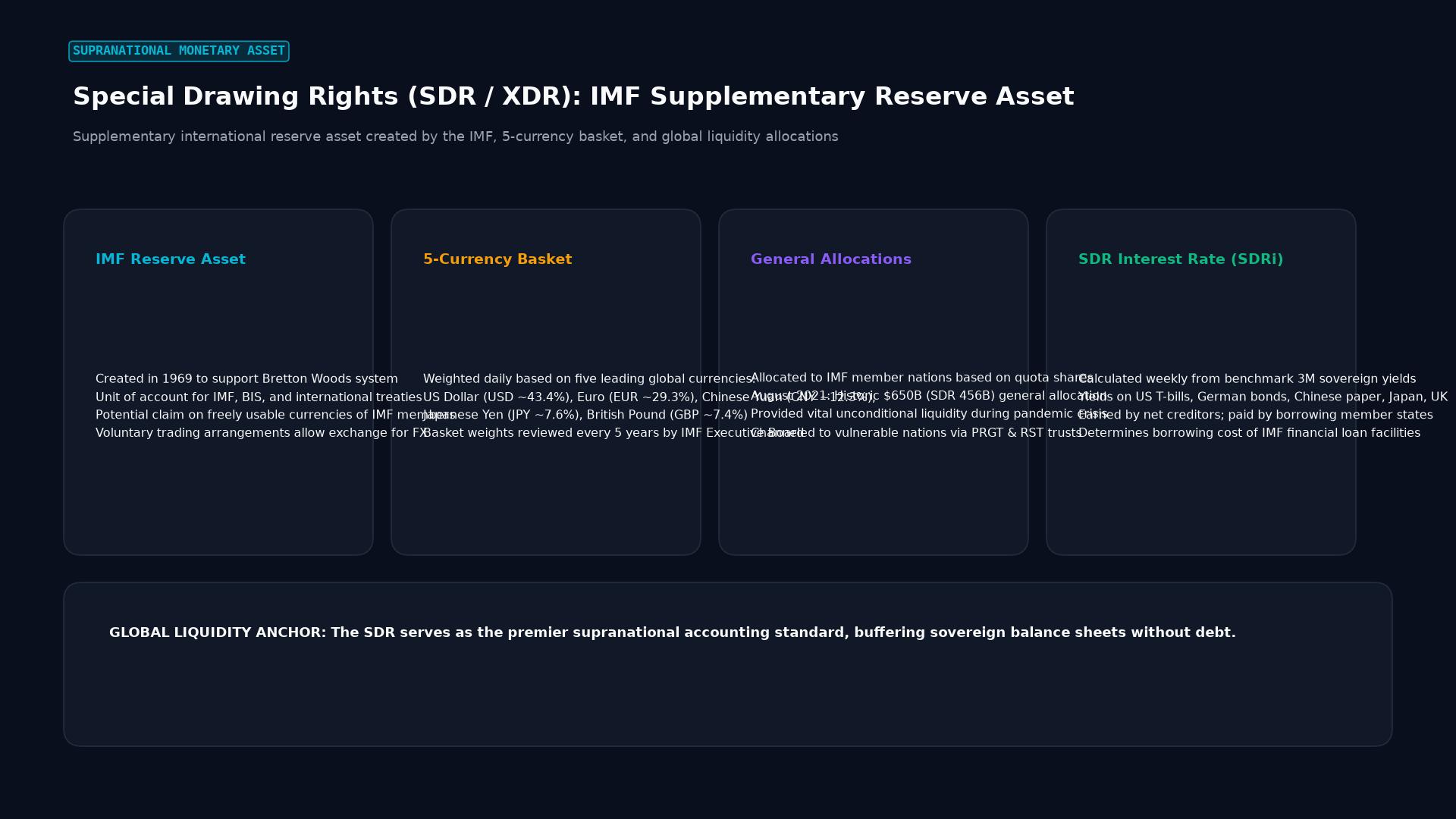 Figure: Supplementary international reserve asset created by the IMF, 5-currency basket, and global liquidity allocations
Historical Genesis: Addressing the Triffin Dilemma
The creation of the Special Drawing Right was driven by systemic structural flaws in the post-WWII international monetary architecture:
- The Bretton Woods Gold Constraint (1960s): Under the 1944 Bretton Woods system, global trade expansion required an expanding supply of US dollars. However, as foreign central bank dollar reserves grew, they outstripped the physical gold reserves backing them in the United States (the classic Triffin Dilemma). The international community feared that global reserve growth would stall, provoking a worldwide deflationary liquidity squeeze.
- First Amendment to the IMF Articles of Agreement (1969): To alleviate this systemic constraint, the IMF created the Special Drawing Right (XDR) as a synthetic, supranational reserve asset. Initially, the value of 1 SDR was defined as exactly 0.888671 grams of fine gold, which was precisely equivalent to 1 US dollar ($35 per ounce of gold).
- Transition to a Currency Basket (1974): Following the Nixon Shock of 1971 and the collapse of the fixed gold-dollar link, the IMF abandoned gold valuation. In July 1974, the SDR was redefined as a basket of 16 major currencies.
- Simplification to Five (and Four) Currencies (1981–2000): In 1981, the IMF simplified the basket to five currencies (USD, Deutsche Mark, French Franc, JPY, GBP). In 1999–2001, the introduction of the single European currency unified the German and French shares into the Euro.
- Inclusion of the Chinese Renminbi (2016): On October 1, 2016, following extensive financial reforms in Beijing, the IMF officially included the Chinese Renminbi (CNY) in the SDR basket, marking the first time an emerging market currency entered the elite global reserve basket.
The SDR Valuation Basket: Mechanics and Weighting
The composition of the SDR basket is formally reviewed by the IMF Executive Board every five years (or sooner if macroeconomic conditions warrant) to ensure it accurately reflects the relative prominence of currencies in the global trading and financial systems.
Criteria for Inclusion in the SDR Basket
To be included in the SDR basket, a currency must satisfy two mandatory qualifying criteria:
- The Export Criterion: The currency is issued by an IMF member state (or monetary union) whose merchandise and service exports ranked among the top four globally over the preceding five-year period.
- The Freely Usable Criterion: The IMF must determine that the currency is widely used to make payments for international transactions and is widely traded in the principal exchange markets (evaluated via foreign exchange turnover, international debt issuance, and global reserve composition).
The Current Basket Weights (2022–2027 Cycle)
Following the comprehensive review concluded in May 2022 (effective August 1, 2022), the IMF established the following percentage weights:
| Currency | Country / Monetary Union | SDR Basket Weight (2022 Review) | Currency Amount in 1 SDR |
|---|---|---|---|
| US Dollar (USD) | United States | 43.38% | 0.57813 |
| Euro (EUR) | Eurozone | 29.31% | 0.37379 |
| Chinese Renminbi (CNY) | China | 12.28% | 1.0993 |
| Japanese Yen (JPY) | Japan | 7.59% | 13.452 |
| British Pound (GBP) | United Kingdom | 7.44% | 0.080870 |
       Daily Mathematical XDR Valuation Formula:

       Value of 1 XDR in USD = 0.57813 * USD_Rate (1.0)
                             + 0.37379 * (USD per EUR)
                             + 1.0993  * (USD per CNY)
                             + 13.452  * (USD per JPY)
                             + 0.08087 * (USD per GBP)
The IMF calculates the exact daily dollar value of the SDR at noon London time each business day using spot exchange rates quoted by market makers, publishing the official rate on the IMF website.
The SDR Interest Rate (SDRi)
The SDR is not merely an accounting unit; it carries an associated benchmark interest rate known as the SDR interest rate (SDRi):
- Calculation Basis: The SDRi is calculated weekly as a weighted average of representative short-term interest rates in the money markets of the five basket currencies:
- USD: 3-month US Treasury Bill rate
- EUR: 3-month Euro short-term rate (€STR)
- CNY: 3-month China Sovereign Treasury Yield
- JPY: 3-month Japanese Treasury Discount Bills
- GBP: 3-month UK Sovereign Treasury Bill rate
- Operational Role:
- The SDRi represents the interest paid by member countries on their sovereign loans borrowed from the IMF.
- It also represents the interest paid to member countries on their holdings of SDRs, and the interest charged to members on their cumulative SDR allocations.
       SDR Interest Rate Mechanism:

       Net Position = SDR Holdings - Cumulative SDR Allocation

       If Holdings > Allocation -> Member receives net interest payments from IMF
       If Holdings < Allocation -> Member pays net interest charges to IMF
SDR Allocations: Creating Global Sovereign Liquidity
The IMF creates SDRs through general or special allocations approved by an 85% supermajority of the IMF Board of Governors. Allocations distribute unconditional reserve liquidity to member states in proportion to their IMF quota shares:
- 1970–1972 Allocation: SDR 9.3 billion to assist post-war liquidity.
- 1979–1981 Allocation: SDR 12.1 billion following global oil price shocks.
- 2009 Global Financial Crisis Allocation: In August and September 2009, the IMF injected SDR 182.6 billion (approx. $250 billion) to prevent a worldwide liquidity freeze following the Great Recession.
- The Historic August 2021 COVID-19 Allocation: On August 23, 2021, the IMF executed the largest allocation in its history: SDR 456.5 billion (equivalent to approximately $650 billion). This historic injection provided immediate liquidity to developing nations combating pandemic public health crises, balance-of-payments collapses, and sovereign debt burdens without adding to their external debt service loads.
Voluntary Trading Arrangements (VTAs)
Because the IMF does not operate a commercial retail banking window, countries wishing to convert their allocated SDRs into hard usable cash (such as US dollars, euros, or renminbi) utilize Voluntary Trading Arrangements (VTAs):
- Advanced economies (such as the US, Germany, Japan, and the UK) maintain standing bilateral agreements with the IMF to purchase SDRs from developing nations in exchange for usable hard currency.
- If VTAs are insufficient, the IMF possesses statutory authority to activate a mandatory “designation mechanism,” compelling countries with strong external balance-of-payments positions to purchase SDRs from distressed member states.
Treaty and Institutional Applications of the XDR
Beyond sovereign central bank balance sheets, the XDR serves as the universal neutral unit of account in global legal conventions:
- The Montreal Convention (1999): In international commercial aviation, airline liability for lost passenger baggage, flight delays, and personal injury is legally denominated in SDRs (e.g., baggage loss liability is capped at 1,288 SDR per passenger).
- Maritime Salvage and Oil Pollution Conventions: The International Maritime Organization (IMO) denominates shipowner civil liability limits for catastrophic marine fuel oil spills in SDRs.
- Universal Postal Union (UPU): International terminal dues and postal transit accounting rates between sovereign postal services are settled in SDRs.
+------------------------------------------------------------------------+
|             Major Historical General SDR Allocations                   |
+------------------------------------------------------------------------+
| Date of Allocation   | Amount in SDRs     | USD Equivalent at Time     |
| 1970 - 1972          | SDR 9.3 Billion    | ~$9.3 Billion              |
| 1979 - 1981          | SDR 12.1 Billion   | ~$15.0 Billion             |
| August 2009          | SDR 182.6 Billion  | ~$250.0 Billion            |
| August 2021          | SDR 456.5 Billion  | ~$650.0 Billion            |
| Cumulative Total     | SDR 660.7 Billion  | ~$935.0 Billion (approx.)  |
+------------------------------------------------------------------------+
Frequently Asked Questions
Can an individual citizen or commercial corporation hold SDRs?
No. Special Drawing Rights are strictly restricted to official holders authorized by the IMF. These include the 190 IMF member sovereign states, the IMF itself, and 20 designated international organizations (such as the Bank for International Settlements, European Central Bank, and regional development banks). Private commercial banks, corporations, and retail citizens cannot hold or trade SDRs.
Why is the SDR assigned the ISO code “XDR”?
Under the international ISO 4217 standard for currency codes, currencies that represent supranational entities, precious metals, or non-national accounting units are assigned codes beginning with the letter “X” (e.g., XAU for gold, XAG for silver, XAF/XOF for CFA francs). The “DR” stands for “Drawing Rights,” producing the standardized financial ticker XDR.
Does an allocation of SDRs create debt for a receiving country?
No. An allocation of SDRs is not a traditional sovereign loan. The IMF grants SDR allocations unconditionally to all member states in proportion to their IMF quotas. A country incurs zero interest or repayment obligations as long as it retains its allocated SDRs. It only incurs net interest charges (at the SDRi rate) if it converts its SDRs into usable foreign currencies, reducing its SDR holdings below its cumulative allocation.
Ready to trade forex?
Open a free demo account with a regulated broker. Practice with virtual funds before risking real money.