XFU
The historical ISO 4217 currency code for the UIC Franc, a specialized synthetic settlement unit of account established by the International Union of Railways (UIC) to clear cross-border rail transport tariffs and multilateral debts among European railway operators.
XFU (UIC Franc - International Railway Clearing Unit)
The currency code XFU is the historical ISO 4217 designation for the UIC Franc (franc UIC), a specialized supranational settlement unit of account created and administered by the International Union of Railways (Union Internationale des Chemins de fer, or UIC), based in Paris. Established to solve complex multilateral clearing problems in post-World War II European transportation, the UIC franc allowed dozens of national railway administrations to price international passenger tickets, transport freight across multiple borders, and settle reciprocal equipment-sharing debts without incurring continuous currency conversion losses or foreign exchange volatility.
Historically defined in parity with the French franc and settled through specialized multilateral rail clearing mechanisms, the XFU was formally retired from ISO 4217 lists following the launch of the physical Euro (EUR) and the complete modernization of European rail accounting into the Single Euro Payments Area (SEPA).
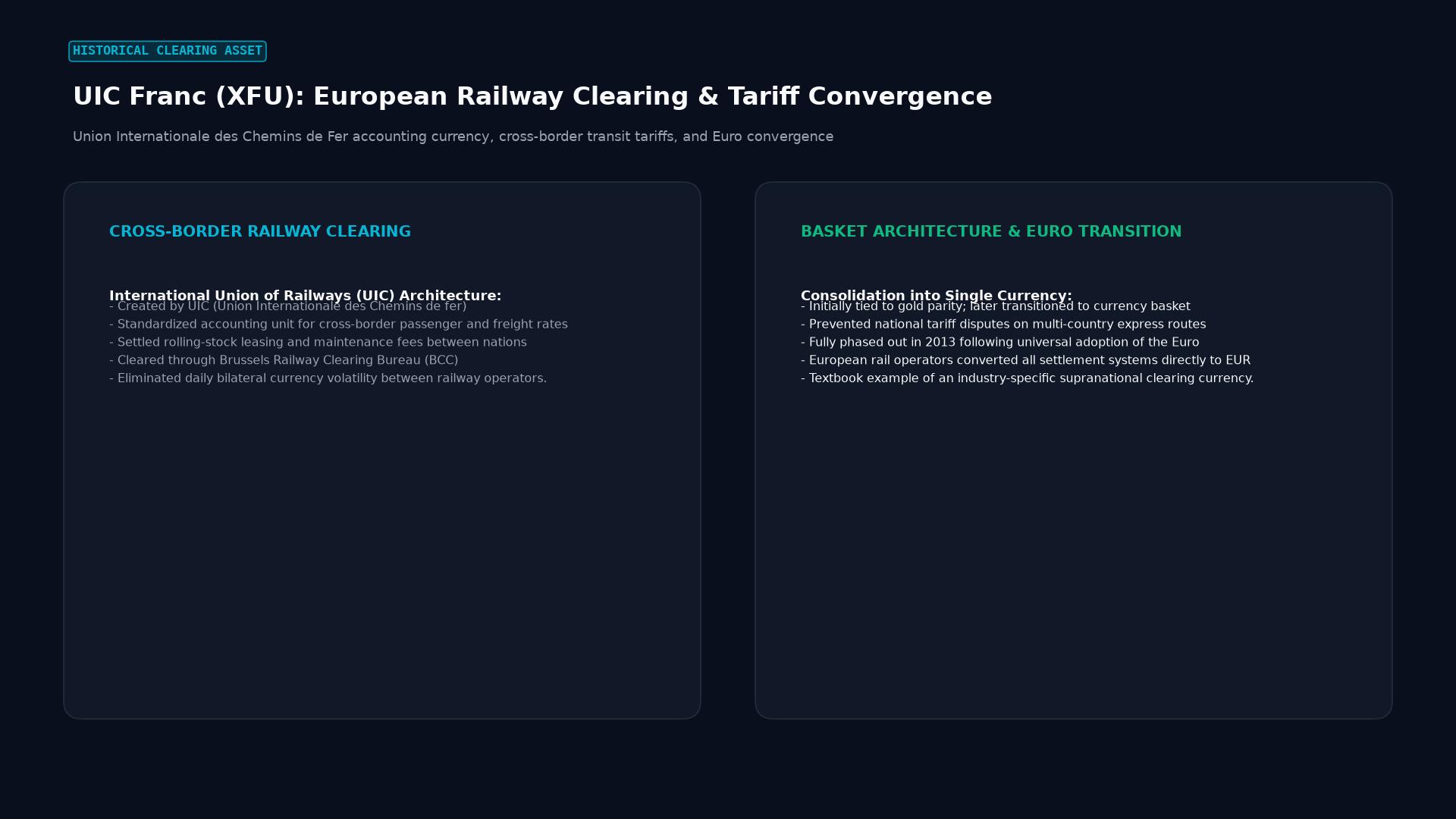 Figure: Union Internationale des Chemins de Fer accounting currency, cross-border transit tariffs, and Euro convergence
Historical Origins and the Post-War European Rail Problem
The expansion of European international commerce in the 19th and early 20th centuries created severe operational and financial friction for rail transport:
- The Border-Crossing Friction: When a passenger purchased a train ticket in Paris to travel through Belgium, Germany, and Switzerland to Milan, multiple national railway companies provided track infrastructure, locomotives, and train staff. Settle-up between SNCF, SNCB, DB, SBB, and FS required pricing each section in a different national fiat currency.
- Post-War Exchange Volatility (1940s–1950s): Following World War II, Europe faced currency shortages, non-convertibility, and frequent unilateral devaluations (e.g., the French franc, Italian lira, and British pound were repeatedly devalued). A rail operator billing another operator in local currency risked receiving payment months later in debased paper money.
- Creation of the UIC Franc: The International Union of Railways (founded in 1922) established a standardized international unit of account: the UIC Franc. Originally defined as equivalent to the French gold franc (Germinal standard), it was subsequently pegged at a 1:1 parity with the French Franc (FRF) following the post-war French currency stabilization.
- Assignment of ISO Code XFU: When the International Organization for Standardization introduced ISO 4217 in 1978 to standardize three-letter global currency codes, the UIC franc was officially assigned the ticker XFU, distinguishing it as a non-national supranational financial accounting instrument (prefixed with “X”).
The Multilateral Clearing Mechanism: Bureau Central de Compensation (BCC)
The primary operational engine utilizing the XFU was the Central Clearing Bureau (Bureau Central de Compensation, or BCC), located in Brussels, Belgium:
1. Unified Tariff Invoicing
All international rail transport agreements, transit freight tariffs, and cross-border passenger ticketing tables published under the International Convention concerning the Carriage of Goods by Rail (CIM) and Carriage of Passengers (CIV) were denominated in XFU.
2. The Monthly Netting Cycle
Rather than settling thousands of bilateral cross-border invoices every day, national rail companies logged their debits and credits with the BCC in Brussels:
- Railway A billed Railway B for 500,000 XFU in freight haulage.
- Railway B billed Railway C for 300,000 XFU in locomotive lease time.
- Railway C billed Railway A for 450,000 XFU in passenger ticket clearing.
- At the end of the monthly accounting cycle, the BCC executed multilateral netting, canceling out offsetting obligations.
       BCC Multilateral Netting Mathematical Formula:

       Net Position_i = Sum(Credits_i) - Sum(Debits_i)

       Where:
       Sum(Credits_i) = Total XFU owed to Railway i by all foreign railways
       Sum(Debits_i)  = Total XFU owed by Railway i to all foreign railways

       Aggregate System Identity:
       Sum_{i=1}^N (Net Position_i) = 0
By reducing gross obligations to a single net balance per operator, the BCC eliminated up to 80% to 90% of cross-border wire transfers, saving European transport operators millions of dollars in banking conversion fees and hedging expenses.
Transition to the Euro and Retirement of XFU
The launch of the European Economic and Monetary Union (EMU) and the physical introduction of the Euro on January 1, 2002, permanently transformed European transportation accounting:
- Elimination of Exchange Risk Across Core Europe: The national currencies of France, Germany, Italy, Spain, Belgium, the Netherlands, Austria, and others were superseded by the Euro. The structural exchange volatility that originally justified the synthetic UIC franc ceased to exist for the vast majority of UIC member networks.
- UIC General Assembly Decision: The UIC General Assembly decreed that all international passenger tariffs, freight tables, and BCC clearing operations would convert directly to the Euro (EUR).
- Formal Deprecation: Following the conversion of European rail systems to the Euro at the official conversion rate of 1 EUR = 6.55957 FRF (and thus 1 EUR = 6.55957 XFU), the ISO 4217 Maintenance Agency formally removed XFU from active currency codes, transferring it to the list of historic withdrawn codes.
+------------------------------------------------------------------------+
|           Comparison: Specialized International Units of Account       |
+------------------------------------------------------------------------+
| Code | Full Name        | Administering Body | Valuation Basis         | Status   |
| XFU  | UIC Franc        | International Rail | Pegged 1:1 to French FRF| Retired  |
| XFO  | Gold Franc       | BIS (Basel)        | 0.290322 g pure gold    | Retired  |
| XDR  | SDR              | IMF (Washington)   | 5-currency basket (USD) | Active   |
| XEU  | ECU (Pre-Euro)   | European Community | Weighted European basket| Replaced |
+------------------------------------------------------------------------+
Applied Operational Case Study: Cross-Border Freight Haulage
To understand how the XFU functioned in historical practice, consider a trans-European industrial freight transport scenario in 1994, prior to the adoption of the single currency:
Operational Scenario
- A German automotive manufacturing plant in Stuttgart ships 10,000 metric tons of steel vehicle frames by rail through Germany, France, and Spain to an assembly plant in Valencia.
- Three independent state rail administrations execute the transit:
- Deutsche Bundesbahn (DB): Transports from Stuttgart to Kehl/Strasbourg (German track).
- Société Nationale des Chemins de fer Français (SNCF): Transports from Strasbourg to Portbou (French track).
- Red Nacional de los Ferrocarriles Españoles (RENFE): Transports from Portbou to Valencia (Spanish track).
Commercial Accounting in XFU
Under UIC regulations, the shipper is billed in a single unified international invoice denominated in UIC francs:
- Total agreed transport charge: 1,200,000 XFU.
- Distribution of route earnings logged at the BCC in Brussels:
- DB entitlement: 300,000 XFU
- SNCF entitlement: 500,000 XFU
- RENFE entitlement: 400,000 XFU
Clearing and Netting Efficiency
Instead of the German customer buying French francs and Spanish pesetas, or SNCF having to sell pesetas on the open foreign exchange market:
- The German customer pays DB in German marks (DEM) converted at the official daily XFU/DEM rate.
- The BCC credits SNCF and RENFE in their monthly XFU accounts.
- These credits offset parallel French shipments of agricultural produce moving northward through Germany.
- Cash only moved across international borders for the small net monthly differential, completely insulating the transport companies from short-term speculative currency runs in the European Exchange Rate Mechanism (ERM).
Frequently Asked Questions
Was the UIC Franc ever issued as physical currency?
No. The XFU was strictly an artificial accounting unit and clearing currency. It was never printed as physical paper money or struck as metallic coins for retail transactions. It existed exclusively on the accounting books of the International Union of Railways, national railway operators, and the Central Clearing Bureau (BCC) in Brussels.
How was the exchange rate of the XFU determined against foreign currencies?
Because the UIC franc was pegged at an exact 1:1 parity with the French franc (FRF) throughout most of its operational lifespan, its exchange rate against other currencies (such as the German mark, British pound, Swiss franc, or US dollar) was calculated directly from the prevailing daily exchange rates of the French franc on the Paris interbank foreign exchange market.
Why is the history of the XFU relevant to modern financial market design?
The XFU and the Brussels Central Clearing Bureau were early pioneers of modern multilateral netting and straight-through clearing. The mathematical netting algorithms developed by international railways to eliminate bilateral currency settlement risks served as conceptual precursors for modern interbank clearing houses (such as Continuous Linked Settlement - CLS Bank) and centralized derivative clearing organizations (CCPs) that safeguard global financial markets today.
Ready to trade forex?
Open a free demo account with a regulated broker. Practice with virtual funds before risking real money.