Y2K
The Year 2000 problem (Millennium Bug), a critical software and data formatting flaw resulting from legacy two-digit year representations, which posed catastrophic operational, liquidity, and settlement risks to global banking and capital market infrastructure.
Y2K (The Year 2000 Financial Market Impact)
The Year 2000 problem (commonly abbreviated as Y2K or the Millennium Bug) was a systemic computational and data storage vulnerability that arose from early software engineering conventions. In the 1960s through 1980s, when computer memory and magnetic storage were expensive, programmers universally abbreviated four-digit calendar years to two digits (e.g., storing “1999” simply as “99”). As the calendar advanced toward midnight on December 31, 1999, financial systems, trading matching engines, and interbank payment rails faced the risk that automated systems would interpret the two-digit year “00” not as 2000, but as 1900.
In the history of financial risk management, banking operations, and central banking, Y2K represented the first globally synchronized operational risk crisis. Had date-parsing logic failed across capital markets, computerized systems would have miscalculated bond interest accruals, triggered erroneous margin calls on expired derivative contracts, inverted loan amortization schedules, and frozen wholesale payment clearing networks like Fedwire, CHIPS, and SWIFT. The coordinated global response permanently established modern operational risk protocols and central bank emergency liquidity frameworks.
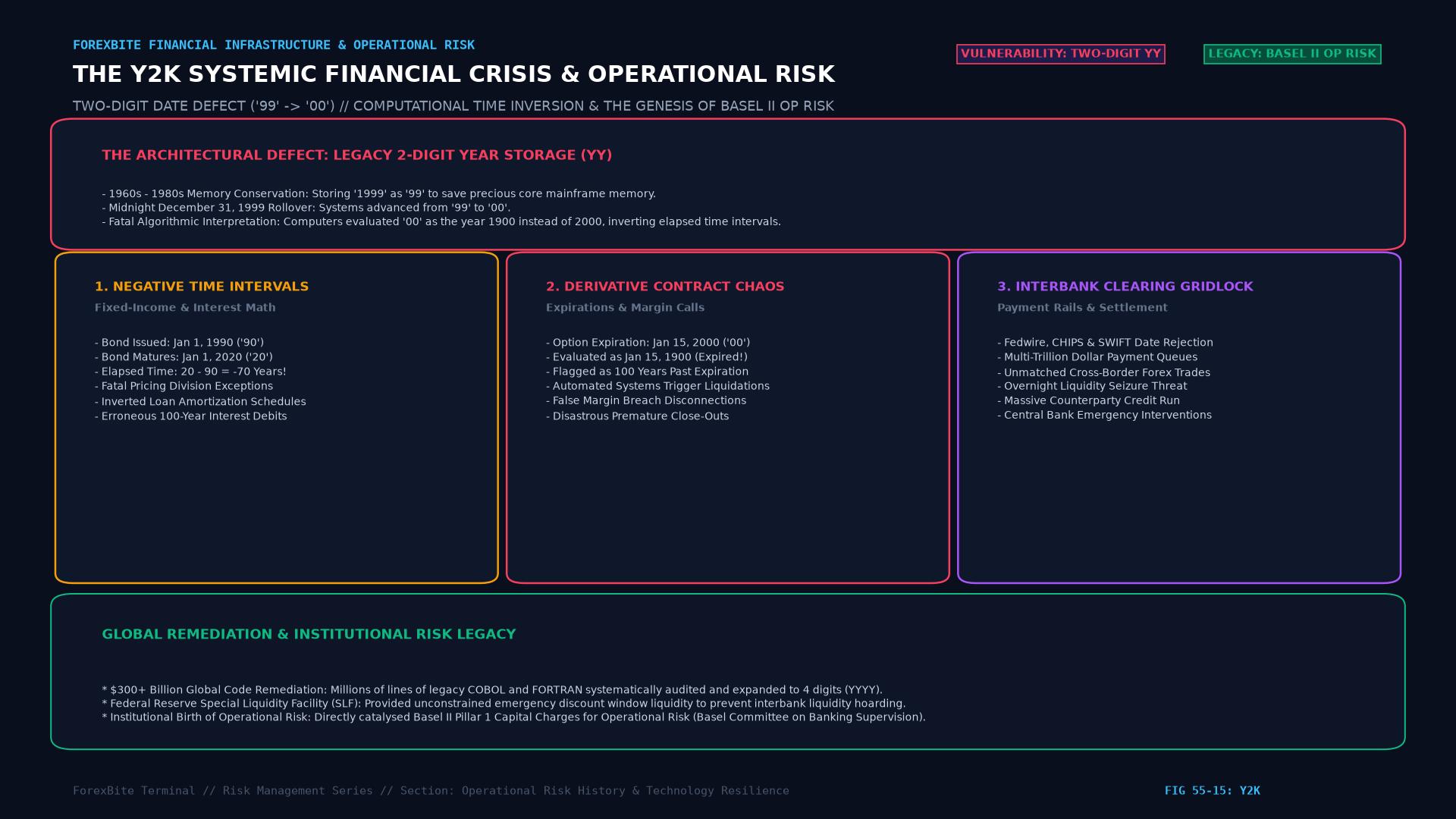 Figure: The Y2K two-digit date defect (‘99’ -> ‘00’) failure modes across fixed-income, derivatives, and interbank clearing, and its legacy in modern Basel II operational risk management.
Technical Mechanics of the Glitch in Financial Systems
Financial mathematics is inherently time-dependent. Yield calculations, compound interest, derivative Greeks, and regulatory capital requirements rely on precise day-count conventions and chronological time intervals ($t_2 - t_1$):
1. Negative Time Intervals and Accrual Failures
Consider an institutional 30-year corporate bond issued on January 1, 1990, maturing on January 1, 2020:
- Under flawed two-digit logic, the computer calculated maturity elapsed time as: $$\Delta t = 20 - 90 = -70 \text{ years}$$
- Rather than recognizing a 30-year tenor, software algorithms produced a negative 70-year interval, causing automated bond pricing engines to divide by negative time or trigger fatal execution exceptions.
2. Derivative Expirations and Margin Calls
Options contracts, interest rate swaps, and futures contracts depend on precise expiration dates:
- If an exchange matching engine processed an option expiration on January 15, 2000 as January 15, 1900, the contract was flagged as 100 years past due.
- Automated clearing systems would have automatically liquidated positions, executed improper default procedures, and frozen trading accounts.
3. Daylight and Leap Year Anomalies
A secondary compounding error embedded in legacy code was the leap year calculation:
- The Gregorian calendar dictates that years divisible by 100 are not leap years unless they are also divisible by 400.
- The year 1900 was not a leap year, but the year 2000 was a leap year (divisible by 400).
- Software relying on simplified leap year algorithms failed to recognize February 29, 2000, creating 24-hour calendar offsets that would have corrupted multi-day settlement cycles (such as T+3 equity settlements).
The Coordinated Central Banking and Regulatory Response
Recognizing that panic and operational gridlock could provoke a worldwide banking run, central banks and global financial regulators executed unprecedented precautionary measures:
1. The Federal Reserve Special Liquidity Facility (SLF)
Under Federal Reserve Chairman Alan Greenspan, the Federal Open Market Committee (FOMC) anticipated that anxiety surrounding potential computer breakdowns might cause commercial banks and retail depositors to hoard physical cash and sovereign liquidity:
- Establishment of the SLF: Operating from October 1, 1999, to April 7, 2000, the SLF allowed depository institutions to borrow uncollateralized overnight funds at a penalty rate (150 basis points above the federal funds target rate) without the traditional regulatory stigma of the discount window.
- Physical Banknote Stockpiling: The Federal Reserve printed and stockpiled an extraordinary $70 billion in physical cash reserves in secure vaults to guarantee that any surge in retail cash withdrawals over the New Year weekend could be fulfilled instantly without run panics.
2. Basel Committee and Joint Year 2000 Council
In 1998, the Basel Committee on Banking Supervision (BCBS), the Bank for International Settlements (BIS), the International Organization of Securities Commissions (IOSCO), and the International Association of Insurance Supervisors (IAIS) created the Joint Year 2000 Council:
- Mandated universal code remediation, code reviews, and end-to-end integration testing across global financial clearing networks.
- Enforced independent compliance audits for all Tier-1 global investment banks, threatening non-compliant institutions with restrictions on interbank market participation.
+------------------------------------------------------------------------+
|          Global Timeline of Financial Market Y2K Mobilization          |
+------------------------------------------------------------------------+
| Date / Period   | Regulatory & Operational Action                      |
| 1996 - 1997     | Regulators issue first formal Y2K banking alerts     |
| 1998            | Joint Year 2000 Council formed by BIS and IOSCO      |
| June 1999       | Street-wide global simulated trading weekend tests   |
| Oct 1, 1999     | Fed activates the Special Liquidity Facility (SLF)   |
| Dec 31, 1999    | Global 24-hour command centers monitor midnight roll |
| Jan 1–3, 2000   | Markets open cleanly with zero systemic disruptions  |
+------------------------------------------------------------------------+
The “Street-Wide” Simulation and Dry Runs
In the spring and summer of 1999, the Securities Industry Association (SIA) in the United States and counterpart associations in London, Tokyo, and Frankfurt conducted the largest simulated trading tests in human history:
- Participants: Hundreds of broker-dealers, commercial banks, institutional asset managers, regional stock exchanges (NYSE, Nasdaq, LSE), and clearing corporations (DTCC, Options Clearing Corporation).
- The Simulation: Over several dedicated weekends, institutions wound their internal computer clocks forward to December 31, 1999, 11:59 PM, processed the stroke of midnight, and executed simulated trading, margin calls, interest accruals, and wire transfers for dates spanning January 3, 2000, and February 29, 2000.
- Flaw Rectification: The tests identified thousands of hidden software bugs in legacy COBOL, Fortran, and assembler code, allowing engineering teams to patch anomalies months before live capital was exposed.
Long-Term Legacy: The Birth of Modern Operational Risk
While popular myth often characterizes Y2K as an “overblown hoax” because catastrophic failures did not materialize on January 1, 2000, financial historians and operational risk specialists understand the opposite: catastrophic failures were averted precisely because the global financial industry spent an estimated $300 billion to $500 billion on remediation, testing, and system redundancy.
The institutional legacy of Y2K permanently transformed risk management:
- Inclusion of Operational Risk in Basel II (2004): Prior to Y2K, banking regulation focused almost exclusively on credit risk and market risk. The realization that a simple computer code defect could collapse the global payments architecture led the Basel Committee to establish Operational Risk as a mandatory Pillar 1 capital requirement under Basel II, defining it as the risk of loss resulting from inadequate or failed internal processes, people, and systems, or from external events.
- Standardization of Business Continuity Planning (BCP): Y2K mandated the creation of secondary data disaster recovery centers, real-time off-site data replication, and crisis incident command structures. These exact BCP protocols saved the US financial system on September 11, 2001, when the destruction of lower Manhattan telecom and office infrastructure was absorbed by backup facilities established during Y2K preparation.
- Acceleration of Enterprise IT Modernization: Millions of lines of legacy mainframe software were permanently audited, retired, or migrated to modern relational database architectures, laying the technological foundation for modern real-time electronic trading.
Frequently Asked Questions
Why were two-digit years used in financial code in the first place?
In the early decades of computing (1950s–1970s), digital data storage was extremely scarce and expensive. Early magnetic core memory and punch cards (such as standard 80-column IBM punch cards) required programmers to economize on every single byte. Dropping the century digits (“19”) saved millions of bytes of memory across sprawling mainframe database records, which was considered an engineering best practice at the time.
Did any actual financial glitches occur on January 1, 2000?
Minor, non-systemic anomalies occurred, but none triggered financial contagion. Some retail credit card terminals rejected valid cards thinking they had expired in 1900, tax calculation programs printed bills showing 100 years of back-interest, and certain bank customer statements briefly displayed dates in the year 1900. However, because core interbank clearing systems (Fedwire, SWIFT, CHIPS) had been thoroughly remediated, zero settlement failures or clearing freezes occurred.
What is the upcoming “Year 2038 Problem” facing financial systems?
The Year 2038 problem (also known as the Unix Millennium Bug or Y2038) is a time formatting vulnerability in computers that measure system time as the number of seconds elapsed since January 1, 1970 (Unix epoch) using a signed 32-bit integer. On January 19, 2038, at 03:14:07 UTC, the 32-bit integer will overflow and wrap around to a negative number, resetting clocks to December 13, 1901. Financial technology systems, embedded network devices, and quantitative trading algorithms are systematically migrating to 64-bit timestamps to eliminate this risk.
Ready to trade forex?
Open a free demo account with a regulated broker. Practice with virtual funds before risking real money.