Yankee Bond
A US-dollar-denominated bond issued in the United States by a foreign government, supranational entity, or foreign corporation, registered with the US Securities and Exchange Commission (SEC) or issued under Rule 144A.
Yankee Bond
In international debt capital markets (DCM) and fixed-income investing, a Yankee Bond is a US-dollar-denominated bond issued within the domestic United States financial market by a foreign issuer, such as an overseas corporation, commercial bank, foreign municipality, or sovereign government. To access the vast liquidity of American institutional investors, Yankee bonds must be registered with the US Securities and Exchange Commission (SEC) under the Securities Act of 1933 or issued under SEC Rule 144A for Qualified Institutional Buyers (QIBs), and they settle through the Depository Trust Company (DTC).
Yankee bonds represent the US domestic branch of the global foreign bond family, which also includes Samurai bonds in Japan, Bulldog bonds in the United Kingdom, and Kangaroo bonds in Australia. For non-US corporate treasurers and sovereign finance ministries, issuing Yankee debt offers access to the deepest pool of long-duration institutional capital on Earth, enabling foreign entities to secure 10-year, 30-year, or even 50-year fixed-rate financing that is unavailable in their domestic debt markets.
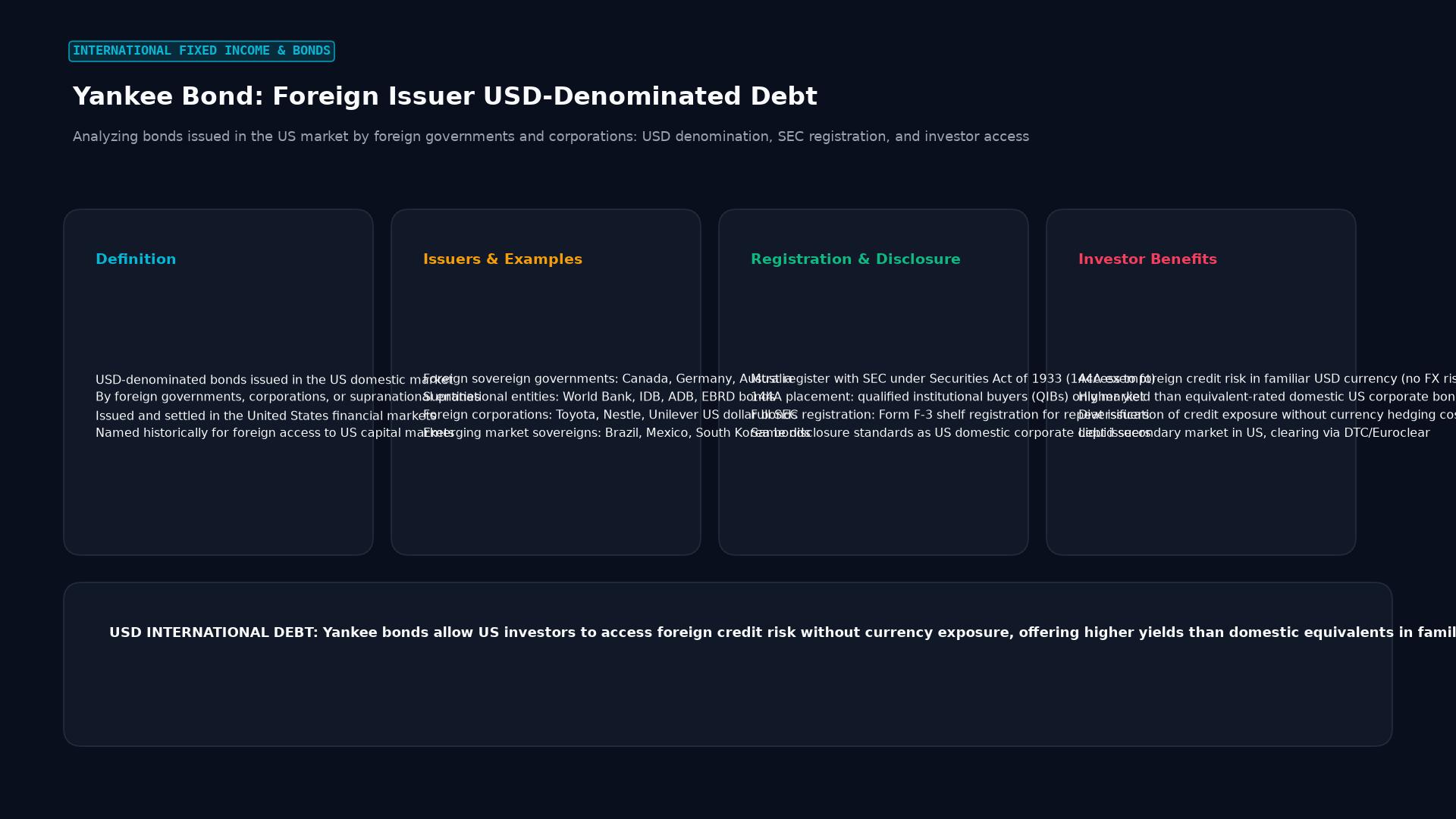 Figure: Analyzing bonds issued in the US market by foreign governments and corporations: USD denomination, SEC registration, and investor access
Regulatory and Structural Framework
To issue bonds directly in the United States, foreign entities must comply with US securities laws:
1. SEC-Registered Public Yankee Bonds
Foreign private issuers (FPIs) seeking to sell bonds to the public retail and institutional market must register securities with the SEC:
- Registration Statements: Typically executed on Form F-1 (initial public offering) or Form F-3 (shelf registration for seasoned foreign issuers).
- Annual Disclosures: Issuers must file annual reports on Form 20-F, providing detailed audited financial statements conforming to US GAAP or International Financial Reporting Standards (IFRS) as issued by the IASB.
- Benefits: Maximizes liquidity, achieves the tightest possible credit spread over US Treasuries, and allows unrestricted trading among all US retail and institutional investors.
2. Rule 144A Yankee Offerings
Due to the substantial legal, accounting, and compliance expenses of full SEC registration, the majority of modern Yankee bond volume is conducted under SEC Rule 144A:
- Target Audience: Restricted exclusively to Qualified Institutional Buyers (QIBs), institutional entities managing at least $100 million in eligible securities.
- Expedited Execution: Bypasses lengthy SEC pre-issuance registration reviews, allowing foreign corporate treasuries to issue debt in days to capture favorable US interest rate windows.
- Registration Rights Agreements: Many 144A Yankee bonds include covenants promising to execute an “Exxon Capital” exchange offer within 365 days, swapping the restricted 144A notes for fully registered SEC public bonds once paperwork is completed.
Strategic Advantages of Issuing Yankee Bonds
Foreign multinational corporations and sovereign governments choose the Yankee market over their domestic bond markets for specific economic reasons:
1. Immense Market Depth and Long Maturities
The US corporate bond market exceeds $10 trillion in total capitalization. In many European, Asian, and Latin American domestic markets, institutional investors rarely purchase corporate debt with maturities exceeding 5 to 7 years. In the US, institutional life insurance companies and pension funds possess multi-decade liabilities, generating massive demand for 10-year, 20-year, and 30-year Yankee paper.
2. Diversification of the Creditor Base
Large multinational issuers (such as BP, Toyota, Nestlé, or TotalEnergies) require billions of dollars in debt financing annually. Relying exclusively on European or Asian banks would saturate local credit limits. Tapping the Yankee market introduces a completely distinct investor base, preventing domestic credit saturation.
3. Funding US Acquisitions
Foreign conglomerates acquiring American businesses (such as a German chemical company acquiring an American pharmaceutical manufacturer) issue Yankee bonds to raise US dollars directly, matching the currency of their debt obligations with the US dollar cash flow generated by the acquired enterprise.
+------------------------------------------------------------------------+
|          Global Foreign Bond Taxonomy: The "National Animals"          |
+------------------------------------------------------------------------+
| Market Segment   | Host Country | Issue Currency | Foreign Issuer Base |
| Yankee Bond      | United States| US Dollar (USD)| Non-US Entities     |
| Samurai Bond     | Japan        | Japanese (JPY) | Non-Japanese Entities|
| Bulldog Bond     | UK           | Sterling (GBP) | Non-UK Entities     |
| Kangaroo Bond    | Australia    | Aus. Dollar(AUD)| Non-Australian Ent. |
| Panda Bond       | China        | Renminbi (CNY) | Non-Chinese Entities|
| Maple Bond       | Canada       | Can. Dollar(CAD)| Non-Canadian Ent.   |
+------------------------------------------------------------------------+
Yankee Bonds vs. Eurobonds: Key Structural Differences
While both Yankee bonds and Eurobonds can be denominated in US dollars, their regulatory architecture, syndicate structure, and clearing mechanisms are fundamentally different:
| Feature / Metric | Yankee Bond | US Dollar Eurobond (Offshore) |
|---|---|---|
| Governing Law | State of New York law | English law or New York law |
| Primary Placement | Domestic United States market | Global offshore international market |
| Regulatory Filing | Registered with SEC or Rule 144A | Unregistered with SEC (Reg S) |
| Primary Clearing | Depository Trust Company (DTC) | Euroclear and Clearstream (Luxembourg) |
| Withholding Tax | Subject to US IRS documentation (W-8BEN) | Typically gross-paying with tax gross-up |
| Underwriting Desk | US domestic syndicate desks | London/European international syndicates |
Hedging the Currency Risk: Cross-Currency Interest Rate Swaps
When a foreign entity issues Yankee debt to finance domestic operations in Europe or Japan, it incurs a currency mismatch: its revenues are in EUR or JPY, but its debt service is in USD. To eliminate this foreign exchange exposure, the corporate treasurer executes a Cross-Currency Interest Rate Swap (CCIRS):
       At Bond Issuance:
       Issuer sends USD Bond Proceeds ------------> Swap Bank
       Issuer receives EUR Cash <------------------ Swap Bank

       Over Bond Lifespan (Semi-Annual Coupons):
       Issuer sends EUR Fixed Coupon --------------> Swap Bank
       Issuer receives USD Coupon Cash <----------- Swap Bank --------> Paid to US Bondholders

       At Maturity:
       Issuer sends EUR Principal -----------------> Swap Bank
       Issuer receives USD Principal <------------- Swap Bank --------> Retires Yankee Bond
Through the cross-currency swap, the foreign corporate treasurer transforms a US dollar Yankee bond into a synthetic fixed-rate euro or yen liability, locking in a known borrowing cost while tapping the superior liquidity of the American bond market.
Applied Issuance Case Study: European Industrial Group
Consider Nordic Engineering Group (NEG), a heavy machinery conglomerate based in Stockholm, Sweden, seeking to finance a 10-year capital expenditure program.
Financing Requirements and Market Friction
- Required Capital: $1,000,000,000 equivalent.
- Required Tenor: 10 Years.
- Domestic Nordic Market Constraint: The Swedish domestic krona bond market cannot absorb a 10-year SEK 10.5 billion single corporate issue without demanding an exorbitant credit spread penalty.
Yankee Bond Issuance Execution
NEG mandates a syndicate of US investment banks (led by J.P. Morgan, Morgan Stanley, and Citigroup) to execute a Rule 144A Yankee bond offering in New York:
- Offering Terms:
- Principal: $1,000,000,000.
- Tenor: 10 Years.
- Coupon: 5.50% semi-annual.
- Pricing Benchmark: 10-Year US Treasury yield (4.25%) + 125 basis points credit spread.
- Investor Allocation: The issue is 3.5x oversubscribed, allocated across 150 US institutional accounts (pension funds, insurance asset managers, high-grade bond mutual funds).
Net Economic Outcome
NEG secures $1.0 billion in guaranteed 10-year funding at a tighter credit spread than could be achieved in Europe. Concurrently, NEG enters a 10-year cross-currency swap, converting the $1.0 billion into Swedish kronor at a fixed synthetic SEK rate, immunizing its balance sheet against USD/SEK currency volatility.
Frequently Asked Questions
Why are these debt instruments called “Yankee” bonds?
The term originated in international financial vernacular in the mid-20th century, where financial instruments issued in the domestic United States were nicknamed “Yankee” (reflecting the historical colloquial term for Americans), just as foreign bonds issued in Japan are called “Samurai bonds” and those in the UK are called “Bulldog bonds.”
Do Yankee bonds carry currency risk for US investors?
No. For US-based investors, Yankee bonds carry zero foreign exchange risk because all coupon payments and principal redemption amounts are denominated and paid strictly in US dollars. However, US investors remain exposed to the foreign issuer’s underlying credit risk, sovereign risk (political risk of the issuer’s home nation), and domestic US interest rate duration risk.
What is the difference between a SEC-registered Yankee and a Rule 144A Yankee?
A SEC-registered Yankee bond is registered with the US Securities and Exchange Commission, requiring public filing of detailed financial disclosures (Form 20-F) and enabling unrestricted trading by both institutional and retail investors. A Rule 144A Yankee bond is a private placement exempt from SEC registration, restricted to sophisticated institutional buyers (QIBs), enabling the foreign issuer to raise capital much faster with lower legal compliance expenses.
Ready to trade forex?
Open a free demo account with a regulated broker. Practice with virtual funds before risking real money.