Yield to Maturity - YTM
The total theoretical annualized rate of return anticipated on a bond if it is held until its final maturity date, equating the present value of all future coupon and principal cash flows to the current market price.
Yield to Maturity (YTM)
In fixed-income analytics, debt capital markets, and institutional investment management, Yield to Maturity (commonly abbreviated as YTM, or simply referred to as a bond’s yield) is the definitive benchmark metric for evaluating bond returns. It represents the internal rate of return (IRR) of an investment in a bond, assuming the security is purchased at its prevailing market price, held until its final legal maturity date, that the issuer honors all coupon and principal commitments without default, and that all interim coupon cash flows are reinvested at an identical interest rate.
YTM serves as the universal pricing language of global debt markets. When traders on Wall Street, the City of London, or Tokyo discuss a bond becoming “cheaper” or “more expensive,” they quote movements in yield to maturity (in basis points) rather than raw dollar dollar prices. Understanding YTM allows investors to compare fixed-income securities of varying maturities, coupon rates, and credit qualities across sovereign, municipal, and corporate bond universes.
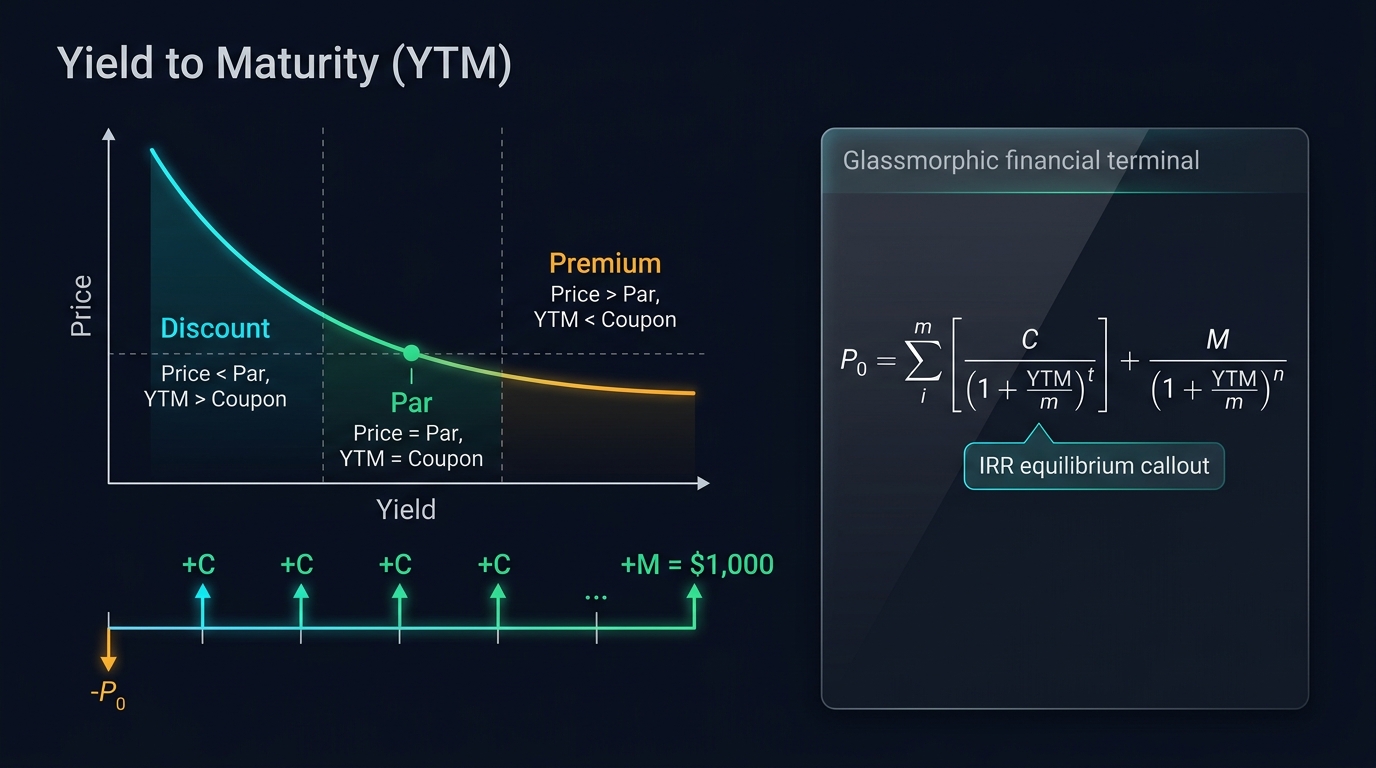
       +-------------------------------------------------------------+
       |             The Mathematical Equilibrium of YTM             |
       +-------------------------------------------------------------+
                                      |
            +-------------------------+-------------------------+
            |                                                   |
            v                                                   v
+-------------------------+                         +-------------------------+
| Cash Outflow (Present)  |                         | Cash Inflows (Future)   |
| - Current Clean Market  |                         | - Semi-Annual Coupons   |
|   Price (P_0)           |                         |   ($C_1, C_2, ..., C_n) |
| - Premium or Discount   |                         | - Face Value Redemption |
|   to Par Value          |                         |   at Maturity ($M)      |
+------------+------------+                         +------------+------------+
             |                                                   |
             +-------------------------+-------------------------+
                                       v
                   +---------------------------------------+
                   |  Discount Rate (YTM) That Solves:     |
                   |  P_0 = Sum[ C_t / (1 + YTM/2)^t ]     |
                   |        + [ M / (1 + YTM/2)^n ]        |
                   +---------------------------------------+
Mathematical Formulation and Bond Pricing Mechanics
The price of an option-free fixed-rate bond is the sum of the discounted present values of its contractual cash flows:
1. The Fundamental Bond Pricing Equation
$$P_0 = \sum_{t=1}^{n} \frac{C}{\left(1 + \frac{YTM}{m}\right)^t} + \frac{M}{\left(1 + \frac{YTM}{m}\right)^n}$$
Where:
- $P_0$: Current market price of the bond (clean price).
- $C$: Periodic coupon cash payment ($C = \frac{\text{Annual Coupon Rate} \times M}{m}$).
- $M$: Par value (face value) of the bond (typically $1,000 for corporate debt).
- $m$: Number of coupon payments per calendar year (typically $m=2$ for semi-annual bonds in the US and UK, or $m=1$ for annual Eurobonds).
- $n$: Total number of compounding periods remaining until maturity ($n = \text{Years to Maturity} \times m$).
- $YTM$: Annualized Yield to Maturity (expressed as a decimal or percentage).
2. Approximate Yield to Maturity Formula
Because solving for YTM directly from the pricing equation requires numerical iteration (such as the Newton-Raphson method), analysts utilize an approximation formula for rapid manual calculations: $$YTM_{\text{approx}} \approx \frac{C + \left(\frac{M - P_0}{n_{\text{years}}}\right)}{\frac{M + P_0}{2}}$$
The Bond Pricing Trinity: Par, Premium, and Discount
The relationship between a bond’s stated coupon rate, its current yield, and its yield to maturity dictates whether the instrument trades at a premium, at par, or at a discount:
+------------------------------------------------------------------------+
|          The Fundamental Yield Hierarchy Across Pricing States         |
+------------------------------------------------------------------------+
| Market Price State     | Mathematical Relationship                     |
| **Discount Bond**      | Market Price < Par  --> Coupon < Current Yield < YTM |
| **Par Bond**           | Market Price = Par  --> Coupon = Current Yield = YTM |
| **Premium Bond**       | Market Price > Par  --> Coupon > Current Yield > YTM |
+------------------------------------------------------------------------+
Yield (%)
^
| Discount Bond: Premium Bond:
| YTM > Current > Coupon Coupon > Current > YTM
|
| [ YTM ] [ Coupon Rate ]
| ^ ^
| | |
| [ Current Yield ] [ Current Yield ]
| ^ ^
| | |
| [ Coupon Rate ] [ YTM ]
+-----------------------------------------------------------> Bond StateExplaining the Dynamics
- Discount Bond ($P_0 < $1,000$): Prevailing market interest rates have risen above the bond’s fixed coupon. Investors demand a price discount so that the capital appreciation realized between the purchase price and the $1,000 par redemption compensates for the below-market coupon, lifting total YTM above the coupon rate.
- Premium Bond ($P_0 > $1,000$): Prevailing market interest rates have fallen below the bond’s fixed coupon. Investors bid the price up above $1,000 to capture the above-market coupon cash flows. The capital loss incurred as the bond price converges toward $1,000 at maturity reduces total YTM below the coupon rate.
The Reinvestment Rate Assumption: A Critical Analytical Caveat
A widespread misconception among non-specialists is that an investor holding a bond to maturity is mathematically guaranteed to earn the exact YTM quoted at the time of purchase. This is true only if a critical assumption is satisfied:
The Reinvestment Risk Reality
The mathematical derivation of YTM assumes that every periodic coupon payment received over the life of the bond is immediately reinvested at an interest rate exactly equal to the original YTM.
- If Interest Rates Drop: Future coupons will be reinvested in the market at lower prevailing yields. The investor’s actual realized compound yield over the entire holding period will be lower than the original YTM.
- If Interest Rates Rise: Coupons will be reinvested at higher rates, resulting in a realized compound return that exceeds the original YTM (assuming the bond is held to final maturity).
- Zero-Coupon Exception: Zero-coupon bonds (such as US Treasury STRIPS) carry zero reinvestment risk because they pay no interim coupons; their realized return is mathematically locked to the initial YTM on purchase day.
Applied Calculation Case Study: Corporate Bond Analysis
Consider an institutional fixed-income analyst evaluating a corporate bond issued by Global Logistics Corp (GLC):
Bond Parameters
- Face Value ($M$): $1,000.
- Annual Coupon Rate: 6.00% (Paid semi-annually: $C = $30.00$ every 6 months).
- Time to Maturity: 5 Years ($n = 10$ semi-annual periods).
- Current Market Price ($P_0$): $950.00 (Trading at a discount).
Step 1: Approximate Calculation
Using the manual approximation formula: $$YTM_{\text{approx}} \approx \frac{60 + \left(\frac{1,000 - 950}{5}\right)}{\frac{1,000 + 950}{2}} = \frac{60 + 10}{975} = \frac{70}{975} \approx \mathbf{7.18%}$$
Step 2: Exact Financial Equation Solution
Setting up the discounted cash flow equality: $$950.00 = \sum_{t=1}^{10} \frac{30}{\left(1 + \frac{YTM}{2}\right)^t} + \frac{1,000}{\left(1 + \frac{YTM}{2}\right)^{10}}$$ Solving via financial iteration yields:
- Semi-annual yield ($y/2$) = 3.606%
- Annualized Nominal YTM (Bond Equivalent Yield) = $3.606% \times 2 = \mathbf{7.21%}$
- Effective Annual Yield (EAY) = $(1 + 0.03606)^2 - 1 = \mathbf{7.34%}$
Analytical Breakdown of Return Components
The 7.21% annualized YTM consists of two distinct economic return drivers:
- Current Cash Yield: $\frac{$60}{$950} \approx 6.32%$ annual cash payout.
- Capital Gain Amortization: The $50 discount ($1,000 par minus $950 price) amortized over the 5-year holding period, contributing an additional 0.89% annualized return.
Frequently Asked Questions
What is the difference between Current Yield and Yield to Maturity?
Current Yield is a simple static ratio calculated as the annual dollar coupon divided by the current market price ($\frac{\text{Annual Coupon}}{P_0}$). It reflects only immediate cash flow income. Yield to Maturity is a comprehensive internal rate of return that accounts for coupon cash flows, the time value of money, the timing of compounding periods, and the capital gain or loss realized when the bond is redeemed at par at maturity.
Why do bond prices move inversely to Yield to Maturity?
Bond prices move inversely to yields because a bond’s future cash flows (coupons and principal) are legally fixed at issuance. When broader market interest rates rise, existing bonds with lower fixed coupons become less attractive, forcing their market prices down until their yield matches prevailing market rates. Conversely, when market interest rates fall, existing high-coupon bonds become more valuable, driving their market prices upward.
How does credit risk affect a bond’s quoted Yield to Maturity?
A bond’s quoted YTM incorporates a credit risk spread above the risk-free sovereign benchmark (e.g., US Treasuries). Higher credit risk (lower credit ratings from S&P, Moody’s, or Fitch) increases the probability of issuer default or debt restructuring. Investors demand a higher compensatory yield spread, pushing the bond’s market price down and lifting its quoted YTM.
Ready to trade forex?
Open a free demo account with a regulated broker. Practice with virtual funds before risking real money.