Eurobond
A Eurobond is an international debt instrument denominated in a currency other than the home currency of the country or market in which it is issued, allowing multinational entities to raise capital from international institutional investors without domestic regulatory filing burdens.
What Is a Eurobond?
A Eurobond is an international bond issued by a corporation, sovereign government, or supranational institution that is denominated in a currency different from the national currency of the country where the bond is syndicated and sold. Despite its name, a Eurobond has no necessary connection to the Euro currency or the European Union. The prefix “Euro” is historical, originating in 1963 when Italian motorway company Autostrade issued the first modern Eurobond in London denominated in U.S. Dollars.
For example, if a Japanese multinational corporation issues a bond denominated in U.S. Dollars and sells it to institutional investors in London, Zurich, and Singapore, the debt security is classified as a Eurobond (specifically a Eurodollar bond). Eurobonds are underwritten by international banking syndicates and cleared through global international central securities depositories (ICSDs) such as Euroclear and Clearstream.
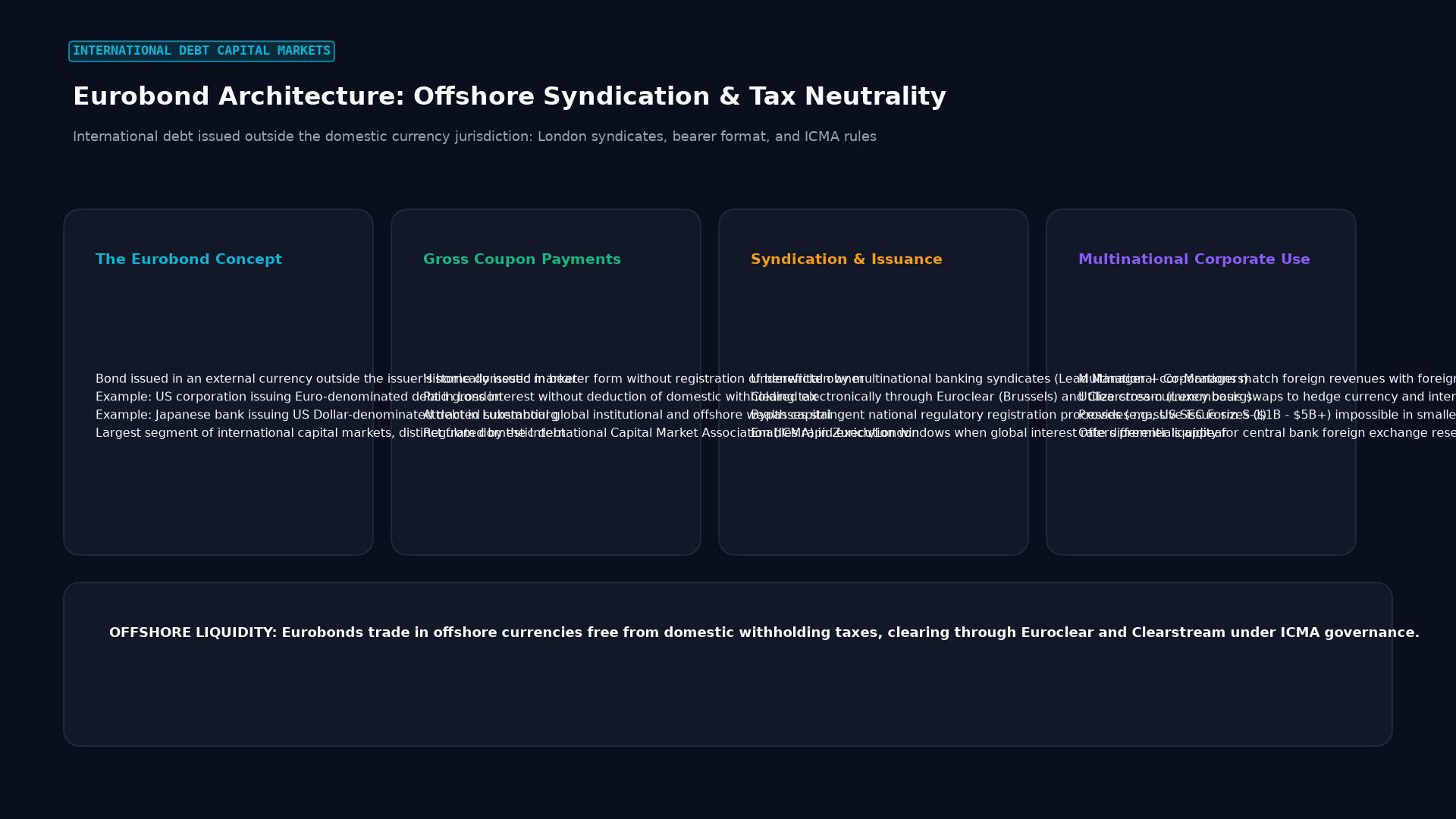 Figure: International debt issued outside the domestic currency jurisdiction: London syndicates, bearer format, and ICMA rules
Key Takeaways
- Currency Independence: A Eurobond is defined by being denominated in a currency outside the issuing jurisdiction (e.g., a British corporation issuing Yen-denominated bonds in Frankfurt).
- Light Regulatory Friction: Eurobonds are typically exempt from national securities registration requirements (such as registering with the U.S. Securities and Exchange Commission - SEC), significantly lowering issuance costs and legal delays.
- Global Liquidity Access: Multinational corporations use the Eurobond market to tap deep pools of offshore institutional capital across Europe, the Middle East, and Asia.
- Clearing via Euroclear and Clearstream: Over 90% of all international Eurobonds settle and clear through the two premier European ICSDs: Euroclear (Brussels) and Clearstream (Luxembourg).
Eurobonds vs. Foreign Bonds vs. Domestic Bonds
Financial analysts distinguish Eurobonds from “Foreign Bonds” by looking at where the bond is issued and what local regulations govern it:
| Feature | Domestic Bond | Foreign Bond | Eurobond |
|---|---|---|---|
| Issuer | Domestic entity | Foreign entity | Foreign or domestic entity |
| Issuance Market | Domestic home market | Single foreign national market | Offshore international market (multiple hubs) |
| Denominated Currency | Domestic national currency | Currency of the foreign market where sold | Any external currency (USD, EUR, JPY, GBP) |
| Nicknames | US Treasuries, UK Gilts | Yankee (USA), Samurai (Japan), Bulldog (UK) | Eurodollar, Euroyen, Kangaroo Eurobond |
| Regulatory Supervision | Full domestic regulator | Strict local regulator (e.g., SEC in USA) | Self-regulated international market standards (ICMA) |
| Taxation | Domestic withholding taxes apply | Subject to host country withholding tax | Typically paid gross without withholding taxes |
Why Multinationals Issue Eurobonds
1. Speed and Low Issuance Cost
Registering a public bond offering in domestic markets (such as filing a Form S-1 with the SEC in the U.S.) requires months of legal audits, public disclosures, and high registration fees. In contrast, Eurobond issuances are structured under standard documentation established by the International Capital Market Association (ICMA) and can be brought to market in days.
2. Hedging Currency Exposure via Cross-Currency Swaps
A European company planning to build a manufacturing facility in the United States needs U.S. Dollars. Rather than borrowing expensive domestic USD bank loans, it can issue a 10-year Eurodollar bond in London. Alternatively, if investors in Europe offer cheaper borrowing costs in Euros, the firm can issue a Euro-denominated Eurobond and execute a Cross-Currency Basis Swap (CCBS) to convert the Euro cash flows into U.S. Dollars.
3. Favorable Investor Base
Eurobonds appeal to international institutional investors, pension funds, central bank reserve managers, and family offices seeking large-block liquidity, high credit ratings, and interest paid gross without local tax deductions.
The Eurobond Issuance Syndicate Process
Eurobond Underwriting Workflow:
1. Lead Manager (Bookrunner): Top investment bank structures terms, coupon, and maturity.
2. Underwriting Syndicate: International consortium of banks guarantees the bond purchase.
3. Selling Group: Brokers distribute bonds to institutional accounts worldwide.
4. Settlement: Delivered electronically against cash through Euroclear or Clearstream.
Frequently Asked Questions
Is a Eurobond always denominated in Euros?
No. In fact, the vast majority of all Eurobonds in circulation are denominated in U.S. Dollars (known as Eurodollar bonds). Eurobonds can be denominated in any convertible global currency, including Japanese Yen (Euroyen), British Pounds (Eurosterling), or Swiss Francs.
Are Eurobonds still issued as physical bearer bonds?
Historically, Eurobonds were issued as anonymous bearer bonds with physical paper coupon clippings, which offered high privacy and tax anonymity. Today, virtually all modern Eurobonds are dematerialized registered electronic book-entry securities held within Euroclear or Clearstream to comply with global anti-money laundering (AML) and tax transparency regulations.
What is the role of the International Capital Market Association (ICMA)?
The ICMA is the self-regulatory international industry association that establishes standard rules, legal recommendations, trading conventions, and settlement practices governing international cross-border Eurobond secondary markets.
Ready to trade forex?
Open a free demo account with a regulated broker. Practice with virtual funds before risking real money.