Yankee Certificate of Deposit
A negotiable, US-dollar-denominated certificate of deposit issued in the United States by the domestic branch or agency of a foreign banking organization, typically traded in large institutional denominations in the money market.
Yankee Certificate of Deposit (Yankee CD)
In wholesale banking, money market microstructure, and short-term corporate treasury management, a Yankee Certificate of Deposit (commonly termed a Yankee CD) is a negotiable, interest-bearing, short-term debt obligation denominated in US dollars and issued within the United States by the state-licensed or federally-licensed branch or agency of a foreign banking organization (FBO). Concentrated primarily among the New York financial district branches of major European, Japanese, Canadian, and Australian banking conglomerates, Yankee CDs represent a core pillar of the multi-trillion-dollar institutional money market.
Yankee CDs are issued in large institutional denominations, typically with a minimum face value of $100,000 to $1,000,000, with round-lot secondary market trading commonly occurring in blocks of $5,000,000 or more. Because they are negotiable, institutional investors can freely trade them on the secondary interdealer broker market prior to maturity. They serve as essential short-term cash management instruments for institutional prime money market mutual funds, corporate treasuries, state and municipal investment pools, and bank asset-liability management (ALM) desks seeking yield enhancement over standard domestic bank deposits and US Treasury bills.
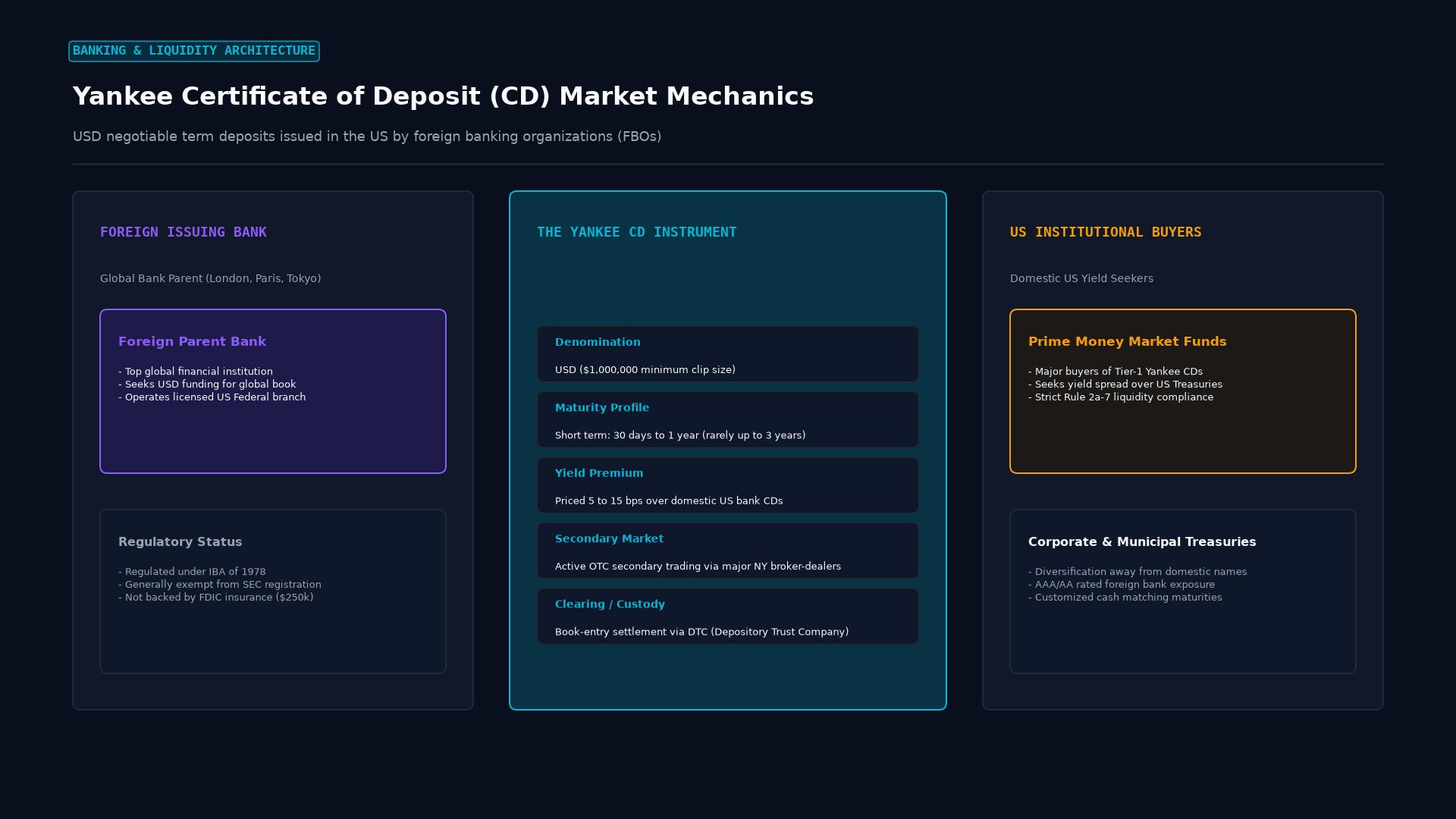 Figure: US institutional money market instrument: negotiable USD certificates of deposit issued by licensed US branches of foreign commercial banks.
Regulatory Framework and Governing Law
The legal architecture governing Yankee CDs was shaped by the evolution of international banking in the United States:
1. The International Banking Act of 1978 (IBA)
Prior to 1978, foreign bank branches operating in the US were chartered and supervised exclusively at the individual state level (predominantly by the New York State Department of Financial Services, NYSDFS), enjoying certain regulatory advantages over domestic US commercial banks. The International Banking Act of 1978 established federal parity:
- Foreign bank branches were brought under the direct regulatory umbrella of the Federal Reserve Board.
- FBO branches became subject to Federal Reserve Regulation D reserve requirements and supervisory examinations.
2. FDIC Insurance Exemption and Negotiable Status
Unlike retail certificates of deposit held by individual bank consumers, Yankee CDs are not insured by the Federal Deposit Insurance Corporation (FDIC):
- FBO branches operating in the wholesale money market are designated as wholesale, uninsured entities.
- Because they carry zero FDIC coverage, institutional investors evaluate them strictly based on the standalone credit rating and financial strength of the issuing foreign parent bank.
- Negotiability is governed under Article 3 of the Uniform Commercial Code (UCC), allowing the holder in due course to transfer title cleanly through book-entry delivery at the Depository Trust Company (DTC).
Technical Characteristics and Market Conventions
Yankee CDs share specific operational mechanics tailored to institutional money market desks:
1. Tenors and Maturity Structure
The vast majority of Yankee CDs feature short maturities:
- Standard Tenors: 30 days, 60 days, 90 days, 180 days, and 270 days.
- Under US banking regulations, bank certificates of deposit carry a statutory minimum maturity of 7 days.
- While maturities can technically extend up to five years, secondary liquidity drops dramatically for tenors beyond one year.
2. Pricing and Yield Conventions
Yankee CDs can be issued on a fixed-rate or floating-rate basis:
- Fixed-Rate Yankee CDs: Quote an annualized coupon interest rate based on an Actual/360 day-count convention, standard across US domestic money markets: $$\text{Interest Payable at Maturity} = \text{Principal} \times \text{Coupon Rate} \times \left(\frac{\text{Actual Days}}{360}\right)$$ $$\text{Maturity Value} = \text{Principal} + \text{Interest Payable}$$
- Floating-Rate Yankee CDs: Coupon rates reset periodically (e.g., monthly or quarterly) pegged to a benchmark reference index, historically USD LIBOR and modernized to the Secured Overnight Financing Rate (SOFR) plus an agreed credit spread (e.g., SOFR + 25 bps).
+------------------------------------------------------------------------+
|          Comparison: Yankee CD vs. Domestic CD vs. Eurodollar CD       |
+------------------------------------------------------------------------+
| Feature / Dimension      | Yankee CD          | Domestic US Bank CD| Eurodollar CD      |
| Issuing Bank Entity      | US Branch of FBO   | US Domestic Bank   | Offshore Bank Branch|
| Geographic Issuance      | United States (NY) | United States      | London, Zurich, Lux|
| Governing Legal Regime   | US Law / Fed Reg D | US Federal / State | English / Local Law|
| Primary Clearing Depot   | DTC (New York)     | DTC (New York)     | Euroclear / Clearstr|
| Typical Denomination     | $1,000,000+        | $100k - $250k+     | $1,000,000+        |
| FDIC Insurance           | Uninsured          | Insured to $250k   | Completely Uninsured|
+------------------------------------------------------------------------+
Why Institutional Investors and Issuers Rely on Yankee CDs
The Yankee CD market fulfills vital complementary functions for both foreign banking organizations and US institutional cash managers:
1. For Foreign Banks: Access to Onshore US Dollar Liquidity
Foreign multinational banks (such as Deutsche Bank, Mitsubishi UFJ, Barclays, or Santander) maintain massive global balance sheets with large US dollar asset books (loans to multinational corporations, global trade finance facilities, and dollar project finance). By issuing Yankee CDs directly out of their New York branches:
- They tap onshore US institutional liquidity directly without having to convert domestic currencies in the volatile foreign exchange swap market.
- They diversify their short-term funding base away from European or Asian wholesale deposits.
2. For Institutional Investors: The “Yankee Yield Premium”
Institutional prime money market funds and corporate cash treasuries frequently face tight yield environments where Treasury bills yield the risk-free rate. Because Yankee CDs represent foreign bank credit obligations and carry zero FDIC insurance:
- They trade at a yield premium (spread) of 5 to 35 basis points over equivalent domestic commercial bank CDs and Treasury bills.
- For a multi-billion-dollar money market fund, capturing an incremental 20 basis points across hundreds of millions in cash reserves represents significant annualized performance enhancement for shareholders.
Applied Investment Case Study: Institutional Cash Portfolio Allocation
Consider Pacific Institutional Prime Reserve Fund (PIPRF), a multi-billion-dollar institutional money market mutual fund operating under SEC Rule 2a-7.
Investment Parameters and Cash Inflow
- PIPRF receives a $50,000,000 corporate cash deposit from a corporate technology client on March 1, which must be invested for exactly 90 days.
- Regulatory Mandates under SEC Rule 2a-7: Maximum weighted average maturity (WAM) constraints, high tier-1 credit rating requirements (A-1/P-1 short-term rating), and stringent daily/weekly liquidity minimums.
Market Opportunity Comparison (90-Day Tenors)
- 90-Day US Treasury Bill: Yield = 5.15%. Total Interest = $643,750.
- 90-Day Domestic Top-Tier US Bank CD (JPMorgan): Yield = 5.30%. Total Interest = $662,500.
- 90-Day Yankee CD (Toronto-Dominion Bank, NY Branch - Rated A-1+/P-1): Yield = 5.45%. Total Interest Calculation: $$\text{Interest} = $50,000,000 \times 0.0545 \times \left(\frac{90}{360}\right) = $50,000,000 \times 0.013625 = $681,250$$
+------------------------------------------------------------------------+
|          90-Day Investment Yield Comparison on $50,000,000             |
+------------------------------------------------------------------------+
| Asset Class            | Quoted Yield | Total Dollar Interest | Spread vs T-Bill |
| US Treasury Bill       | 5.15%        | $643,750              | Baseline (0 bps) |
| Domestic Bank CD       | 5.30%        | $662,500              | +15 bps          |
| Yankee CD (TD Bank NY) | 5.45%        | $681,250              | +30 bps          |
+------------------------------------------------------------------------+
Strategic Allocation Decision
PIPRF executes the purchase of the $50,000,000 Toronto-Dominion Bank New York Branch Yankee CD. The portfolio manager captures an additional $37,500 in clean net cash yield over the 90-day holding period compared to Treasuries, while remaining fully compliant with Rule 2a-7 credit quality and liquidity guidelines.
Frequently Asked Questions
Are Yankee CDs protected by the FDIC?
No. Yankee certificates of deposit issued by the wholesale branches or agencies of foreign banking organizations are not covered by FDIC insurance. Because they are designed exclusively for sophisticated corporate treasuries, pension funds, and institutional money market managers purchasing multi-million-dollar blocks, investors rely entirely on the creditworthiness, balance sheet strength, and regulatory standing of the foreign parent banking group.
Can an individual retail investor purchase a Yankee CD?
While there is no legal prohibition preventing an individual from owning a Yankee CD, practical market barriers make them inaccessible to ordinary retail investors. Yankee CDs are issued in institutional round-lots (minimum $100,000, typically $1,000,000+) and are traded through specialized institutional money market interdealer broker networks rather than retail brokerage order books. Retail investors access Yankee CDs indirectly by holding shares in institutional prime money market funds.
What is the difference between a Yankee CD and a Yankee Bond?
The primary difference lies in maturity and market structure: a Yankee CD is a short-term money market instrument with a maturity typically ranging from 30 days to one year, issued by the US branch of a foreign bank to fund short-term dollar liquidity. A Yankee Bond is a long-term debt capital market security with maturities spanning 5 to 30+ years, issued by foreign corporations, banks, or sovereign governments to finance long-term capital investments.
Ready to trade forex?
Open a free demo account with a regulated broker. Practice with virtual funds before risking real money.