Yield to Call - YTC
The annualized rate of return earned on a callable bond assuming the issuer exercises its redemption option on the earliest scheduled call date at the specified call price.
Yield to Call (YTC)
In fixed-income mathematics, bond portfolio management, and corporate debt underwriting, Yield to Call (commonly abbreviated as YTC) is the theoretical annualized internal rate of return (IRR) earned by an investor who purchases a callable bond at its current market price and holds it until its earliest scheduled call date, assuming the issuing corporation or municipality exercises its contractual right to redeem the debt early at the predetermined call price.
Callable bonds grant the issuer an embedded American or European call option. When market interest rates decline below a bond’s stated coupon rate, corporate treasurers have a strong economic incentive to “call” (retire) the existing high-interest debt and reissue replacement debt at lower prevailing rates (a process termed debt refunding). Consequently, when a callable bond trades at a market premium above its face value, Yield to Call replaces Yield to Maturity (YTM) as the primary realistic benchmark metric for evaluating expected investor returns.
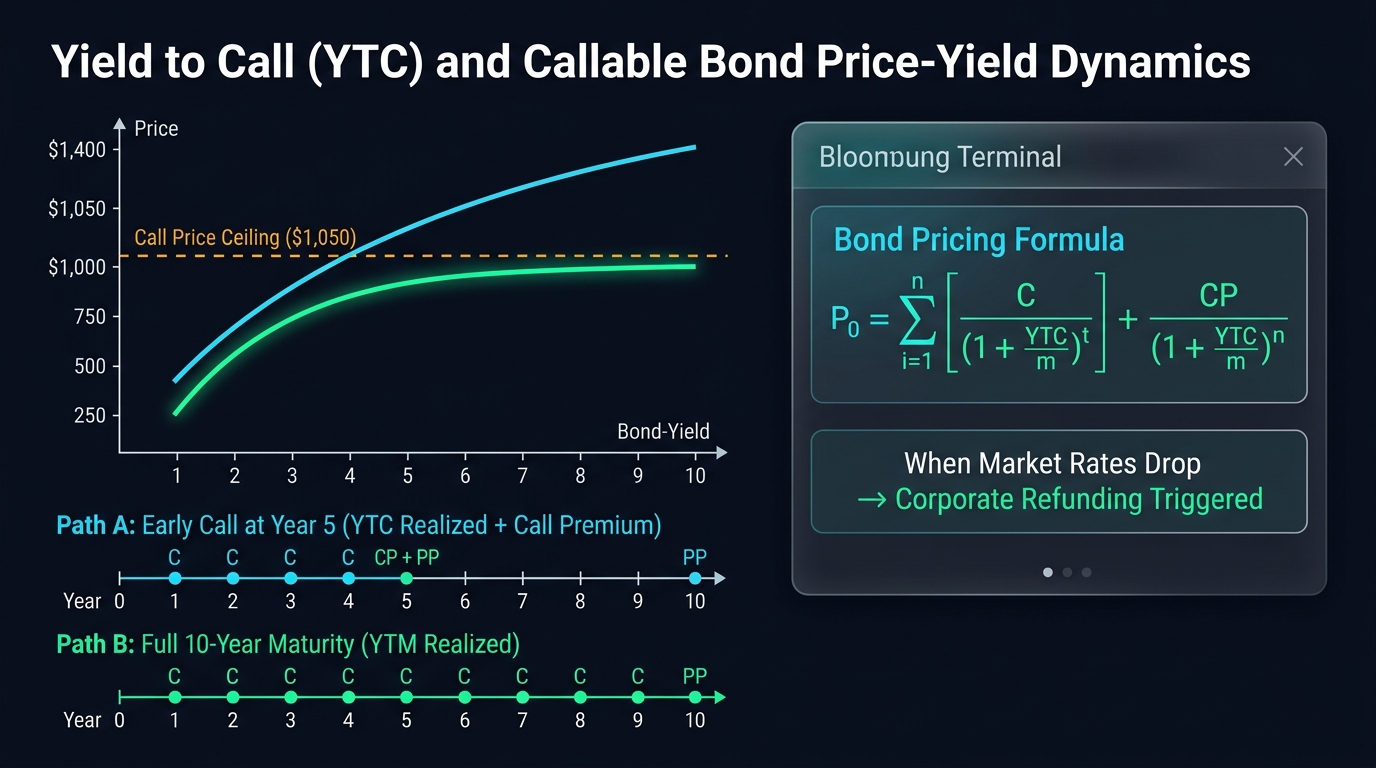
       +-------------------------------------------------------------+
       |             Cash Flow Timeline of a Callable Bond           |
       +-------------------------------------------------------------+
                                      |
            +-------------------------+-------------------------+
            |                                                   |
            v                                                   v
+-------------------------+                         +-------------------------+
| Path A: Bond is Called  |                         | Path B: Held to Maturity|
| (Yield to Call - YTC)   |                         | (Yield to Maturity - YTM)|
+------------+------------+                         +------------+------------+
| - Periodic Coupon Cash  |                         | - Periodic Coupon Cash  |
| - Call Date: Year 5     |                         | - Maturity: Year 10     |
| - Payoff: Call Price    |                         | - Payoff: Par Value     |
|   (e.g., $1,020)        |                         |   ($1,000)              |
+------------+------------+                         +------------+------------+
             |                                                   |
             +-------------------------+-------------------------+
                                       v
                   +---------------------------------------+
                   |  Bond Valuation Decision:             |
                   |  If Interest Rates Fall:              |
                   |  Issuer Calls Bond -> YTC Realized    |
                   |  If Interest Rates Rise:              |
                   |  Issuer Leaves Debt -> YTM Realized   |
                   +---------------------------------------+
Mathematical Formulation of Yield to Call
The calculation of Yield to Call solves for the discount rate that equates the current clean market price of the bond to the present value of its future scheduled cash flows up to the call date:
1. The Core Valuation Formula
$$P_0 = \sum_{t=1}^{n} \frac{C}{\left(1 + \frac{YTC}{m}\right)^t} + \frac{CP}{\left(1 + \frac{YTC}{m}\right)^n}$$
Where:
- $P_0$: Current clean market price of the bond (including any applicable purchase premium or discount).
- $C$: Contractual periodic coupon payment ($C = \frac{\text{Annual Coupon Rate} \times \text{Par Value}}{m}$).
- $m$: Compounding frequency per year (typically $m=2$ for semi-annual corporate and municipal bonds).
- $n$: Total number of coupon periods remaining until the designated call date ($n = \text{Years to Call} \times m$).
- $CP$: The contractual Call Price paid by the issuer to redeem the bond (often par plus a call premium, e.g., $1,020 or $1,050).
- $YTC$: The annualized Yield to Call solved via numerical iteration or financial calculator polynomial algorithms.
2. Approximate Yield to Call Formula
For quick estimations without financial software, analysts utilize the following approximation: $$YTC_{\text{approx}} \approx \frac{C + \left(\frac{CP - P_0}{n_{\text{years}}}\right)}{\frac{CP + P_0}{2}}$$
Structural Features of Callable Bonds
Callable debt instruments incorporate specific contractual covenants detailed in the bond indenture:
1. Call Protection Period (Deferred Call)
Most callable bonds include a period of call protection (typically 3 to 5 years following initial issuance) during which the issuer is legally prohibited from calling the bond, guaranteeing the investor a minimum window of uninterrupted high-coupon cash flow.
2. Call Premiums
To compensate bondholders for the inconvenience of having their debt redeemed early, issuers establish a call premium above the $1,000 par face value. Call schedules are often stepped downward over time:
- Call in Year 5: $1,040 (4% premium).
- Call in Year 6: $1,030 (3% premium).
- Call in Year 7: $1,020 (2% premium).
- Call in Year 8 onwards: $1,000 (Par call).
3. Make-Whole Call Provisions
Modern investment-grade corporate bonds frequently feature a make-whole call:
- Rather than redeeming the bond at a fixed lump sum (like $1,020), the issuer must pay a redemption price equal to the present value of all remaining future coupons and principal, discounted at a tight spread (e.g., Treasury yield + 15 bps).
- Because make-whole calls make early redemption expensive for the issuer, they provide bondholders with full market value protection.
+------------------------------------------------------------------------+
|          Comparison: Yield to Call (YTC) vs. Yield to Maturity (YTM)   |
+------------------------------------------------------------------------+
| Dimension                | Yield to Call (YTC)        | Yield to Maturity (YTM)    |
| Evaluation Horizon       | Earliest scheduled call date| Final legal maturity date |
| Terminal Cash Flow       | Contractual Call Price (CP)| Face Value at Par ($1,000) |
| Dominant Pricing State   | Premium bonds (Price > Par)| Discount bonds (Price < Par)|
| Driver of Realization    | Declining interest rates   | Rising interest rates      |
| Risk Highlighted         | Reinvestment risk          | Duration & default risk    |
+------------------------------------------------------------------------+
The Asymmetry of Negative Convexity
Standard non-callable bonds exhibit positive convexity: as market interest rates decline, bond prices rise at an accelerating rate. Callable bonds, however, exhibit negative convexity as prices approach the call price:
Bond Price ($)
  ^
  |                     Non-Callable Bond (Positive Convexity)
  |                   .-'
  |                .-'
  |             .-'   Callable Bond (Compression Ceiling at Call Price)
  |          .-'     .------------------------- [Call Price Limit]
  |       .-'    _.-'
  |    .-'   _.-'
  | .-'  _.-'   <-- Zone of Negative Convexity
  |' _.-'
  +-----------------------------------------------------------> Falling Rates
Price Compression (The Call Ceiling)
When market interest rates drop, the price appreciation of a callable bond hits a natural ceiling around its call price. Investors will not pay $1,150 for a bond if the issuer can redeem it tomorrow for $1,020. This dynamic limits capital appreciation for bondholders while leaving them fully exposed to downside capital loss if rates surge, creating an asymmetric risk profile.
Applied Valuation Case Study: Corporate Callable Bond
Consider an institutional fixed-income investor evaluating a callable corporate bond issued by Delta Industrial Holdings:
Bond Specifications
- Par Value: $1,000.
- Coupon Rate: 7.00% (Paid semi-annually: $35.00 every 6 months).
- Legal Maturity: 10 Years (20 semi-annual periods).
- Call Provision: Callable in 5 Years (10 semi-annual periods) at a call price of $1,030.
- Current Market Price ($P_0$): $1,080 (Trading at a premium due to falling benchmark interest rates).
Step 1: Calculate Yield to Maturity (YTM)
Using financial iteration for a 10-year holding period: $$1,080 = \sum_{t=1}^{20} \frac{35}{\left(1 + \frac{YTM}{2}\right)^t} + \frac{1,000}{\left(1 + \frac{YTM}{2}\right)^{20}}$$ $$\mathbf{YTM \approx 5.92% \text{ annualized}}$$
Step 2: Calculate Yield to Call (YTC)
Evaluating cash flows over the 5-year window up to the $1,030 call price: $$1,080 = \sum_{t=1}^{10} \frac{35}{\left(1 + \frac{YTC}{2}\right)^t} + \frac{1,030}{\left(1 + \frac{YTC}{2}\right)^{10}}$$ $$\mathbf{YTC \approx 5.56% \text{ annualized}}$$
Analytical Conclusion
Because the bond trades at a premium ($1,080), YTC (5.56%) is lower than YTM (5.92%). If market interest rates remain low, the issuer will logically call the bond in Year 5 to refinance at cheaper rates. The realistic expected return for the investor is the 5.56% Yield to Call, which also represents the bond’s Yield to Worst (YTW).
Frequently Asked Questions
Why does a bond’s Yield to Call matter more than its Yield to Maturity when trading at a premium?
When a bond trades at a substantial premium above par, it indicates that prevailing market interest rates have dropped well below the bond’s stated coupon rate. In this scenario, it is economically rational for the corporate issuer to call the bond early to refinance debt at lower interest costs. Assuming the bond will survive to maturity misleads the investor, whereas YTC calculates the true return assuming early redemption.
What is reinvestment risk for a callable bondholder?
Reinvestment risk occurs when an issuer calls a high-yielding bond during a low-interest-rate environment. The investor receives their principal back, but must now reinvest that capital into new bonds offering substantially lower prevailing market yields, permanently lowering the portfolio’s cash income.
What happens to YTC if market interest rates rise significantly?
If market interest rates rise above the bond’s coupon rate, the market price of the bond will decline below par (trading at a discount). In this environment, the issuer has zero economic incentive to call the bond, as refinancing would require paying higher rates. The call option becomes out-of-the-money, the probability of early redemption drops toward zero, and the bond’s valuation transitions from Yield to Call to Yield to Maturity (YTM).
Ready to trade forex?
Open a free demo account with a regulated broker. Practice with virtual funds before risking real money.