Yield to Worst - YTW
The lowest potential annualized rate of return that can be received on a bond with embedded options without the issuer defaulting, calculated by evaluating all possible redemption dates, including call dates, put dates, and final maturity.
Yield to Worst (YTW)
In fixed-income portfolio management, institutional debt trading, and wealth management, Yield to Worst (commonly abbreviated as YTW) is the definitive conservative yield metric for evaluating bonds that contain embedded options, such as call provisions, put options, sinking funds, or multi-tiered prepayment schedules. YTW calculates the absolute lowest theoretical annualized return an investor can realize across all possible contractual redemption scenarios, excluding issuer insolvency or credit default.
By evaluating the yield generated across every scheduled call date alongside final maturity, YTW prevents investors from falling into the psychological trap of relying on an unrealistically high Yield to Maturity (YTM) for bonds trading at a market premium. For institutional bond funds, Bloomberg fixed-income benchmark indices, and corporate wealth advisers, YTW represents the mandatory regulatory standard for disclosing portfolio yield expectations to clients.
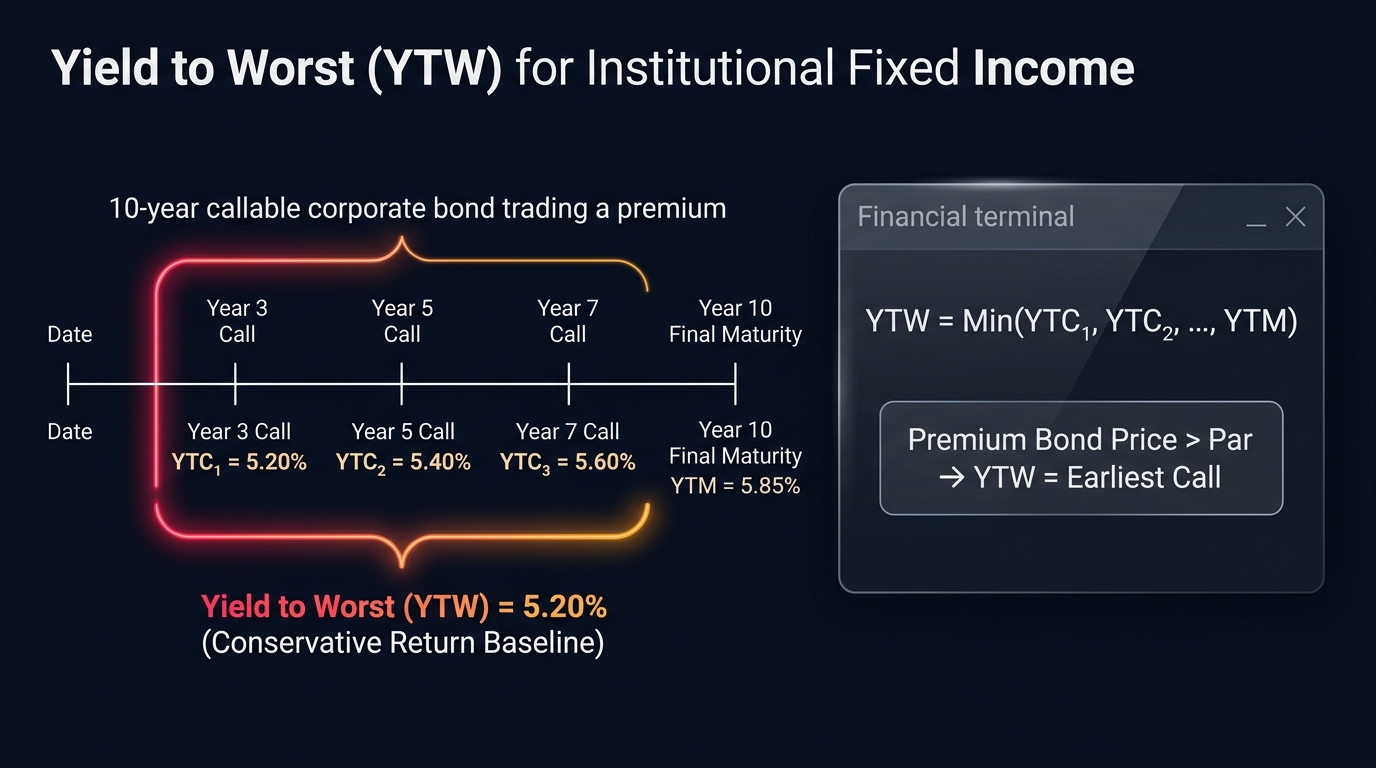
       +-------------------------------------------------------------+
       |             The Yield to Worst Evaluation Matrix            |
       +-------------------------------------------------------------+
                                      |
            +-------------------------+-------------------------+
            |                                                   |
            v                                                   v
+-------------------------+                         +-------------------------+
| Evaluate All Call Dates |                         | Final Legal Maturity    |
| - Call Date 1 (Year 3)  |                         | - 10-Year Final Mat.    |
|   -> YTC_1 = 5.20%      |                         |   -> YTM = 5.85%        |
| - Call Date 2 (Year 5)  |                         +------------+------------+
|   -> YTC_2 = 5.40%      |                                      |
| - Call Date 3 (Year 7)  |                                      |
|   -> YTC_3 = 5.60%      |                                      |
+------------+------------+                                      |
             |                                                   |
             +-------------------------+-------------------------+
                                       v
                   +---------------------------------------+
                   |  Yield to Worst (YTW) Formula:        |
                   |  YTW = Min( YTC_1, YTC_2, ..., YTM )  |
                   |  YTW = Min( 5.20%, 5.40%, ..., 5.85% )|
                   |  YTW = 5.20% (Conservative Baseline)  |
                   +---------------------------------------+
Mathematical Formulation and Algorithmic Determination
Yield to Worst is not determined by a single closed-form mathematical equation. Instead, it is an algorithmic minimum search that calculates the internal rate of return (IRR) across all contractually permissible redemption dates:
1. The Core Algorithmic Definition
$$\text{Yield to Worst (YTW)} = \min \left( YTM, YTC_1, YTC_2, \dots, YTC_k, YTP_1, \dots, YTP_j \right)$$
Where:
- $YTM$: Standard Yield to Maturity evaluated to the final legal maturity date.
- $YTC_k$: Yield to Call calculated for each specific scheduled call date $k$, using the corresponding contractual call price ($CP_k$).
- $YTP_j$: Yield to Put calculated for any embedded put options allowing the bondholder to force early redemption at put price $PP_j$.
2. General Pricing Rule: Premium vs. Discount Bonds
- For Bonds Trading at a Premium ($P_0 > \text{Par}$): Prevailing interest rates have dropped below the coupon rate. The corporate issuer has an economic incentive to refinance. In the vast majority of cases, Yield to Call is lower than Yield to Maturity, meaning: $$\text{If } P_0 > \text{Par} \implies YTW = YTC_{\text{earliest}}$$
- For Bonds Trading at a Discount ($P_0 < \text{Par}$): Prevailing interest rates have risen above the coupon rate. The issuer will not call the bond early because refinancing would require paying higher borrowing costs. Therefore: $$\text{If } P_0 < \text{Par} \implies YTW = YTM$$
+------------------------------------------------------------------------+
|          Behavior of Yield to Worst Across Bond Pricing States         |
+------------------------------------------------------------------------+
| Pricing Environment  | Primary Economic Incentive | YTW Equivalence    |
| **Premium Bond**     | Issuer calls early to refi | **YTW = YTC**      |
| **Par Bond**         | Indifferent / Neutral      | **YTW = YTM = YTC**|
| **Discount Bond**    | Issuer leaves debt alive   | **YTW = YTM**      |
+------------------------------------------------------------------------+
Why Yield to Worst is Essential for Institutional Fixed-Income
Institutional investors and regulatory bodies mandate YTW reporting to eliminate systematic portfolio return distortions:
1. Eliminating Marketing Deception in Bond Funds
Prior to strict YTW reporting rules, mutual fund marketing materials frequently advertised the Yield to Maturity of high-coupon callable corporate bonds to attract retail income investors. For example, advertising an 8.0% YTM on a bond trading at $1,150 misled investors, because the issuer would inevitably call the bond at $1,020 in year two, generating an actual annualized return of only 3.5%. YTW enforces truth-in-advertising by mandating disclosure of the conservative 3.5% figure.
2. Asset-Liability Matching (ALM) for Pension Funds and Insurers
Life insurance companies and public pension funds must match incoming bond cash flows against multi-decade policyholder obligations:
- If an ALM desk assumes a 30-year bond will pay coupons for three decades, but the bond is called after 5 years, the fund experiences a massive duration collapse and cash reinvestment shortfall.
- Utilizing YTW and effective duration to the worst date ensures institutional balance sheets do not over-estimate future interest earnings.
3. Benchmark Index Construction (Bloomberg US Aggregate)
Major fixed-income indices (such as the Bloomberg US Aggregate Index, Bloomberg US Corporate High Yield Index, and ICE BofA Global Corporate Index) utilize YTW as the universal standard for calculating index-level yields whenever constituent debt securities carry embedded call or put options.
Applied Calculation Case Study: Multi-Call High-Yield Corporate Note
Consider Apex Energy Partners (AEP), which issued a high-yield corporate bond during a higher interest rate environment. An institutional credit analyst is evaluating the bond today:
Bond Covenants and Market Data
- Par Value: $1,000.
- Annual Coupon Rate: 8.50% (Paid semi-annually: $C = $42.50$ every 6 months).
- Legal Maturity: 10 Years from today (20 semi-annual periods).
- Embedded Call Schedule:
- Call 1 (in 2 Years / 4 periods): Callable at $1,042.50 (Par + 1 year coupon half).
- Call 2 (in 4 Years / 8 periods): Callable at $1,021.25 (Par + half year coupon half).
- Call 3 (in 6 Years / 12 periods): Callable at $1,000.00 (Par call).
- Current Clean Market Price ($P_0$): $1,095.00 (Trading at a significant premium).
Step 1: Calculate Yields Across All Scenarios
Using financial discounted cash flow iteration:
- Yield to Maturity (10 Years to Par $1,000): $$1,095 = \sum_{t=1}^{20} \frac{42.50}{\left(1 + \frac{YTM}{2}\right)^t} + \frac{1,000}{\left(1 + \frac{YTM}{2}\right)^{20}} \implies \mathbf{YTM = 7.12%}$$
- Yield to Call 1 (2 Years to Call Price $1,042.50): $$1,095 = \sum_{t=1}^{4} \frac{42.50}{\left(1 + \frac{YTC_1}{2}\right)^t} + \frac{1,042.50}{\left(1 + \frac{YTC_1}{2}\right)^4} \implies \mathbf{YTC_1 = 5.62%}$$
- Yield to Call 2 (4 Years to Call Price $1,021.25): $$1,095 = \sum_{t=1}^{8} \frac{42.50}{\left(1 + \frac{YTC_2}{2}\right)^t} + \frac{1,021.25}{\left(1 + \frac{YTC_2}{2}\right)^8} \implies \mathbf{YTC_2 = 6.28%}$$
- Yield to Call 3 (6 Years to Call Price $1,000.00): $$1,095 = \sum_{t=1}^{12} \frac{42.50}{\left(1 + \frac{YTC_3}{2}\right)^t} + \frac{1,000}{\left(1 + \frac{YTC_3}{2}\right)^{12}} \implies \mathbf{YTC_3 = 6.54%}$$
+------------------------------------------------------------------------+
|               Apex Energy Bond Scenario Yield Schedule                 |
+------------------------------------------------------------------------+
| Scenario Date         | Horizon (Years) | Redemption Price | Calculated Yield |
| Call Date 1 (Year 2)  | 2 Years         | $1,042.50        | **5.62% (YTW)**  |
| Call Date 2 (Year 4)  | 4 Years         | $1,021.25        | 6.28%            |
| Call Date 3 (Year 6)  | 6 Years         | $1,000.00        | 6.54%            |
| Final Maturity (Yr 10)| 10 Years        | $1,000.00        | 7.12% (YTM)      |
+------------------------------------------------------------------------+
Institutional Conclusion
$$\text{Yield to Worst (YTW)} = \min(5.62%, 6.28%, 6.54%, 7.12%) = \mathbf{5.62%}$$ The institutional credit manager records the expected baseline yield on this investment as 5.62%, completely ignoring the headline 7.12% YTM. If interest rates remain supportive, Apex Energy will call the debt at Year 2, and the investor will realize 5.62%.
Frequently Asked Questions
Does Yield to Worst account for the risk of corporate default?
No. Yield to Worst calculates the minimum annualized return under the assumption that the issuing corporation or municipality honors all contractual legal commitments. It does not model credit default, bankruptcy restructuring, or principal recovery hair-cuts. Investors must evaluate credit risk separately via credit ratings, credit default swap (CDS) spreads, and fundamental balance sheet solvency analysis.
Can Yield to Worst ever be higher than Yield to Maturity?
No. By mathematical definition, Yield to Worst is the minimum value across all possible redemption outcomes, including YTM ($\text{YTW} \le \text{YTM}$). YTW can be equal to YTM (as is standard for non-callable bonds or bonds trading at a discount), but it can never exceed YTM.
What is the relationship between Yield to Worst and Effective Duration?
When a bond’s YTW is driven by a call date (YTW = YTC), fixed-income risk engines calculate the bond’s interest rate sensitivity (Effective Duration) to that specific call date rather than to final legal maturity. This phenomenon, known as duration compression, means a 30-year callable bond trading at a premium may exhibit the interest rate price sensitivity of a short-term 3-year note.
Ready to trade forex?
Open a free demo account with a regulated broker. Practice with virtual funds before risking real money.