Z-Tranche
An accretion or zero-coupon tranche within a collateralized mortgage obligation (CMO) that receives neither cash interest nor principal payments until all preceding sequential tranches are fully retired, with accrued interest capitalizing into the principal balance.
What Is a Z-Tranche?
A Z-tranche, also known as an accretion bond, accrual bond, or zero-coupon tranche, is a specialized class of debt within a collateralized mortgage obligation (CMO) structure. Unlike conventional mortgage-backed security classes that distribute monthly interest payments to investors, a Z-tranche receives zero cash interest and zero principal repayments throughout its initial holding period.
During this accrual phase, the contractual coupon interest that would normally be disbursed in cash is instead accreted (added directly to the bond’s outstanding face principal balance). The underlying cash interest that is withheld from the Z-tranche is redirected by the mortgage trust waterfall to accelerate the amortization and early retirement of senior sequential-pay tranches (such as Tranches A, B, and C).
Once all senior sequential classes are completely paid off, the Z-tranche transitions into its payout phase. At this juncture, the Z-tranche investor begins collecting both regular cash coupon payments based on the newly expanded principal balance, as well as rapid principal repayments until the entire accreted balance is extinguished.
Because of this delayed cash flow structure, Z-tranches exhibit exceptionally long effective durations, pronounced price volatility, and heightened sensitivity to interest rate movements and underlying mortgage prepayment speeds.
Cash Flow Waterfall and Structural Mechanics
In a typical multi-tranche CMO backed by agency mortgage pools (such as Fannie Mae, Freddie Mac, or Ginnie Mae pass-throughs), cash flow allocations follow a strict hierarchical waterfall. The structural behavior of the Z-tranche divides into two distinct operational phases:
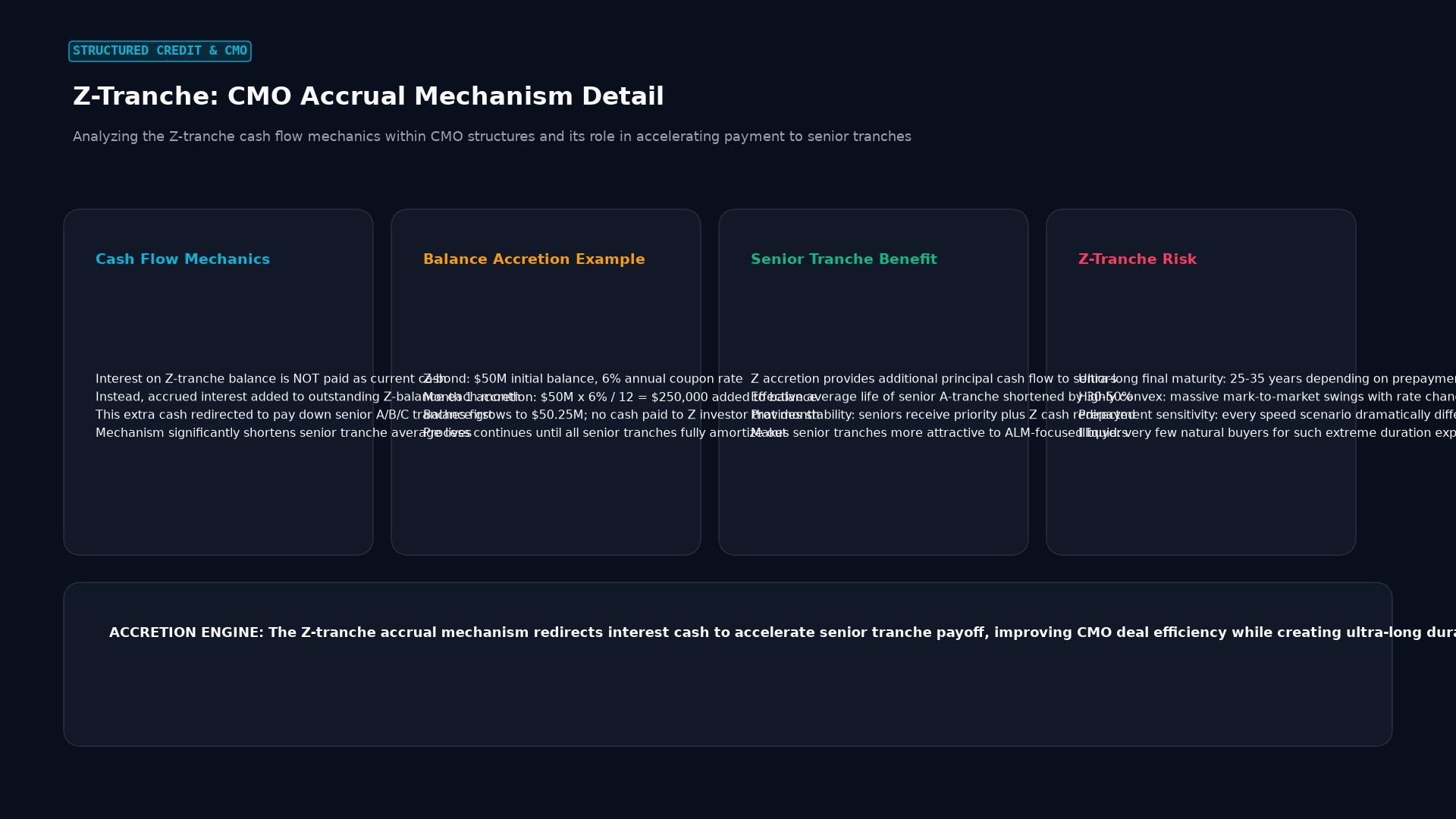 Figure: Analyzing the Z-tranche cash flow mechanics within CMO structures and its role in accelerating payment to senior tranches
Phase 1: The Accrual Period
- Borrowers in the collateral pool make monthly mortgage payments consisting of principal and interest.
- Tranche A receives its contractual interest and all principal collections (scheduled amortization plus unscheduled prepayments).
- The contractual coupon payment of the Z-tranche is calculated but withheld in cash.
- This withheld dollar amount is added directly to the principal balance of the Z-tranche, compounding on a monthly basis.
- The cash equivalent of this accreted interest is channeled directly to Tranche A as an additional principal redemption, shortening Tranche A’s weighted average life (WAL).
- Once Tranche A is fully retired, principal and redirected Z-interest flow to Tranche B, and subsequently to Tranche C.
Phase 2: The Amortization Period
- Once all preceding sequential tranches are liquidated, the Z-tranche enters amortization.
- The Z-tranche now commands first priority in the remaining CMO cash flow structure.
- The investor begins receiving cash interest based on the expanded principal balance.
- All incoming mortgage principal payments from the remaining collateral pool are applied exclusively to retire the Z-tranche’s principal.
                           CMO CASH FLOW WATERFALL: PAYOUT PHASE
                    (After Tranches A, B, and C Are Completely Retired)

       [Mortgage Pool Principal & Interest Collections]
                             │
                             ▼
                   [Total Available Cash]
                             │
               ┌─────────────┴─────────────┐
               ▼                           ▼
      [Cash Coupon Interest]     [Principal & Prepayments]
     (Paid on Accreted Face)    (Direct Principal Reduction)
               │                           │
               └─────────────┬─────────────┘
                             │
                             ▼
                     [Z-Tranche Investor]
                     (Full Cash Distribution)
Numerical Example of Principal Accretion
To illustrate how interest accretion accelerates senior debt retirement and magnifies the Z-tranche face value, consider a simplified three-tranche CMO structure:
- Total Collateral Pool: $100,000,000 at a fixed 6.00% gross coupon.
- Tranche A (Senior Sequential): $60,000,000 initial face, 5.50% coupon.
- Tranche B (Intermediate Sequential): $25,000,000 initial face, 5.50% coupon.
- Tranche Z (Accretion Tranche): $15,000,000 initial face, 5.50% coupon.
Year 1 Accretion Calculations:
- The annual contractual coupon owed to the Z-tranche is: $$\text{Annual Accretion} = $15,000,000 \times 5.50% = $825,000$$
- Instead of receiving $825,000 in monthly cash disbursements, the Z-tranche balance compounds. At the end of Year 1, the new Z-tranche principal balance is: $$\text{New Principal} = $15,000,000 + $825,000 = $15,825,000$$
- The $825,000 of redirected cash is transferred to Tranche A, paying down Tranche A’s principal balance over and above the regular mortgage principal collections.
- By Year 5, compounding interest raises the Z-tranche principal balance to approximately $19,604,000.
- When Tranches A and B are fully paid down at Year 7, the Z-tranche balance has accreted to roughly $21,800,000. The investor now begins receiving monthly cash coupon payments calculated on $21.8 million rather than the original $15 million investment.
Comparative Analysis: Z-Tranche vs. Other CMO Classes
CMO structures partition cash flows to meet the specific risk-return appetites of different institutional investors.
| Feature / Metric | Z-Tranche (Accretion Bond) | Sequential-Pay Class (A/B) | Planned Amortization Class (PAC) | Companion / Support Tranche |
|---|---|---|---|---|
| Initial Cash Interest | None (accrues to balance) | Paid monthly in cash | Paid monthly in cash | Paid monthly in cash |
| Initial Principal | Locked out until prior tranches retire | First priority (Tranche A) | Structured payment schedule | Absorbs prepayment shocks |
| Effective Duration | Extremely long (often 10 to 20 years) | Short to intermediate (1 to 5 years) | Stable, predictable (3 to 7 years) | Highly volatile |
| Prepayment Sensitivity | Severe extension and contraction risk | Moderate | Low (protected by PAC collar bands) | Extreme (protects the PAC tranche) |
| Target Investor Base | Pension funds, life insurers, endowments | Commercial banks, money market funds | Conservative fixed-income managers | Yield-seeking hedge funds, total return funds |
Investment Risks and Sensitivity Profile
Investing in Z-tranches involves distinct structural risks that require continuous quantitative monitoring:
1. Extension Risk in Rising Rate Environments
When prevailing interest rates rise, mortgage refinancing activity declines sharply. Homeowners retain existing mortgages, causing the Conditional Prepayment Rate (CPR) of the collateral pool to drop. Consequently, senior tranches take significantly longer to amortize. Because the Z-tranche cannot receive principal until earlier classes retire, its expected cash flows are deferred into the distant future. This extension drastically increases the bond’s effective duration, resulting in steep market price declines.
2. Contraction and Call Risk in Declining Rate Environments
When market interest rates drop substantially, mortgage borrowers refinance rapidly. Prepayment speeds surge, triggering accelerated retirement of Tranches A and B. The Z-tranche enters its amortization window far earlier than anticipated. While this rapid return of capital prevents negative price extension, it subjects the investor to severe reinvestment risk, forcing capital reallocation at prevailing low interest rates.
3. Reinvestment Risk and Cash Flow Lumps
Unlike standard coupon-bearing bonds that generate predictable monthly income streams suitable for liability matching, a Z-tranche produces zero cash flow during its formative years followed by a flood of cash payments. Institutional asset-liability committees (ALCO) must ensure this back-loaded cash profile coincides with projected future disbursements.
Structural Role of Z-Tranches in Financial Engineering
Why do investment banks and mortgage securitizers structure Z-tranches?
- Enhancing Senior Tranche Protection: By redirecting Z-tranche interest into senior principal paydowns, senior tranches (such as AAA-rated Tranche A) are paid off much faster, reducing their weighted average life and shielding them from prolonged credit or macro volatility.
- Yield Enhancement for Long-Horizon Capital: In exchange for assuming high extension risk and foregoing immediate liquidity, Z-tranche buyers earn higher nominal yields than comparable duration Treasury securities or standard agency pass-through bonds.
- Asset-Liability Matching for Long-Dated Liabilities: Defined-benefit pension funds and life insurance companies facing obligations due 15 to 30 years in the future utilize Z-tranches to lock in compounding returns without the administrative burden or reinvestment friction of deploying monthly coupon checks.
Frequently Asked Questions
Why does a Z-tranche have longer duration than standard mortgage bonds?
A Z-tranche pays no cash coupons during its accrual period, meaning 100% of its cash flows occur at later dates after prior tranches retire. In fixed-income mathematics, duration measures the weighted average time until expected cash flows are received. By postponing all cash distributions to later stages, the Z-tranche behaves like a zero-coupon bond, maximizing its duration and price sensitivity relative to benchmark interest rate shifts.
How does prepayment speed affect the accretion period of a Z-tranche?
Prepayment speed directly dictates the duration of the accrual phase. When prepayments accelerate (high CPR), senior tranches are paid down rapidly, bringing forward the date when the Z-tranche begins receiving cash. Conversely, when prepayments slow down (low CPR), senior tranches remain outstanding longer, prolonging the Z-tranche’s accrual phase and delaying cash receipts.
What is the difference between a Z-tranche and a traditional zero-coupon bond?
While both instruments make no periodic cash coupon payments during their early life, a traditional zero-coupon bond (such as a Treasury STRIP) has a fixed, guaranteed maturity date and redemption value. In contrast, a Z-tranche is backed by an amortizing pool of mortgages subject to borrower prepayments. Neither its final maturity date nor its total accreted principal is strictly fixed, exposing the investor to prepayment, extension, and contraction risks.
Ready to trade forex?
Open a free demo account with a regulated broker. Practice with virtual funds before risking real money.