Tranche
A tranche is a distinct, segmented slice of a pooled debt instrument or structured financing vehicle, partitioned by seniority, credit rating, risk exposure, and cash flow priority in a capital waterfall.
What Is a Tranche?
In structured finance and capital markets, a tranche (derived from the French word for “slice”) represents a partitioned security within a single pooled asset vehicle—such as a Collateralized Debt Obligation (CDO), Collateralized Loan Obligation (CLO), or Asset-Backed Security (ABS). Financial engineers create tranches by pooling hundreds of individual debt obligations (mortgages, corporate loans, or credit card receivables) and slicing the aggregate cash flows into discrete investment tiers.
Each tranche carries distinct parameters regarding payment priority, interest rate coupon, credit rating, and risk of default. In this structured hierarchy—known as the capital waterfall—senior tranches receive principal and interest cash flows first and carry top investment-grade ratings (AAA/Aaa). Subordinated or mezzanine tranches receive cash flows only after senior obligations are fulfilled. At the base lies the equity or “first-loss” tranche, which absorbs initial portfolio defaults in exchange for the highest prospective yields.
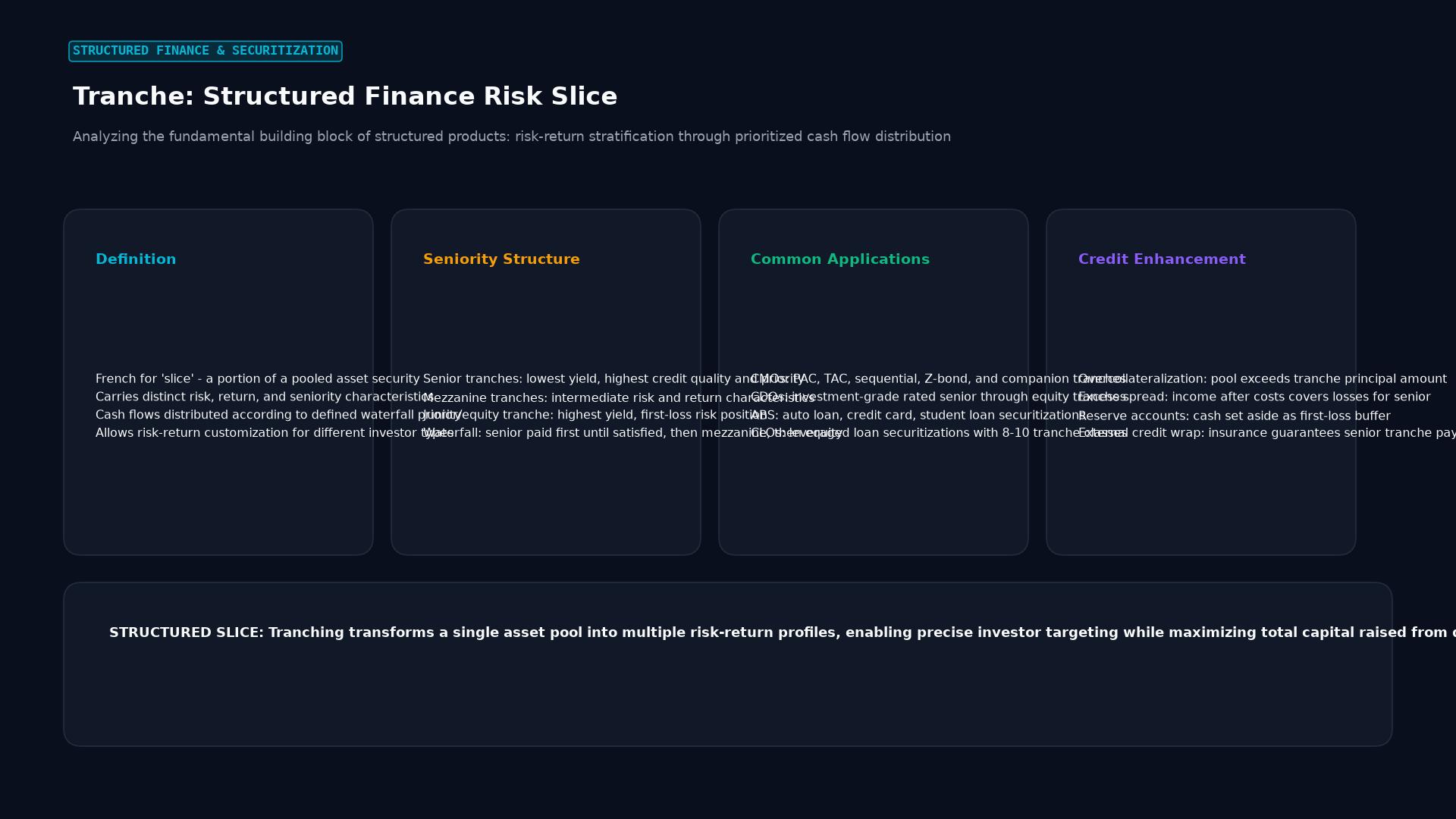 Figure: Analyzing the fundamental building block of structured products: risk-return stratification through prioritized cash flow distribution
Mathematical Formulation: Attachment & Detachment Points
The risk and return characteristics of any tranche are mathematically defined by its Attachment Point ($A$) and Detachment Point ($D$), expressed as cumulative loss percentages of the underlying collateral portfolio.
1. Tranche Loss Function
Let $L_{\text{portfolio}}$ represent the cumulative percentage loss incurred by the underlying collateral pool. The percentage loss allocated to a specific tranche $i$ with boundaries $[A_i, D_i]$ is given by:
$$L_i = \frac{\min\left( \max(0, L_{\text{portfolio}} - A_i), D_i - A_i \right)}{D_i - A_i}$$
- Zero Loss: If $L_{\text{portfolio}} \le A_i$, the tranche incurs no loss ($L_i = 0$).
- Partial Impairment: If $A_i < L_{\text{portfolio}} < D_i$, the tranche suffers partial principal write-down.
- Total Wipeout: If $L_{\text{portfolio}} \ge D_i$, the tranche suffers a $100%$ total loss of principal ($L_i = 1$).
2. Expected Loss and Credit Enhancement
The thickness of subordinate tranches situated below tranche $i$ represents its credit enhancement or subordination cushion:
$$\text{Subordination}_i = A_i$$
For example, a senior tranche with an attachment point of $20%$ ($A = 0.20$) can withstand an aggregate collateral portfolio loss of up to $20%$ before sustaining a single dollar of principal impairment.
Tranche Taxonomy Across the Capital Stack
Different tranches cater to divergent institutional risk mandates, capital adequacy requirements, and return hurdles:
| Tranche Class | Credit Rating | Primary Investor Base | Coupon Structure | Subordination Protection |
|---|---|---|---|---|
| Super Senior / Senior | AAA to AA | Central banks, sovereign wealth funds, pension funds, life insurers | Floating rate (SOFR + 100–160 bps) | High (absorbs losses only after 20%–35% default rate) |
| Mezzanine | A to BBB- | Asset managers, specialty credit funds, insurance general accounts | Floating rate (SOFR + 250–500 bps) | Moderate (protected by equity tranche; attachment 8%–15%) |
| Subordinated / Junior | BB+ to B- | High-yield funds, multi-strategy credit hedge funds | Fixed or floating (SOFR + 600–900 bps) | Low (attachment 4%–8%; vulnerable to cyclical downturns) |
| Equity / First-Loss | Unrated | CLO collateral managers, opportunistic private debt funds | Residual cash flow (Targeted IRR: 12%–18%+) | None (attachment 0%; absorbs initial defaults directly) |
Structural Mechanics: Overcollateralization & Interest Coverage
Structured vehicles enforce dynamic balance sheet tests to protect senior tranche holders during deteriorating market conditions:
- Overcollateralization (OC) Test: Requires the par value of the underlying collateral pool to exceed the aggregate par value of active debt tranches: $$\text{OC Ratio} = \frac{\text{Collateral Par Value}}{\sum \text{Par Value of Senior Tranches}} \ge \text{Target Barrier (e.g., 120%)}$$
- Interest Coverage (IC) Test: Ensures that periodic interest collections generated by performing underlying assets adequately exceed the coupon liabilities owed to senior noteholders: $$\text{IC Ratio} = \frac{\sum \text{Interest Collections}}{\sum \text{Senior Tranche Coupons Due}} \ge \text{Target Barrier (e.g., 130%)}$$
If either test fails, the capital waterfall redirects residual cash flows away from junior and equity tranches to accelerate principal amortization on senior tranches until ratios are restored.
Real-World Institutional Case Study: The 2007–2008 CDO Tranche Collapse
The financial crisis of 2007–2008 demonstrated how faulty mathematical correlations can compromise credit tranches. Wall Street investment banks created multi-billion-dollar synthetic and cash Collateralized Debt Obligations (CDOs) backed by BBB-rated subprime residential mortgage-backed securities (RMBS).
Rating agencies (Moody’s, S&P, Fitch) utilized David X. Li’s Gaussian Copula model, assuming that default correlations across geographically dispersed US regional mortgage markets were negligible ($\rho \approx 0.10$ to $0.20$). Relying on this assumption, structuring desks argued that even if local housing markets suffered idiosyncratic shocks, nationwide systemic defaults would remain bounded:
[Flawed Pre-Crisis Assumption]
Local defaults uncorrelated -> 80% of BBB mortgages repackaged into AAA CDO Tranche

[2007-2008 Nationwide Housing Crisis]
Correlation jumped to rho -> 1.0 (Systemic Subprime Contagion)
                    |
                    v
Portfolio defaults exceeded detachment points:
Subordinate Equity wiped out (0% - 5%)
Mezzanine Tranches wiped out (5% - 20%)
"AAA" Super Senior Tranches suffered 50% - 80% losses
                    |
                    v
Mass downgrades of $3+ Trillion in structured notes triggered global banking insolvencies
When nationwide house prices plummeted simultaneously in 2007, default correlation jumped toward unity. Cumulative losses rapidly breached the $20%$ detachment points of senior tranches, causing supposedly “risk-free” AAA notes to plunge to pennies on the dollar and leading to the near-collapse of AIG, Merrill Lynch, and Citigroup.
Frequently Asked Questions
What does “tranche thickness” mean in structured finance?
Tranche thickness refers to the percentage width between a tranche’s attachment point ($A$) and detachment point ($D$), calculated as $D - A$. For example, a mezzanine tranche with an attachment point of $10%$ and a detachment point of $18%$ has a thickness of $8%$. Thickness determines the absolute dollar capacity of losses the tranche can absorb before it is entirely written down.
Why do equity tranches offer double-digit returns if they have no protection?
The equity tranche represents the leveraged residual beneficiary of the structured vehicle. Because senior tranches are financed at low interest rates (e.g., SOFR + 1.25%), the spread between the higher yield earned on the collateral pool and the low financing cost of senior debt accrues entirely to the equity holders, creating substantial leveraged returns as long as defaults remain low.
Can sovereign bailouts or IMF lending facilities have tranches?
Yes. Outside of structured finance, the term “tranche” is widely used by international institutions like the International Monetary Fund (IMF) and European Stability Mechanism (ESM) to designate phased disbursement installments of rescue loans. Each tranche is released only upon the recipient government meeting predetermined fiscal reform milestones and structural austerity targets.
Ready to trade forex?
Open a free demo account with a regulated broker. Practice with virtual funds before risking real money.