Zero-Coupon Bond
A zero-coupon bond is a fixed-income debt instrument that pays no periodic interest or coupon payments, issued at a substantial discount to its face value and redeemed at full par value upon maturity.
A zero-coupon bond—frequently referred to as an “accrual bond” or “discount bond”—is a specialized fixed-income debt security that does not distribute regular interest (coupon) payments throughout its lifespan. Instead, the bond is sold to investors at a deep discount to its stated par (face) value. At maturity, the issuer redeems the security at 100% of its par value.
The investor’s financial return consists entirely of the capital gain generated as the bond’s discounted purchase price steadily converges toward its full maturity value over time. In quantitative finance, zero-coupon yields are the purest representation of interest rates across different maturities, forming the foundation of modern yield curves and derivatives pricing models.
The Mathematical Pricing Formula
The fair market value of a zero-coupon bond is computed by discounting its future face value back to the present using the investor’s required yield to maturity (YTM):
$$\text{Price} = \frac{M}{(1 + r)^n}$$
Where:
- $M$ = Maturity par value (typically $1,000).
- $r$ = Required annual yield to maturity (expressed as a decimal).
- $n$ = Number of years remaining until maturity.
A Concrete Numerical Example
Suppose an institutional pension fund purchases a 10-year zero-coupon bond with a face value of $1,000 when prevailing benchmark market interest rates sit at 5.0%:
$$\text{Price} = \frac{$1,000}{(1 + 0.05)^{10}} = \frac{$1,000}{1.62889} = \mathbf{$613.91}$$
- The investor pays $613.91 today.
- Over the next ten years, the investor receives zero cash distributions.
- At the end of Year 10, the issuer pays the full $1,000.00.
- The cumulative interest earned equals $386.09, delivering an exact compounded annual return of 5.0%.
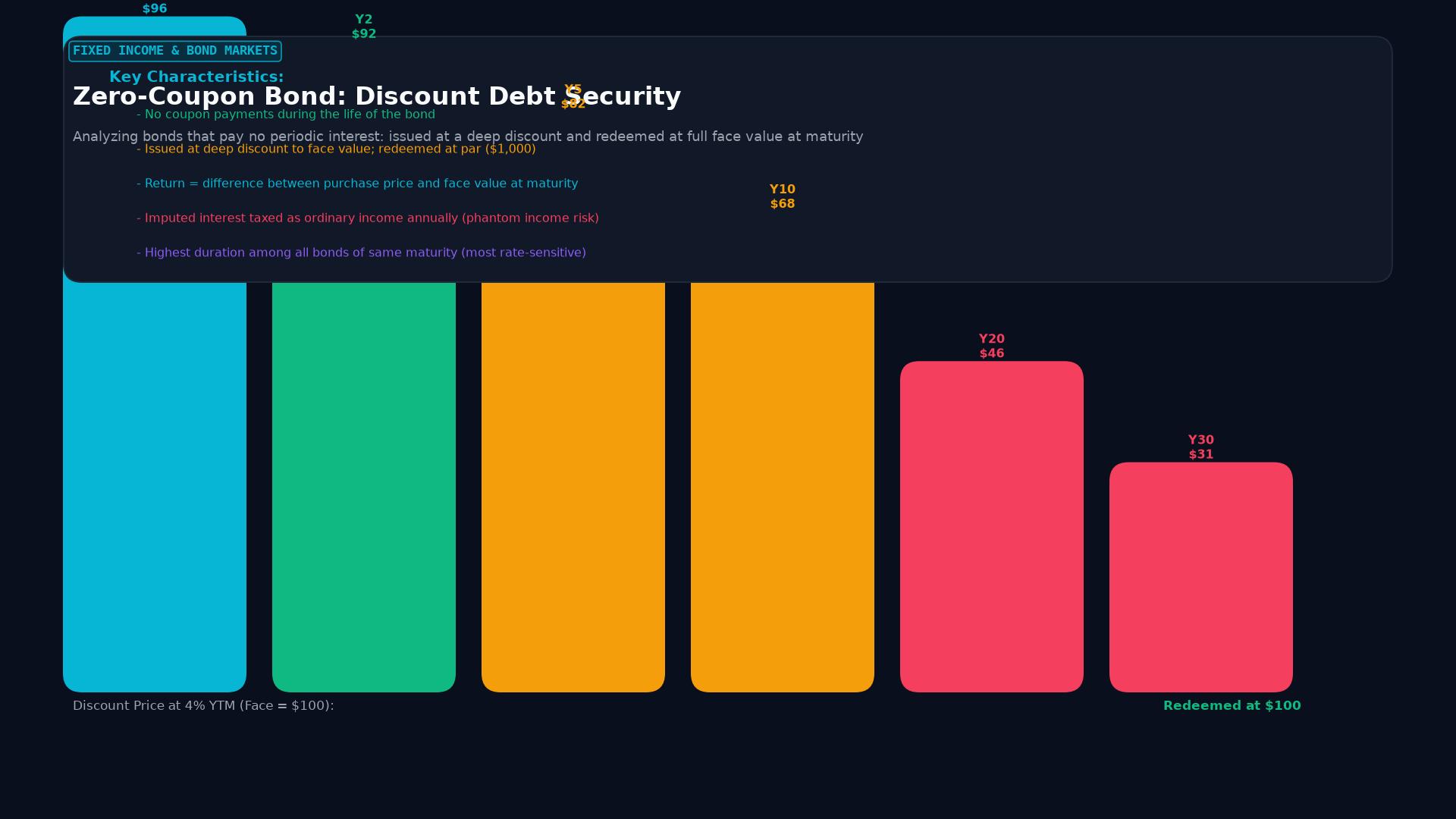 Figure: Analyzing bonds that pay no periodic interest: issued at a deep discount and redeemed at full face value at maturity
Zero Reinvestment Risk vs. Extreme Duration Volatility
Zero-coupon bonds possess unique mathematical risk characteristics compared to traditional coupon-bearing bonds:
| Characteristic | Zero-Coupon Bond | Conventional Coupon Bond |
|---|---|---|
| Cash Flow Profile | Single lump sum at maturity | Periodic semiannual interest payments + principal at maturity |
| Reinvestment Risk | Zero: Compound yield is locked in at purchase with no payments to reinvest | High: Periodic coupons must be reinvested at prevailing future interest rates |
| Macaulay Duration | Equals exact maturity (a 20-year zero has a duration of exactly 20.0 years) | Substantially less than maturity (cash flow received earlier reduces duration) |
| Price Volatility | Extreme sensitivity to interest rate fluctuations | Moderate sensitivity; ongoing coupon cash cushions price swings |
Because a zero-coupon bond pays no cash until the final maturity date, its duration equals its exact term to maturity. Consequently, when central bank interest rates fluctuate, long-dated zero-coupon bonds experience violent price swings, making them popular speculative vehicles for institutional investors betting on major interest rate cycles.
Real-World Examples: T-Bills and STRIPS
- U.S. Treasury Bills (T-Bills): Short-term debt issued by the U.S. government with maturities of 4 to 52 weeks is issued naturally as zero-coupon debt. An investor might buy a 6-month $10,000 T-bill for $9,750 and redeem it for $10,000 six months later.
- Treasury STRIPS: In the 1980s, the U.S. Treasury introduced Separate Trading of Registered Interest and Principal of Securities (STRIPS). Investment banks take a standard 30-year coupon-bearing Treasury bond and “strip” it into 61 separate securities: 60 individual semiannual coupon payments and 1 final principal payment, each trading as an independent zero-coupon bond.
Relevance to Foreign Exchange and Derivatives
Quantitative currency analysts use zero-coupon bonds to construct the zero-coupon yield curve (or spot yield curve). Unlike standard bond curves distorted by varying coupon sizes, a zero-coupon curve provides the pure, unadulterated time value of money.
This clean yield structure is required to calculate theoretical forward exchange rates via the Covered Interest Rate Parity equation:
$$F = S \times \left(\frac{1 + r_{\text{quote}}}{1 + r_{\text{base}}}\right)^T$$
Where $r_{\text{quote}}$ and $r_{\text{base}}$ are the exact zero-coupon interest rates for the respective currencies over duration $T$.
Key Takeaways
- Discount Purchase: Zero-coupon bonds pay no ongoing interest; they are bought at a discount and redeem at par value at maturity.
- Elimination of Reinvestment Risk: Investors lock in an exact compounded yield to maturity at the time of purchase, free from future interest rate uncertainty.
- High Price Sensitivity: Because their Macaulay duration equals their full maturity, zero-coupon bonds experience greater price volatility when interest rates shift than coupon bonds.
- T-Bills and STRIPS: Short-term government bills and stripped long-term treasuries are the most common real-world implementations.
- Derivatives Benchmark: The zero-coupon yield curve is the foundational input used by institutional currency desks to price forward exchange contracts and interest rate swaps.
Frequently Asked Questions
How are zero-coupon bonds taxed if they pay no annual cash interest?
In many jurisdictions (including the United States under IRS rules), investors must pay annual income tax on the “phantom income”—the imputed interest that accrues mathematically each year as the bond inches closer to par—even though no cash is received until maturity. For this reason, taxable retail investors often hold zero-coupon bonds inside tax-deferred retirement accounts (such as IRAs or 401ks).
What happens to a zero-coupon bond if interest rates decline?
When interest rates decline, existing zero-coupon bonds surge in market price with immense velocity. Because of their high duration, a small drop in benchmark rates produces massive percentage capital gains on secondary bond exchanges.
Can corporations issue zero-coupon bonds?
Yes. Corporations occasionally issue zero-coupon notes to raise capital without incurring the immediate cash-flow burden of making ongoing semiannual interest payments, deferring all debt servicing until the bond’s final maturity.
Ready to trade forex?
Open a free demo account with a regulated broker. Practice with virtual funds before risking real money.