Zero-Cost Collar
An options hedging strategy where an investor holding an underlying asset purchases an out-of-the-money protective put financed entirely by selling an out-of-the-money covered call with matching expiration, securing a downside floor at zero net premium cost.
What Is a Zero-Cost Collar?
A zero-cost collar, also termed a cashless collar or costless collar, is a multi-leg options hedging strategy designed to protect unrealized gains on an underlying asset without incurring net out-of-pocket cash expenses. The strategy is constructed by combining an existing long position in an underlying security (such as equities, foreign exchange, or commodities) with two simultaneous option trades:
- Purchasing an Out-of-the-Money (OTM) Put Option: Provides a guaranteed price floor, shielding the investor from catastrophic declines below the put strike price ($K_p$).
- Selling (Writing) an Out-of-the-Money (OTM) Call Option: Generates option premium income that offsets the cost of the protective put, establishing an upside cap at the call strike price ($K_c$).
The strike prices are calibrated so that the premium received from writing the call equals the premium paid to purchase the put ($C = P$), resulting in a net initial cash outlay of zero:
$$\text{Net Initial Premium Outlay} = P_{\text{paid}} - C_{\text{received}} = $0.00$$
In exchange for acquiring downside protection at zero initial cash cost, the investor agrees to forfeit all capital appreciation above the call strike price.
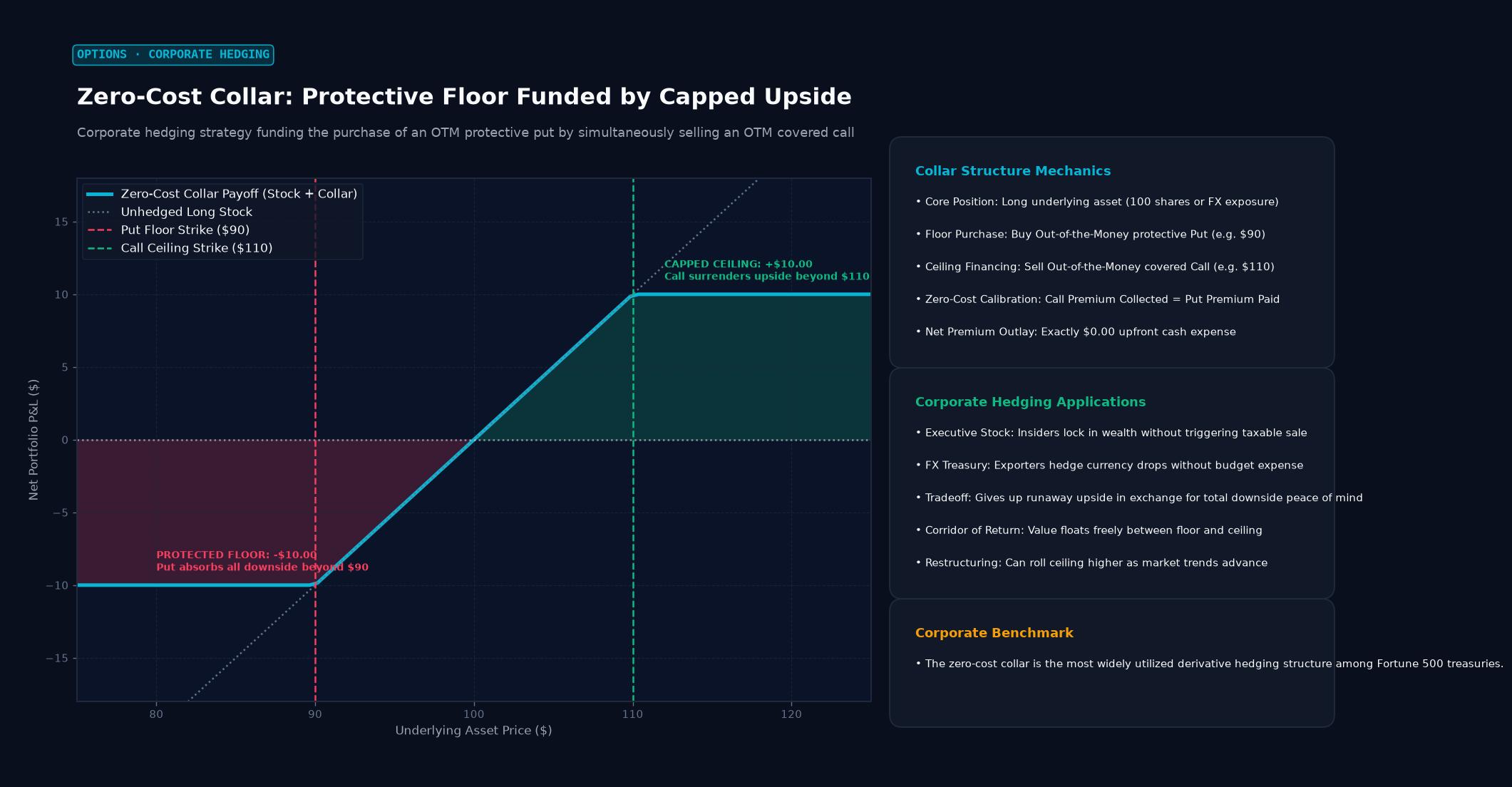 Figure: Corporate hedging strategy funding the purchase of an OTM protective put by simultaneously selling an OTM covered call
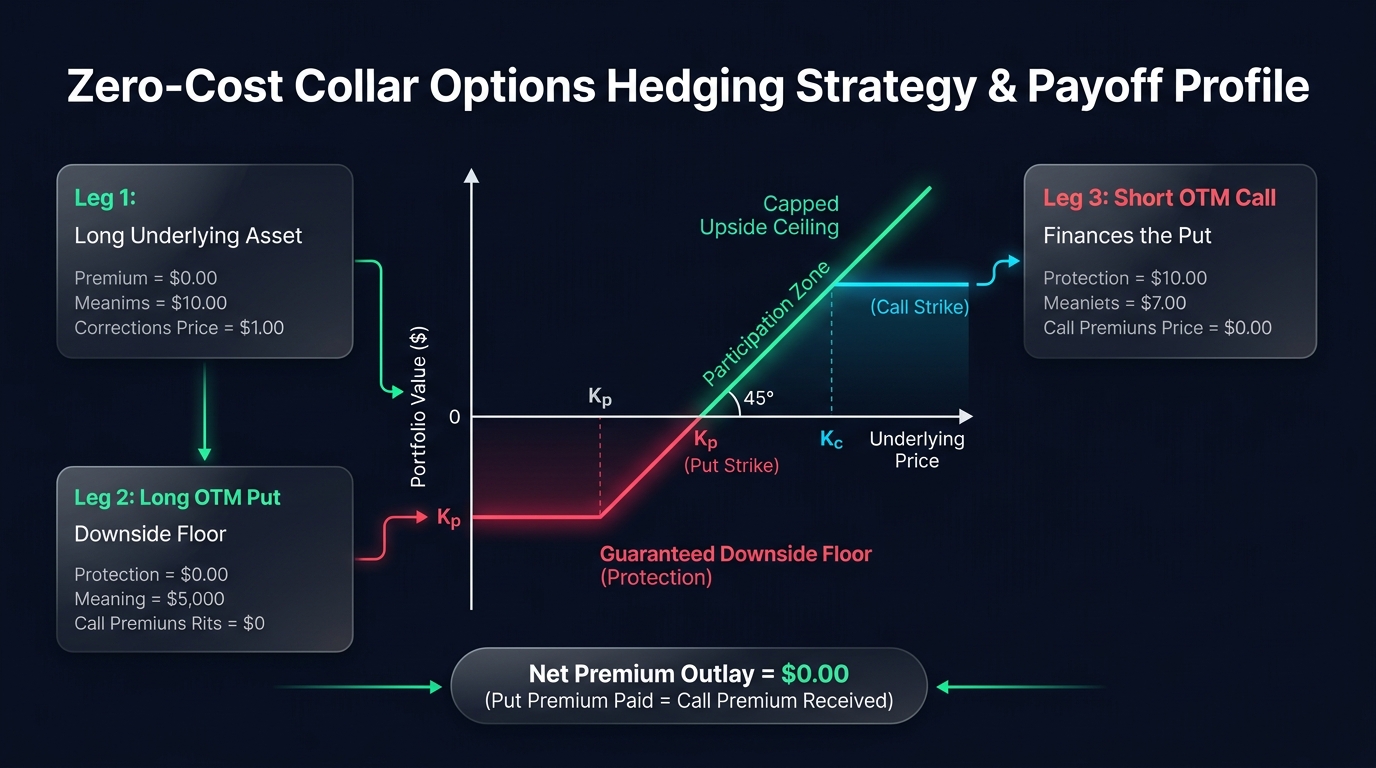
Payoff Structure and Mathematical Mechanics
Consider an investor holding 100 shares of an underlying asset currently trading at spot price $S_0$. The investor establishes a collar by purchasing a put with strike $K_p$ (where $K_p < S_0$) and selling a call with strike $K_c$ (where $K_c > S_0$), both expiring at time $T$.
The combined value of the hedged position at expiration ($V_T$) is determined by three distinct price zones:
Zone 1: Downside Market Crash ($S_T \le K_p$)
If the asset price drops below the put strike price, the call option expires worthless ($C_T = 0$), while the protective put finishes in-the-money with an intrinsic value of $K_p - S_T$. The investor exercises the put, selling the shares at $K_p$: $$V_T = S_T + (K_p - S_T) = K_p$$ The position value cannot fall below $K_p$, establishing an absolute floor.
Zone 2: Range-Bound Consolidation ($K_p < S_T \le K_c$)
If the asset price remains between the two strike prices at expiration, both the put and the call expire out-of-the-money and worthless. The investor retains ownership of the underlying shares, and the portfolio value mirrors the prevailing market price: $$V_T = S_T$$
Zone 3: Strong Bullish Rally ($S_T > K_c$)
If the asset price rallies above the call strike price, the put expires worthless ($P_T = 0$), but the short call is exercised against the investor. The investor is obligated to deliver the shares to the call buyer at strike price $K_c$: $$V_T = S_T - (S_T - K_c) = K_c$$ The position value is capped at $K_c$, sacrificing any further gains.
Concrete Trading Example
An institutional fund manager holds 100,000 shares of a global semiconductor stock currently trading at $100.00 per share, representing a $10,000,000 position. The manager expects heightened macroeconomic volatility over the next six months and wishes to protect against a potential 25% market drawdown without paying cash for puts.
The options market offers six-month European-style options:
- Protective Put Strike ($K_p$): $90.00 (10% downside buffer) | Premium: $4.50 per share.
- Covered Call Strike ($K_c$): $115.00 (15% upside ceiling) | Premium: $4.50 per share.
Execution:
- Buy 1,000 Put contracts (100,000 shares) at $4.50: Outflow = $450,000.
- Sell 1,000 Call contracts (100,000 shares) at $4.50: Inflow = $450,000.
- Net Initial Premium: $-$450,000 + $450,000 = $0.00$.
Expiration Scenarios at Month 6:
| Scenario / Stock Price at Expiration | Unhedged Position Value | Put Payoff | Call Payoff | Collared Portfolio Value | Net Gain / Loss vs. Spot |
|---|---|---|---|---|---|
| Severe Crash ($70.00) | $7,000,000 | +$2,000,000 | $0 | $9,000,000 | -$1,000,000 (-10.0%) |
| Moderate Decline ($85.00) | $8,500,000 | +$500,000 | $0 | $9,000,000 | -$1,000,000 (-10.0%) |
| Unchanged ($100.00) | $10,000,000 | $0 | $0 | $10,000,000 | $0.00 (0.0%) |
| Moderate Rise ($110.00) | $11,000,000 | $0 | $0 | $11,000,000 | +$1,000,000 (+10.0%) |
| Massive Rally ($140.00) | $14,000,000 | $0 | -$2,500,000 | $11,500,000 | +$1,500,000 (+15.0%) |
Under the worst-case scenario ($70.00 stock price), the collar saves the investor $2,000,000 in capital losses. Under the best-case scenario ($140.00 stock price), the investor caps total profit at $1,500,000, forfeiting $2,500,000 in windfall gains.
Strategic Applications Across Markets
                      APPLICATIONS OF ZERO-COST COLLARS

      ┌───────────────────────┼───────────────────────┐
      ▼                       ▼                       ▼
 [Corporate Insiders]   [FX Corporate Hedgers]  [Commodity Producers]
 Hedges concentrated    Exporters lock in FX    Oil & gold miners lock
 stock without tax      corridor for foreign    minimum sale price to
 liquidation triggers   currency receivables    guarantee debt service
1. Corporate Executives and Founders
Senior corporate executives and startup founders often hold massive, concentrated equity stakes in their companies. Selling shares directly can trigger severe capital gains taxes and send negative public signals to the market. By executing a zero-cost collar through a private banking desk, the executive locks in a minimum floor value on their wealth without selling underlying shares.
2. Foreign Exchange (FX) Risk Reversals
Multinational corporations expecting foreign currency receipts utilize zero-cost collars (commonly known in FX markets as risk reversals or cylinder options). A European exporter receiving USD in six months buys an OTM EUR call / USD put while selling an OTM EUR put / USD call with equal premium, establishing a guaranteed exchange rate corridor.
3. Energy and Agricultural Producers
Crude oil drillers and commercial farmers construct zero-cost collars to ensure solvent cash flow. By purchasing OTM put options financed by selling OTM call options, a mining or drilling company guarantees debt coverage while preserving participation in moderate commodity price increases.
Comparative Analysis: Collar vs. Alternative Strategies
| Strategy | Initial Net Premium | Downside Protection | Upside Potential | Suitable Market Outlook |
|---|---|---|---|---|
| Zero-Cost Collar | Exactly $0.00 | Complete below Put strike | Capped at Call strike | Neutral to mildly bullish with downside fear |
| Protective Put | High debit (expensive) | Complete below Put strike | Unlimited | Highly bullish long-term with near-term crash fear |
| Covered Call | Credit received | Very limited (only premium) | Capped at Call strike | Neutral to slightly bullish, seeking income |
| Outright Share Sale | Zero (generates cash) | Complete (100% in cash) | Zero (forfeits all upside) | Bearish; no longer wishes to hold asset |
Legal and Tax Complexities: The Constructive Sale Rule
In the United States, investors implementing equity collars must carefully observe IRS regulations to avoid triggering immediate tax liabilities:
- IRC Section 1259 (Constructive Sales of Appreciated Financial Positions): Under US tax law, if a collar is structured too tightly (meaning the spread between the put strike and the call strike is very narrow, eliminating virtually all risk of loss and opportunity for gain), the IRS deems the transaction a “constructive sale.” This immediately triggers taxable capital gains on the entire unrealized position as if the stock were sold at market value.
- Safe Harbor Guidelines: To avoid constructive sale classification, wealth management firms generally structure collars with a sufficiently wide corridor, ensuring the put strike and call strike are separated by at least 15% to 20%, and the maturity extends between 1 and 3 years.
- IRC Section 1092 (Straddle Rules): Holding offsetting positions that substantially diminish the risk of loss creates an options straddle for tax purposes. Under straddle rules, the investor’s holding period for long-term capital gains qualification is suspended while the collar remains open.
Frequently Asked Questions
Can a collar be structured with a net credit or debit?
Yes. Although the zero-cost collar is calibrated so that the call and put premiums offset exactly to zero, an investor can adjust strikes to create a net-credit collar (selling a call closer to the money to generate immediate income, while setting a deeper out-of-the-money put) or a net-debit collar (paying a small fee for tighter downside protection with higher upside participation).
What happens if the stock pays a dividend while the collar is active?
When holding a collar, the investor retains legal ownership of the underlying shares and continues to receive all regular shareholder dividends. However, if the stock approaches the call strike price near an ex-dividend date, the call holder may exercise the call early to capture the dividend payment, resulting in the early assignment and sale of the underlying stock.
How does implied volatility (the volatility skew) affect zero-cost collar pricing?
In equity options, the volatility skew typically causes out-of-the-money puts to trade at higher implied volatilities than equidistant out-of-the-money calls due to market demand for crash protection. Because puts are more expensive per delta than calls, the upside call strike must often be placed closer to the current stock price (or the put strike placed further away) to achieve a true zero net premium.
Ready to trade forex?
Open a free demo account with a regulated broker. Practice with virtual funds before risking real money.