Delta
Delta is a fundamental options risk metric (the primary Greek) that measures the expected change in an option's premium resulting from a one-unit change in the price of the underlying asset. It also functions as a hedge ratio and an approximate proxy for the probability of expiring in-the-money.
What Is Delta in Options Trading?
In financial derivatives and options analysis, Delta ($\Delta$) is the primary first-order risk sensitivity metric—the most prominent of the mathematical coefficients collectively known on trading desks as the Greeks.
Derived from the Black-Scholes-Merton options pricing model, Delta quantifies the theoretical sensitivity of an option contract’s premium to price movements in the underlying asset (such as a spot currency pair, stock, or commodity future):
$$ \Delta = \frac{\partial V}{\partial S} $$
Where $\partial V$ represents the change in the option’s theoretical value, and $\partial S$ represents an infinitesimal change in the spot price of the underlying asset.
In practical terms, Delta answers a fundamental trading question: If the underlying currency pair moves by 1 full pip (or $1.00), how much will my option premium change?
The Numerical Range of Delta: Calls vs. Puts
Because call options and put options possess opposing directional relationships to the underlying market, their Delta values fall into distinct numerical ranges:
- Call Options (Positive Delta: $0.0 \text{ to } +1.0$): A call option grants the right to buy the underlying asset. Because a call becomes more valuable as the underlying price rises, its Delta is always positive. A call option with a Delta of +0.60 is expected to gain approximately 0.60 pips (or $0.60) for every 1.0-pip (or $1.00) advance in the underlying currency.
- Put Options (Negative Delta: $0.0 \text{ to } -1.0$): A put option grants the right to sell the underlying asset. Because a put increases in value when the underlying price drops, its Delta is always negative. A put option with a Delta of -0.40 will gain 0.40 pips in value if the underlying currency drops by 1.0 pip, and lose 0.40 pips if the currency rises by 1.0 pip.
The Three Core Operational Interpretations of Delta
Professional options traders and institutional risk managers utilize Delta in three distinct ways:
1. Directional Price Sensitivity (Gearing)
Delta tells a trader how aggressively their position responds to market movements. A deep in-the-money option with a Delta of 0.95 behaves almost identically to holding the physical spot currency, capturing 95% of every market tick. A far out-of-the-money option with a Delta of 0.10 moves sluggishly, capturing only 10% of underlying price swings.
2. The Hedge Ratio (Delta-Neutral Hedging)
Delta defines the exact mathematical quantity of the underlying asset required to establish a risk-neutral hedge.
- If an institutional bank sells (writes) a call option covering 1,000,000 EUR with a Delta of +0.50, the bank has an open short delta exposure of -500,000 EUR.
- To perfectly eliminate directional price risk, the bank immediately buys 500,000 EUR in the spot foreign exchange market.
- If the Euro rises, the gain on the spot position cancels out the loss on the written call option. This technique forms the foundation of institutional delta-neutral market making.
3. Probability of Expiring In-the-Money
Under standard Black-Scholes assumptions, the absolute value of an option’s Delta serves as a close mathematical proxy for the risk-neutral probability that the contract will expire In-the-Money (ITM):
- An option with a 0.70 Delta carries approximately a 70% statistical probability of finishing in-the-money at expiration.
- An At-the-Money option with a 0.50 Delta carries roughly a 50% probability of finishing in-the-money.
- A deep out-of-the-money option with a 0.15 Delta has only an approximate 15% probability of finishing in-the-money.
Moneyness and Delta Progression
An option’s Delta is dynamic, expanding and contracting continuously as the spot price moves relative to the strike price:
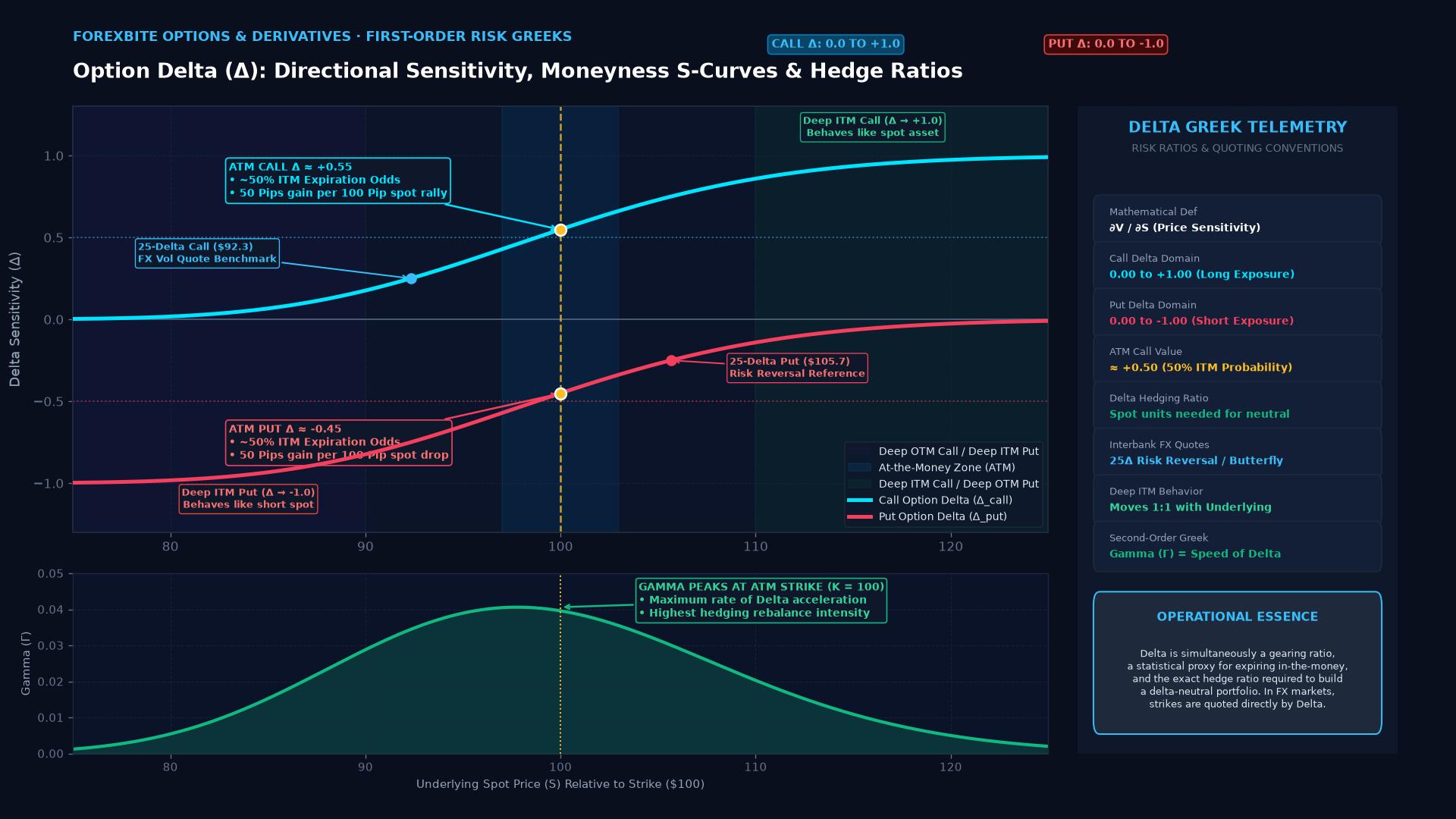
The rate at which Delta changes as the underlying price moves is governed by a second-order Greek: Gamma ($\Gamma$). Gamma peaks for at-the-money options, causing an ATM contract’s Delta to shift rapidly toward 0 or 1.0 as the market fluctuates.
Interbank Forex: The Delta Quoting Convention
In equity options, contracts are organized and quoted by fixed strike prices (e.g., Apple $200 Call). In institutional foreign exchange, however, options are quoted directly by Delta.
Interbank dealing desks do not quote strike prices because exchange rates constantly fluctuate and vary by interest differentials. Instead, brokers and market makers quote contracts as:
- “10-Delta Call” or “25-Delta Put”
- The 25-Delta Risk Reversal: The difference in implied volatility between a 25-delta call and a 25-delta put. If traders are paying a higher volatility premium for 25-delta puts than 25-delta calls, it reveals that institutional smart money is aggressively hedging against downside market risk.
Practical Trading Example: Calculating Position Delta
Consider a retail options trader constructing a directional position on GBP/USD:
- Current GBP/USD Spot Price: 1.3000
- The trader purchases 3 Call Option Contracts on GBP/USD (each contract covering 100,000 GBP).
- The call options have a strike price of 1.3100 and a Delta of +0.40.
- Calculate Total Position Delta: $$ \text{Total Delta} = 3 \text{ contracts} \times 100,000 \text{ GBP} \times 0.40 = +120,000 \text{ GBP Delta} $$
- Interpreting the Exposure: Holding these 3 options gives the trader the equivalent directional exposure of holding £120,000 in the spot market (1.2 Standard Lots).
- Price Movement: Over the next session, GBP/USD surges by 50 pips (+0.0050).
- Estimated Gain: $$ \text{Expected Gain} = 50 \text{ pips} \times 0.40 \text{ Delta} = 20 \text{ pips per contract} $$ $$ \text{Total Dollar Gain} = 3 \text{ contracts} \times (100,000 \times 0.0020) = $600.00 $$
As GBP/USD rallied closer to the 1.3100 strike, Gamma will have increased the Delta from 0.40 up toward 0.50, accelerating future gains if the rally continues.
Key Takeaways
- Delta measures the sensitivity of an option’s premium to a one-unit change in the underlying asset’s price.
- Call deltas range from 0.0 to +1.0; put deltas range from 0.0 to -1.0.
- Delta functions simultaneously as a price sensitivity coefficient, a hedging ratio, and a probability proxy for finishing in-the-money.
- In institutional forex, vanilla options are quoted by Delta (e.g., 25-delta risk reversals) rather than static strike prices.
- Delta is dynamic, moving toward 1.0 as an option goes deeper in-the-money and toward 0.0 as it falls out-of-the-money.
FAQ
Can an option’s Delta exceed 1.0? No. For standard vanilla options, Delta cannot exceed +1.0 for calls or -1.0 for puts. A Delta of 1.0 means the option moves in perfect one-to-one lockstep with the underlying asset; it cannot move faster than the asset itself without leverage multipliers.
Why does Delta change as expiration approaches? As time to expiration elapses, the uncertainty regarding where the price will finish diminishes. For an in-the-money option, Delta steadily drifts toward 1.0 as expiration nears because the probability of it remaining in-the-money approaches 100%. Conversely, an out-of-the-money option’s Delta collapses toward 0.0.
What is a “Delta-Neutral” portfolio? A Delta-neutral portfolio is an investment position constructed such that the net sum of all positive and negative deltas equals zero. Such a portfolio is temporarily immune to small directional price movements, allowing the trader to profit purely from changes in volatility (Vega) or time decay (Theta).
Ready to trade forex?
Open a free demo account with a regulated broker. Practice with virtual funds before risking real money.