Zero-Minus Tick
A securities trade executed at the exact same price as the immediately preceding transaction, but at a lower price than the last preceding transaction of a differing price, historically prohibiting short-sale executions under US securities regulations.
What Is a Zero-Minus Tick?
A zero-minus tick, also known as a downtick match or zero-downtick, is a market microstructure classification describing a trade executed at the exact same price as the immediately preceding transaction, but at a lower price than the most recent transaction that occurred at a different price level.
In electronic and floor-based exchange environments, trade ticks describe the directional momentum of executed market transactions. While a standard minus tick (downtick) occurs when a trade prints at an absolute price lower than the prior print, trading volume frequently clusters at the same price before moving. If five consecutive trades execute at $50.00 following an initial drop from $50.25, the first trade is a minus tick, while the subsequent four trades are categorized as zero-minus ticks.
The zero-minus tick held monumental regulatory importance in US capital markets for seven decades under the original Securities and Exchange Commission (SEC) Rule 10a-1 (The Uptick Rule). Under this historic rule, short sales were strictly prohibited on any minus tick or zero-minus tick, preventing aggressive short sellers from pounding a declining stock into a downward liquidity spiral.
Market Microstructure: Classifying Tick Sequences
To accurately determine tick status, market surveillance systems and trade classification algorithms track a continuous string of transaction prices:
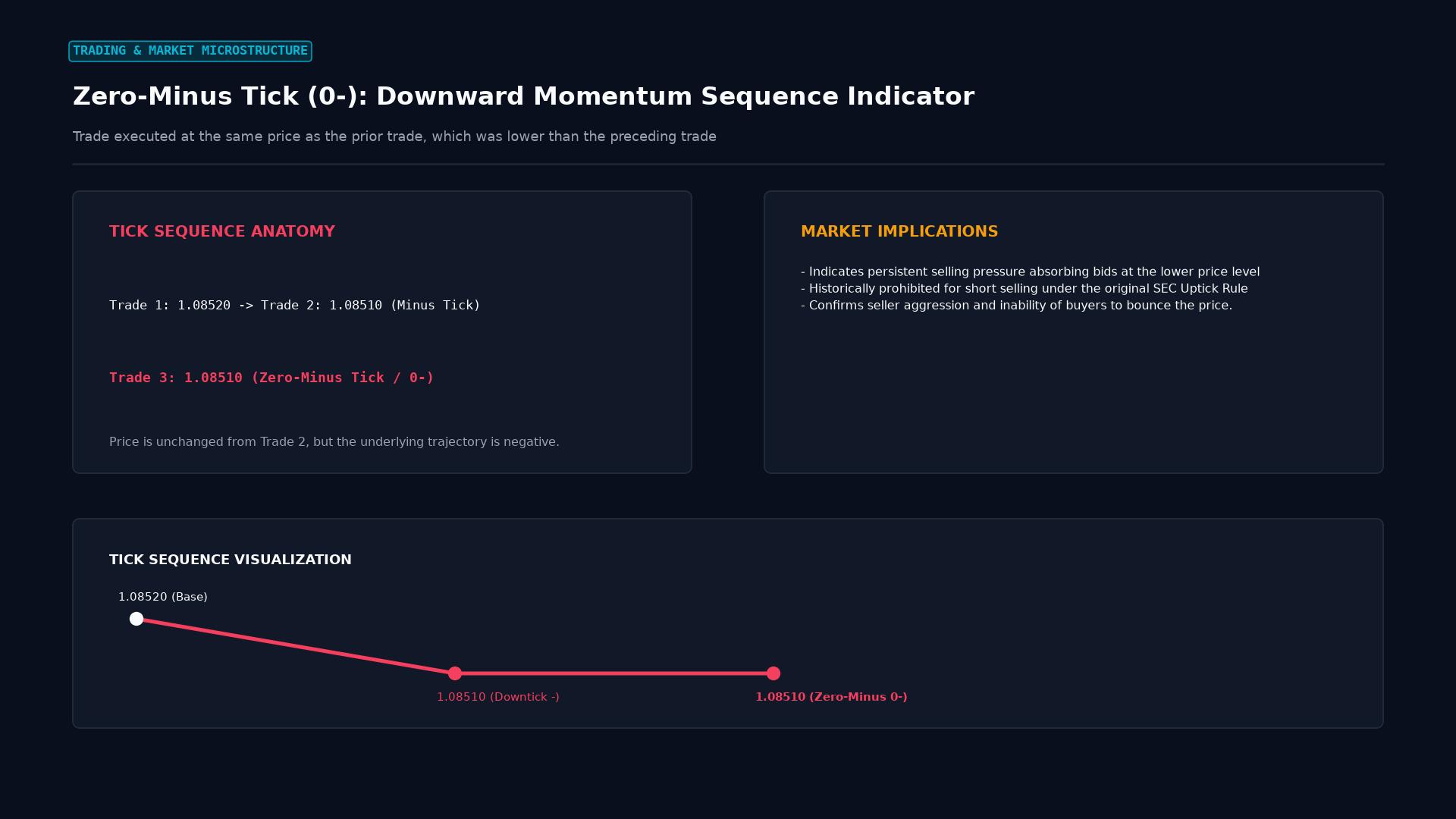 Figure: Microstructure tick sequence: trade price matching previous price following a downtick, confirming persistent seller aggression.
The Formal Tick Classification Matrix:
- Plus Tick (Uptick, $+$): A trade executed at a price higher than the trade immediately preceding it ($P_t > P_{t-1}$).
- Zero-Plus Tick ($0+$): A trade executed at the same price as the prior trade ($P_t = P_{t-1}$), where the last differing transaction price was lower ($P_{t-1} > P_{\text{last different}}$).
- Minus Tick (Downtick, $-$): A trade executed at a price lower than the trade immediately preceding it ($P_t < P_{t-1}$).
- Zero-Minus Tick ($0-$): A trade executed at the same price as the prior trade ($P_t = P_{t-1}$), where the last differing transaction price was higher ($P_{t-1} < P_{\text{last different}}$).
The Historic SEC Rule 10a-1 (The Uptick Rule)
Established by the SEC in 1938 pursuant to the Securities Exchange Act of 1934 following the devastating market crashes of 1929 and 1937, Rule 10a-1 was engineered to eliminate predatory “bear raids,” where coordinated market participants shorted massive blocks of stock to trigger margin liquidations.
The core legal mandate of Rule 10a-1 established:
- Permitted Short Sales: A market participant could legally execute a short sale only on a plus tick or a zero-plus tick.
- Prohibited Short Sales: A short sale order was strictly barred from executing on a minus tick or a zero-minus tick.
                  RULE 10a-1 EXECUTION PERMISSIONS

             ┌─────────────────────────┬─────────────────────────┐
             │       PLUS TICK (+)     │     ZERO-PLUS TICK (0+) │
             │   Price moved UPWARD    │   Price same; prior UP  │
             ├─────────────────────────┴─────────────────────────┤
             │           SHORT SALE PERMITTED (LEGAL)            │
             └───────────────────────────────────────────────────┘

             ┌─────────────────────────┬─────────────────────────┐
             │      MINUS TICK (-)     │    ZERO-MINUS TICK (0-) │
             │  Price moved DOWNWARD   │  Price same; prior DOWN │
             ├─────────────────────────┴─────────────────────────┤
             │           SHORT SALE PROHIBITED (ILLEGAL)         │
             └───────────────────────────────────────────────────┘
The prohibition against executing on a zero-minus tick was critical. If regulations had banned short sales solely on outright minus ticks, a short seller could wait for a single buyer to execute a down-trade and then exhaust all remaining bids at that depressed price level via zero-minus ticks. Restricting zero-minus ticks ensured that short sellers could never supply liquidity to an order book that was actively drifting downward.
Evolution: Repeal and the Modern Alternative Uptick Rule (Rule 201)
The regulatory handling of ticks underwent profound structural shifts with the rise of electronic trading and decimals:
1. The 2007 Repeal of Rule 10a-1
In 2004, the SEC launched a pilot study under Regulation SHO, exempting one-third of the Russell 3000 index from tick restrictions. Econometric analysis by the SEC’s Office of Economic Analysis concluded that the tick test contributed little to market quality and introduced execution drag in high-speed, decimalized markets (where prices move in pennies rather than eighths or sixteenths of a dollar). In June 2007, the SEC formally eliminated Rule 10a-1.
2. The 2008 Financial Crisis and Rule 201 (2010)
Following the collapse of Bear Stearns, Lehman Brothers, and the 2008 financial crash, public and political outcry demanded reinstatement of short-sale protections. In 2010, the SEC adopted Rule 201 of Regulation SHO (The Alternative Uptick Rule):
               MODERN RULE 201 CIRCUIT BREAKER MECHANISM

  [Stock Plunges >= 10% From Prior Close]
                     │
                     ▼
  [Rule 201 Circuit Breaker Triggered]
  Enforced for remainder of the day + entire next trading day
                     │
                     ▼
  [Trading Systems Restrict Short Sales]
  Short orders can ONLY execute at a price ABOVE the National Best Bid (NBB)
  Shorting at or below the current bid is strictly blocked by exchange algorithms
Under modern Rule 201, the system does not track zero-minus trade ticks directly. Instead, it enforces a continuous bid-based price test: short sales can only be executed at a price higher than the current National Best Bid (NBB), preserving the economic intent of the historic zero-minus tick prohibition while operating natively within modern high-frequency electronic limit order books.
Role in Quantitative Microstructure: The Lee-Ready Algorithm
In academic empirical finance and quantitative trading, trade execution data recorded in the consolidated tape does not report whether a trade was buyer-initiated or seller-initiated.
To infer trade direction for calculating market impact, order flow toxicity, and the Volume-Synchronized Probability of Toxicity (VPIN), quants utilize the Lee-Ready Algorithm (1991):
- The Quote Test: If a trade prints above the midpoint of the prevailing National Best Bid and Offer (NBBO), it is categorized as buyer-initiated. If it prints below the midpoint, it is categorized as seller-initiated.
- The Tick Test (Fallback): If a trade prints exactly at the bid-ask midpoint, the algorithm falls back to the tick test:
- A trade on a plus tick or zero-plus tick is classified as buyer-initiated.
- A trade on a minus tick or zero-minus tick is classified as seller-initiated.
Accurately identifying zero-minus ticks is essential for quantitative models tracking aggressive institutional selling pressure in dark pools and lit venues.
Frequently Asked Questions
Why was a short sale allowed on a zero-plus tick but banned on a zero-minus tick?
A zero-plus tick indicates that although the current execution price is unchanged from the prior trade, the last directional price shift was upward. This indicated positive or stable buying interest. In contrast, a zero-minus tick reflects an environment where the last directional price shift was downward, signaling selling pressure. Regulators permitted short sales on zero-plus ticks because the underlying momentum was positive, while banning them on zero-minus ticks to prevent piling on to a downward price drop.
How did the shift from fractions to decimals in 2001 affect the tick test?
Prior to 2001, US equities traded in fractions (minimum tick sizes of 1/8 or 1/16 of a dollar, equal to $0.125 or $0.0625). An uptick represented a meaningful price hurdle. When markets transitioned to decimalization with a minimum tick size of one cent ($0.01), a stock could experience an uptick on a tiny $0.01 movement, allowing short sellers to circumvent the spirit of the rule with ease. This dilution of effectiveness contributed to the eventual reform of the rule.
Does the zero-minus tick rule apply to modern retail forex or crypto trading?
No. Foreign exchange (Forex) and cryptocurrency markets are decentralized, over-the-counter (OTC) global markets that have never been subject to US SEC tick test regulations. Retail forex and crypto traders can enter short positions freely regardless of whether the preceding price tick was positive, negative, or flat.
Ready to trade forex?
Open a free demo account with a regulated broker. Practice with virtual funds before risking real money.