Uptick Rule
The Uptick Rule is a market regulation designed to prevent short sellers from deliberately driving down the price of an asset, stipulating that short-sale orders may only be executed at a price higher than the prior transaction or strictly above the prevailing national best bid.
What Is the Uptick Rule?
The Uptick Rule is a foundational market conduct regulation established to restrict predatory short selling and prevent speculative “bear raids”—coordinated market operations where traders aggressively dump short orders into a declining market to trigger stop-loss orders and panic selling.
Originally enacted by the US Securities and Exchange Commission (SEC) in 1938 under the Securities Exchange Act of 1934 (as Rule 10a-1), the rule established that an equity could only be sold short if the trade executed at a price higher than the preceding sale (an uptick) or at the same price if that price was higher than the trade before it (a zero-uptick). Although repealed in 2007, the catastrophic financial panic of 2008 compelled regulators to introduce a modernized framework in 2010 known as the Alternative Uptick Rule (SEC Rule 201).
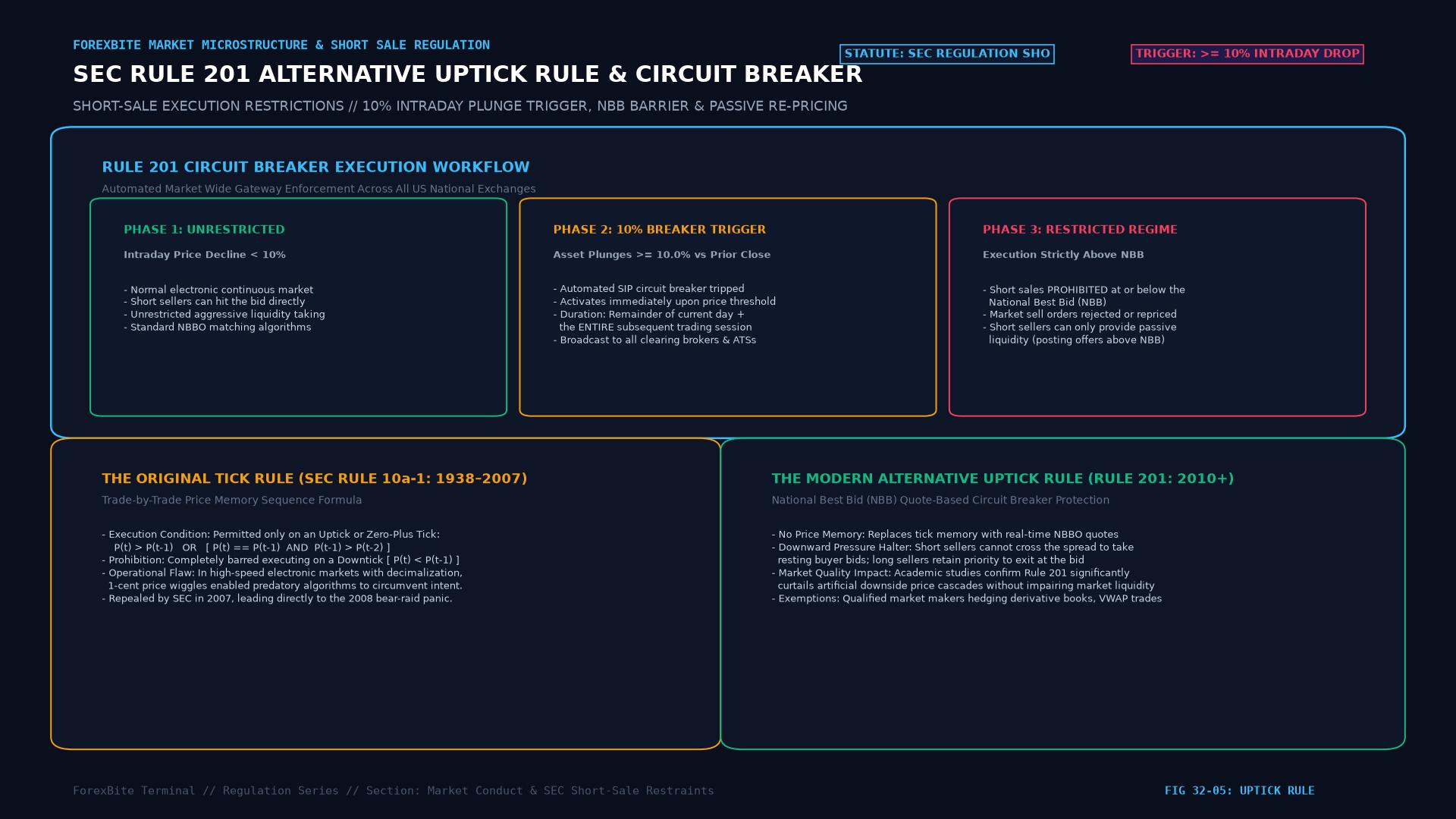 Figure: The SEC Rule 201 circuit breaker workflow triggering automated short-sale execution restrictions strictly above the National Best Bid upon a 10% intraday price decline.
Mathematical Formulation & Regulatory Logic
The regulatory mechanisms governing short sales have evolved from trade-by-trade price memory to quote-based circuit breakers:
1. The Original Rule 10a-1 (1938–2007)
Under Rule 10a-1, a short sale at price $P_t$ was legally permitted if and only if:
$$P_t > P_{t-1} \quad \text{or} \quad (P_t = P_{t-1} \text{ and } P_{t-1} > P_{t-2})$$
If $P_t < P_{t-1}$ (a downtick), all short-sale orders were rejected by the floor specialist or electronic gateway.
2. The Alternative Uptick Rule (Rule 201, 2010–Present)
Under modern market fragmentation across dozens of electronic exchanges and dark pools, tracking historical ticks proved computationally inefficient. Rule 201 instead establishes a percentage drop threshold:
$$\Delta P_{\text{session}} = \frac{P_t - P_{\text{prior_close}}}{P_{\text{prior_close}}} \le -0.10 \quad (-10%)$$
Once this condition is satisfied for security $i$, the trading venue’s matching engine enforces a price-test restriction:
$$P_{\text{short}} > \text{NBB}_t$$
Where $\text{NBB}_t$ is the instantaneous consolidated National Best Bid. A short seller cannot take liquidity by crossing the spread; they must wait for a buyer to lift their resting ask offer at a price strictly higher than the prevailing bid.
Historical Evolution of Short-Sale Regulations
The regulatory stance on short selling has oscillated between free-market deregulation and systemic risk containment:
| Era / Regulation | Mechanism | Scope | Primary Regulatory Motivation |
|---|---|---|---|
| 1938: Rule 10a-1 | Strict tick test (execution allowed only on +tick or 0+ tick). | All exchange-listed US equities. | Curb speculative bear raids blamed for the 1929 Great Crash. |
| 2004–2007: Reg SHO Pilot | Suspended tick test on one-third of Russell 3000 stocks. | Large-cap pilot stocks. | SEC economic study concluded tick rules had negligible liquidity benefits. |
| 2007: Complete Repeal | Tick test abolished across all US equity markets. | All US exchange equities. | Belief in frictionless electronic markets and automated liquidity. |
| 2010: Rule 201 (Current) | Circuit-breaker triggered by $10%$ intraday drop; shorting restricted to $> \text{NBB}$. | All National Market System (NMS) stocks. | Restoring investor confidence following the 2008 banking collapse. |
Does the Uptick Rule Apply to Forex?
In foreign exchange markets, the Uptick Rule does not apply.
Because spot foreign exchange is an over-the-counter (OTC) market that trades globally across independent interbank networks without a centralized exchange or regulatory clearing house, enforcing a centralized tick test is technically impossible. Furthermore, foreign exchange is inherently symmetric: selling one currency (e.g., selling EUR in EUR/USD) is mechanically identical to buying another currency (buying USD). Banning short sales in currency pairs would arbitrarily restrict purchasing sovereign legal tender.
Equity Short Sale:       Borrow shares -> Sell shares -> Repurchase to cover (Asymmetric)
Forex Short Sale:        Sell Base Currency / Buy Quote Currency (Symmetric Two-Way Flow)
Real-World Institutional Case Study: The 2007 Repeal & The 2008 Wall Street Panic
In July 2007, following a multi-year economic pilot study, the SEC voted unanimously to eliminate the 1938 Uptick Rule, declaring that modern automated markets provided sufficient depth to prevent artificial price manipulation without regulatory tick constraints.
The timing proved disastrous. Over the subsequent 14 months, the global subprime mortgage crisis unraveled, and investment banks faced unprecedented speculative pressure:
[July 2007: SEC Eliminates Uptick Rule]
Short sellers granted unrestricted ability to hit the bid continuously

[2008 Financial Crisis: Bear Stearns, Lehman Brothers, Merrill Lynch]
Negative rumors regarding toxic mortgage exposure surfaced
                    |
                    v
Hedge funds dumped millions of short-sale market orders directly into falling bids
                    |
                    v
Absence of Uptick Rule allowed short sellers to drive stock prices down tick-by-tick
without waiting for buying interest to emerge
                    |
                    v
Lehman Brothers plummeted from $65 to $0; Bear Stearns collapsed to $2
In September 2008, facing systemic insolvency across the financial sector, SEC Chairman Christopher Cox enacted an emergency temporary ban on all short selling of 799 financial stocks. Cox later publicly expressed profound regret for eliminating the original uptick rule in 2007. The public outcry led the SEC to adopt the modernized Alternative Uptick Rule (Rule 201) in early 2010.
Frequently Asked Questions
What is a “short exempt” order under Rule 201?
A short exempt order (marked with tag SSE) is a specialized short-sale order submitted by registered market makers or bona fide arbitrageurs that is legally excused from Rule 201 price restrictions. Market makers utilize short exempt orders to facilitate customer liquidity, hedge derivative positions, or execute index arbitrage trades during volatile market selloffs.
Can a stock trigger the Alternative Uptick Rule during pre-market trading?
No. Under SEC Rule 201, the $10%$ circuit breaker can only be triggered during regular market trading hours (09:30 to 16:00 Eastern Time). However, if an asset closes down $10%$ or more during regular hours, the restriction remains legally active throughout after-hours trading and the entire following trading session.
How does the Alternative Uptick Rule protect retail investors?
By prohibiting aggressive short sellers from executing trades at the bid, the rule prevents institutional trading algorithms from flooding the order book and triggering a self-fulfilling cascade of retail stop-loss liquidations, allowing natural buyers time to evaluate whether a selloff is fundamentally justified.
Ready to trade forex?
Open a free demo account with a regulated broker. Practice with virtual funds before risking real money.