Zero-Rated Goods
Essential products and services subject to a zero percent Value Added Tax (VAT) or Goods and Services Tax (GST) rate at consumer sale, while permitting manufacturers and merchants to reclaim input tax credits on production costs.
What Are Zero-Rated Goods?
Zero-rated goods are specific categories of products and services subject to a zero percent (0%) consumption tax rate under Value Added Tax (VAT) or Goods and Services Tax (GST) fiscal regimes. Although no sales tax is charged to the final consumer at the point of sale, zero-rated supplies remain fully integrated within the statutory tax reporting system.
The defining economic feature of a zero-rated supply is that the producing enterprise retains the legal right to claim a full refund (Input Tax Credit) from the government for all VAT or GST paid on its raw materials, capital equipment, commercial rent, and operational business inputs.
Governments establish zero-rated tax classifications to achieve two paramount socio-economic objectives:
- Mitigating Regressive Taxation: Consumption taxes are inherently regressive, absorbing a significantly higher proportion of income from low-income households than from wealthy families. Applying a zero tax rate to basic survival necessities (such as unprocessed food, prescription medicines, and residential electricity) protects vulnerable populations from cost-of-living burdens.
- Promoting Export Competitiveness: In accordance with World Trade Organization (WTO) and OECD fiscal conventions, almost all physical merchandise and professional services manufactured for international export are classified as zero-rated, ensuring domestic companies compete on a level playing field in global markets without embedded domestic tax inflation.
Zero-Rated vs. VAT-Exempt: The Critical Economic Distinction
In tax economics and corporate accounting, business operators frequently conflate zero-rated goods with exempt goods. However, their financial mechanics and corporate cash flow impacts are fundamentally opposite:
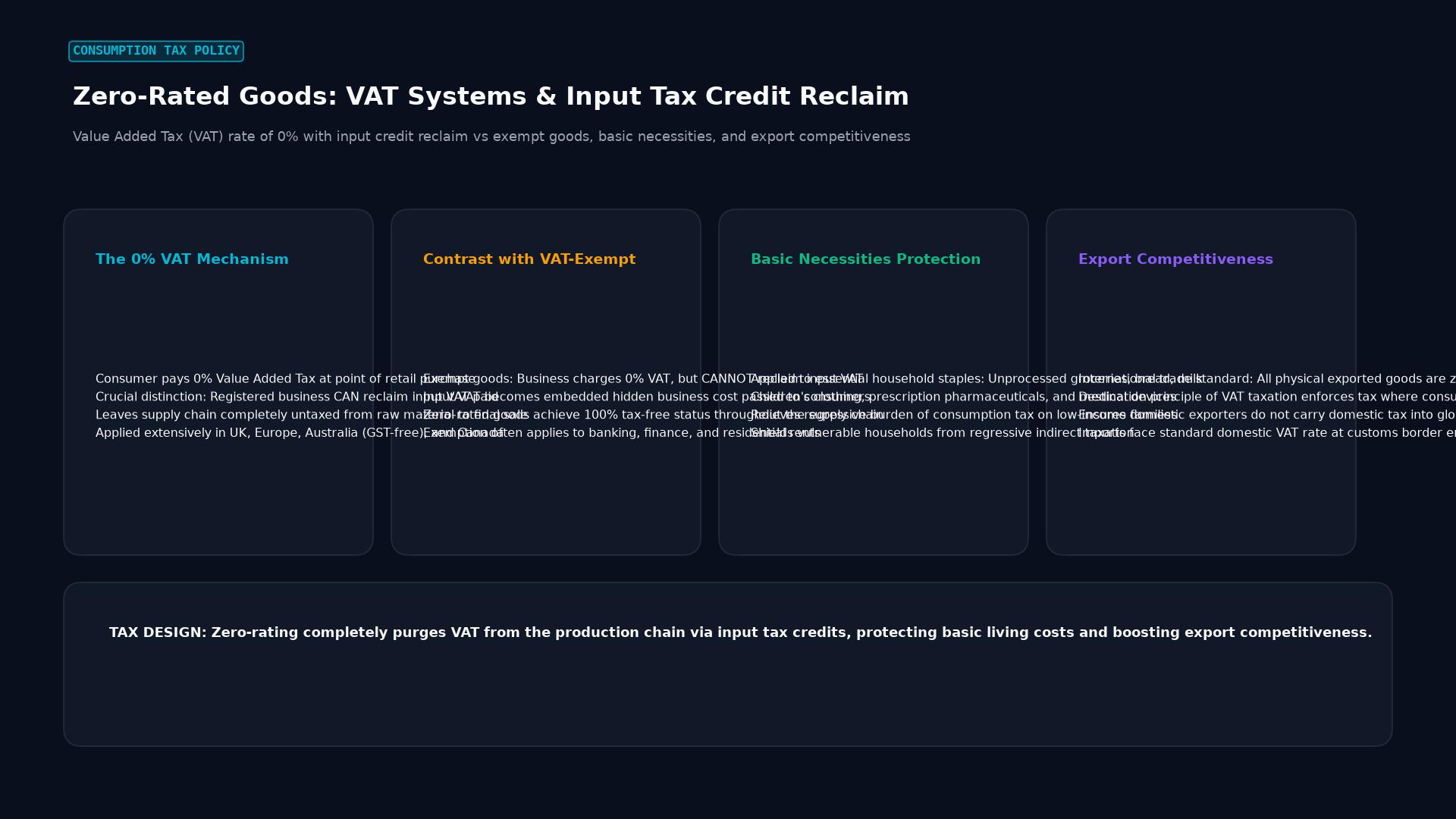 Figure: Value Added Tax (VAT) rate of 0% with input credit reclaim vs exempt goods, basic necessities, and export competitiveness
| Dimension / Mechanism | Standard-Rated Supplies | Zero-Rated Supplies | VAT-Exempt Supplies |
|---|---|---|---|
| Output VAT Charged to Consumer | Standard rate (e.g., 20%) | Exactly 0% | None (Outside scope / Exempt) |
| Input Tax Credit Recovery | Full refund of input VAT | Full refund of input VAT | Zero recovery (Input tax is lost) |
| Impact on Consumer Retail Price | Increases by the tax rate | True tax-free price | May rise as business passes unrecovered tax |
| Statutory VAT Registration | Mandatory if above threshold | Permitted / Recommended | Generally not permitted for exempt-only |
| Typical Product Examples | Luxury goods, electronics, autos | Basic foodstuffs, exports, books | Financial services, residential rents, healthcare |
Under an exempt classification, because the enterprise cannot reclaim input VAT paid to its vendors, that tax expense becomes an embedded operating cost (known as tax cascading). Businesses typically pass this hidden expense along to retail customers through higher base prices. In contrast, zero-rating purges 100% of the consumption tax burden from the entire vertical production chain.
Typical Categories of Zero-Rated Supplies
While statutory tax definitions vary across jurisdictions (such as the UK HMRC, European Union member states, Canada under the GST, and Australia under the GST), zero-rated supplies generally cluster across five primary categories:
                      COMMON ZERO-RATED SUPPLY CATEGORIES

      ┌───────────────────────┼───────────────────────┐
      ▼                       ▼                       ▼
 [Basic Staple Foods]    [Prescription Drugs]    [International Exports]
 Raw grains, milk, fresh  Prescription medicines, Cross-border commercial
 vegetables, meat, bread infant formula, sanitary freight, export goods,
 (excluding restaurants)  and medical appliances  international flights
      │                                               │
      └───────────────────────┬───────────────────────┘
                              ▼
                   [Books & Public Education]
                   Physical textbooks, digital books,
academic periodicals, newspapers- Essential Foodstuffs: Unprocessed agricultural staples including flour, raw meat, fresh poultry, dairy milk, vegetables, and unprocessed fruit. Restaurant meals, hot takeout foods, confectioneries, and alcoholic beverages are systematically excluded and subject to standard VAT rates.
- Medical Supplies and Healthcare: Prescription pharmaceuticals, life-saving medical devices, physical mobility aids, and infant nutrition products.
- Merchandise Exports and International Freight: Physical goods shipped overseas, international commercial shipping, cross-border aviation passenger services, and specialized legal or financial services provided to non-resident entities.
- Public Education and Literature: Printed textbooks, educational workbooks, academic journals, public library supplies, and, in many modern jurisdictions, digital e-books.
- Public Transport and Infrastructure: Municipal bus systems, commuter trains, subway networks, and water utility distributions to residential dwellings.
Supply Chain Accounting Case Study: Export Manufacturing
To understand the cash flow dynamics of zero-rating, examine an industrial aerospace manufacturing company based in a country with a standard 20% VAT rate. The enterprise produces precision satellite components exclusively for export to international aerospace clients.
Quarter 1 Financial Transactions:
- Raw Material Purchases: The manufacturer purchases specialized carbon fiber and titanium alloys from domestic suppliers for $5,000,000, paying $1,000,000 in input VAT (20%).
- Capital Machinery Investment: Installs robotic tooling equipment costing $2,000,000, paying $400,000 in input VAT (20%).
- Total Input VAT Paid: $$1,000,000 + $400,000 = $1,400,000$.
Quarter 1 Commercial Sales:
- The firm exports completed satellite sub-assemblies to an overseas space agency for $10,000,000.
- Because the transaction constitutes an international export, the statutory tax rate is 0%.
- Output VAT Collected from Customer: $$10,000,000 \times 0% = $0.00$.
Tax Return Filing with the Fiscal Authority:
$$\text{Net Tax Payable} = \text{Output VAT} - \text{Input VAT}$$ $$\text{Net Tax Payable} = $0.00 - $1,400,000 = -$1,400,000$$
Because the net figure is negative, the national treasury issues a direct electronic wire refund of $1,400,000 to the aerospace manufacturer. The firm suffers zero tax leakage, maintaining price competitiveness against global aerospace conglomerates based in jurisdictions without value-added tax regimes.
Fiscal and Policy Challenges
While zero-rating achieves vital equity and trade objectives, it creates substantial fiscal and administrative complications for revenue authorities:
- Erosion of National Fiscal Revenues: Zero-rating broad swathes of consumer spending significantly reduces government tax collections, forcing fiscal policymakers to levy higher standard VAT rates on other goods or rely on direct income taxes.
- The “Borderline” Legal Dilemma: Tax authorities face endless administrative litigation regarding arbitrary legal definitions. A famous historic example is the United Kingdom’s Jaffa Cakes legal battle (1991): UK tax law zero-rates cakes but levies standard 20% VAT on chocolate-covered biscuits. The court ultimately ruled that Jaffa Cakes are legally cakes (because they turn hard when stale rather than soft), exempting them from VAT.
- Missing Trader and Carousel Fraud: In cross-border trading zones like the European Union, organized criminal syndicates exploit zero-rated export mechanisms through carousel fraud. Fraudsters purchase zero-rated goods across borders, sell them domestically with standard VAT, pocket the collected VAT, and disappear before tax authorities can audit the transactions.
Frequently Asked Questions
Does the United States have zero-rated goods?
The United States does not have a federal Value Added Tax (VAT) or Goods and Services Tax (GST). Instead, 45 US states and thousands of local municipalities levy retail sales taxes. While state sales tax systems do not use the term “zero-rated,” many states exempt basic groceries and prescription drugs from state sales taxes. However, because sales tax is not a multi-stage credit-invoice system, retailers do not claim input tax credits in the manner of international VAT systems.
Can a business claim a VAT refund if 100% of its sales are zero-rated?
Yes. Businesses that deal exclusively in zero-rated goods (such as dedicated agricultural grain producers or pure export manufacturing facilities) continually generate negative net tax liabilities. These enterprises register for VAT specifically to file regular periodic refund claims, receiving cash disbursements from the tax authority to recover the input VAT paid on their capital expenditures and operating costs.
Why aren’t all healthy foods zero-rated by governments?
Defining what constitutes “healthy” or “essential” food is administratively difficult. While raw fruits, grains, and vegetables are universally zero-rated, processed foods, pre-packaged snack bars, fruit juices with added sugar, and restaurant preparations present complex regulatory boundaries. Tax authorities deliberately restrict zero-rating to clearly defined basic staples to prevent legal loopholes and protect public tax revenue.
Ready to trade forex?
Open a free demo account with a regulated broker. Practice with virtual funds before risking real money.