Market Sentiment in Forex: Trading the Crowd's Psychology
Market sentiment captures the collective mood of forex participants. Learn how to measure fear, greed, and positioning extremes — and use them to identify high-probability turning points.
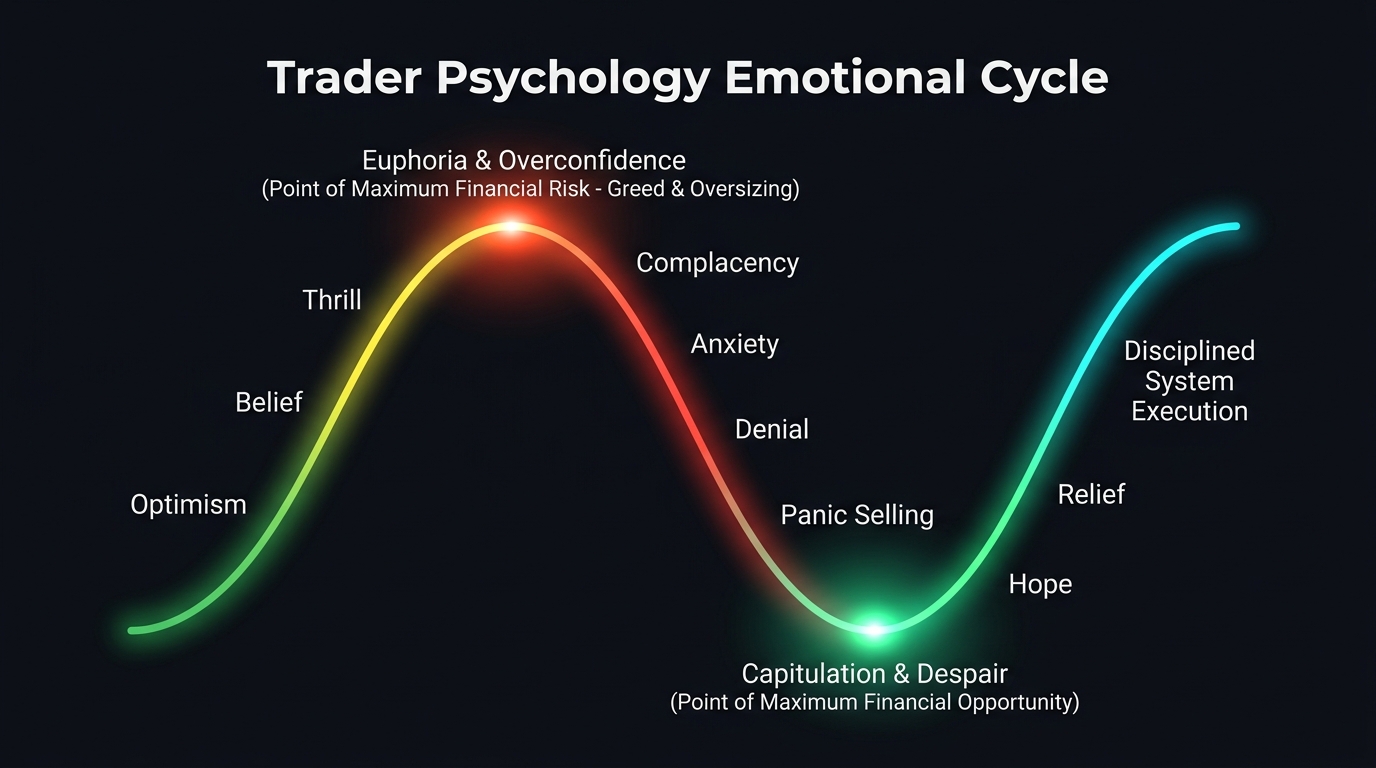
If technical analysis is the science of forex — rule-based, repeatable, measurable — then sentiment analysis is closer to the art. It asks a deceptively simple question: what do most market participants currently believe about this currency, and is that belief about to change?
Markets move on expectations, not just on facts. Understanding the psychological state of the crowd can tell you things that a candlestick chart or a GDP report simply can’t.
What Market Sentiment Actually Means
Sentiment is the aggregate attitude of market participants toward a specific currency or currency pair. When traders are predominantly optimistic about the dollar — positioning heavily long, buying on dips, interpreting news favorably — sentiment is “bullish.” When fear dominates, positions shift defensively, and negative data is amplified, sentiment turns “bearish.”
The critical insight is that sentiment is self-reinforcing until it isn’t. A bullish crowd keeps buying, which pushes prices higher, which attracts more buyers, which pushes prices higher still. This feedback loop can persist far longer than fundamental analysis would suggest is rational. Eventually, the crowd reaches a point of maximum optimism — virtually everyone who wants to be long already is — and there are no new buyers left to push the price further. At that point, any negative catalyst triggers a sharp reversal.
This is why sentiment analysis is particularly powerful at extremes: not for identifying the direction of the current trend, but for identifying when that trend is exhausted.
How Fear and Greed Shape Currency Markets
Every significant forex move has an emotional dimension. The 2022 dollar surge wasn’t just about Fed rate hikes — it was driven by genuine fear about global recession and a flight to the dollar as the world’s safe haven. The yen’s multi-decade weakness through 2022–2023 wasn’t purely about the Bank of Japan’s yield curve control policy; it reflected global traders’ collective conviction that Japanese monetary policy was irrecoverably dovish, which became a self-fulfilling narrative.
Two emotions dominate:
Fear drives capital into safe haven currencies: the US dollar (in global crises), Japanese yen (in risk-off periods), and Swiss franc (in European-specific crises). When equity markets fall sharply, EUR/USD and GBP/USD often fall too, while USD/JPY can move in either direction depending on whether the crisis is global or regional.
Greed/risk appetite favors higher-yielding, growth-correlated currencies: Australian dollar, New Zealand dollar, and emerging market currencies. When global growth expectations are strong and investors are confident, these currencies attract flows.
Watching equity markets, gold prices, and the VIX volatility index alongside currency pairs gives you real-time sentiment signals that don’t show up on a forex chart alone.
Tools for Measuring Sentiment
Commitment of Traders (COT) Report
The CFTC (Commodity Futures Trading Commission) publishes weekly data showing the net positions of different participant types in currency futures markets. Released every Friday for data through the previous Tuesday, it covers:
- Commercial traders (corporations hedging real business exposure)
- Non-commercial/speculative traders (hedge funds and large speculators)
- Non-reportable positions (smaller retail-adjacent traders)
The non-commercial (speculative) net position is what most forex traders focus on. When speculative funds are at an extreme net-long position in a currency — a reading near historical highs — it’s a contrarian signal. There are few buyers left; the currency is vulnerable to a reversal on any negative catalyst.
The COT report doesn’t give precise entry signals, but used alongside technical analysis, it can tell you when a breakout is likely to be faded (everyone already positioned) versus followed (positioning is light and directional momentum has room to run).
Retail Positioning Data
Several major brokers publish percentage data showing what proportion of their clients are long versus short on major pairs. Because retail traders systematically tend to trade against trends (buying dips in downtrends, selling rallies in uptrends), extreme retail positioning often functions as a contrarian indicator.
When 80% of retail clients are long on a pair that’s been falling, it frequently signals the sell-off has more to run before the retail crowd capitulates. When retail sentiment aligns with the trend — most clients are long on a pair that’s been rising — the contrarian signal is less useful (retail crowd being right in trending markets).
News Flow and Narrative Analysis
The dominant narrative driving markets at any given time shapes how participants interpret incoming data. When “Fed pivot” expectations were driving sentiment in late 2022, every piece of US data was interpreted through that lens — good data was bad for stocks (because it meant no pivot) and bad data was good.
When you understand the current narrative, you can anticipate how markets will react to surprises. A positive jobs report normally strengthens the dollar; in a “recession fear” environment, the same data might trigger a relief rally in risk assets that actually weakens the dollar.
Reading central bank speeches, financial press coverage, and analyst reports isn’t optional if you want to understand sentiment — it’s where the narrative lives.
Applying Sentiment in Practice
Sentiment works best as a filter, not as a primary entry signal. A practical framework:
- Identify the current narrative — what story is the market telling about this currency?
- Check COT positioning — are speculative funds at extreme levels?
- Look for divergence — if sentiment is extremely bullish but price is failing to make new highs, that divergence is a warning sign.
- Wait for technical confirmation — sentiment tells you conditions are ripe for a move; technical analysis tells you when and where to enter.
The best trades occur when sentiment, fundamentals, and technicals align. When everyone is positioned one way (sentiment), the economic picture is deteriorating (fundamental), and price is failing at a key resistance level (technical), that’s a confluence of signals that professional traders wait for specifically.
Next: Money Management: The Rules That Keep You in the Game
Previous: Fundamental Analysis
Related lessons: Forex Trader Psychology | What Is the COT Report
Related dictionary terms: Market Sentiment | Safe Haven | Risk-Off | COT Report

Ready to Practice This Strategy?
Test what you learned on a free, risk-free demo account before risking real money.