Fundamental Analysis for Forex Beginners
Fundamental analysis explains why currencies move over weeks and months. Learn how interest rates, GDP, inflation, and central bank decisions drive long-term currency value.
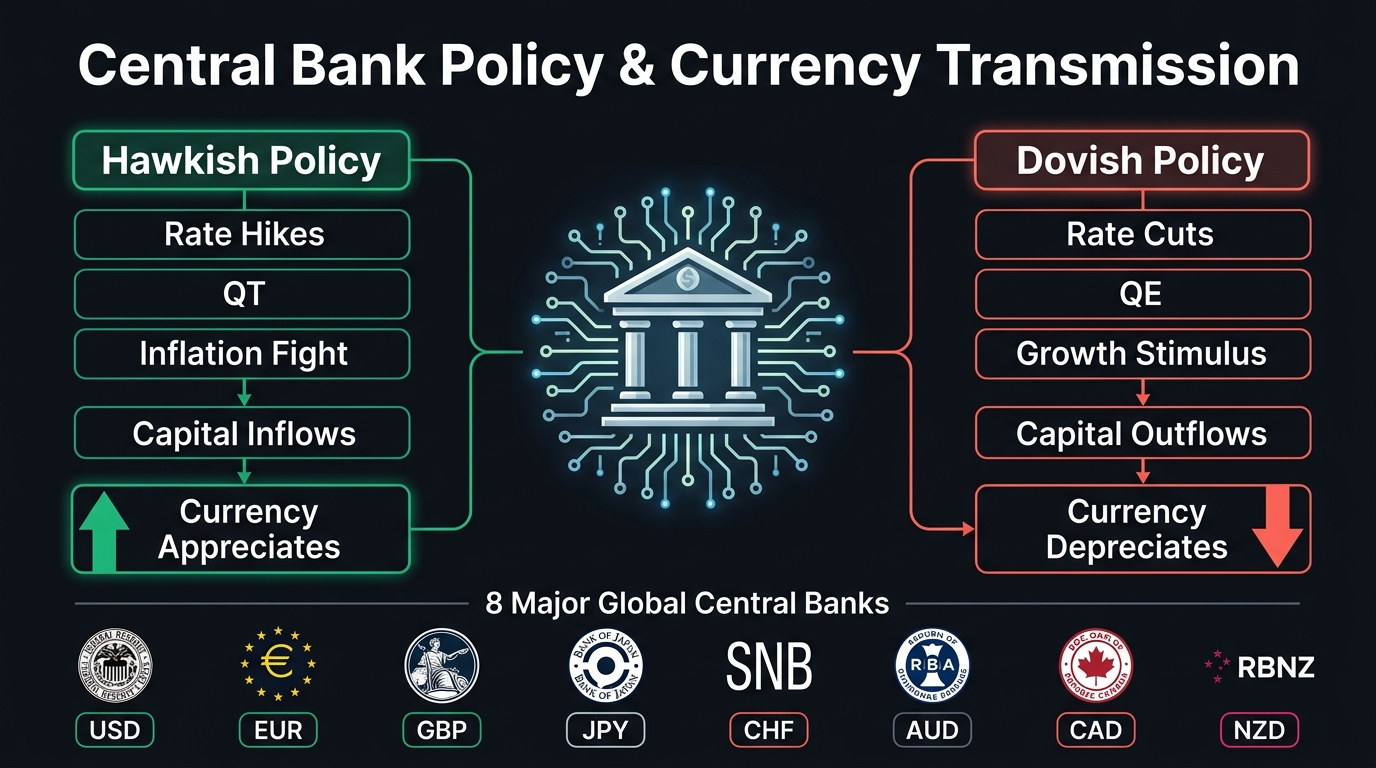
Price charts show you what currency prices are doing. Fundamental analysis tells you why. Understanding the economic forces that drive currency value doesn’t require an economics degree — it requires knowing which indicators matter, what they signal, and how market participants typically respond to them.
This lesson covers the core of fundamental analysis for forex traders: the economic framework, the data that moves markets, and how to build a coherent picture from multiple sources.
The Core Question: Why Does a Currency Have Value?
A currency’s value in forex is its relative purchasing power compared to another currency. The Swiss franc doesn’t have an absolute value — it has a value measured against the euro, the dollar, the yen. That relative value is determined by market participants constantly reassessing which economy is stronger, which central bank is more hawkish, and which currency offers better returns.
Three fundamental factors drive this assessment at the macro level:
Interest rate differentials — the difference between what you earn holding one currency versus another. If US Treasury bonds yield 5% and Japanese government bonds yield 0.1%, global capital flows toward the dollar. Investors need dollars to buy those bonds, which pushes the dollar higher.
Economic growth expectations — if analysts expect the UK economy to outperform the eurozone over the next 12 months, sterling tends to attract inflows at the expense of the euro.
Inflation dynamics — high inflation erodes a currency’s purchasing power, but it also prompts central banks to raise rates — which can be supportive. The relationship is non-linear and requires context.
The Economic Calendar: Your Essential Tool
The economic calendar lists scheduled data releases, central bank meetings, and policy announcements that can move currency prices. Knowing what’s coming — and when — is fundamental analysis in practice.
High-impact releases to watch:
| Release | Currency | Typical Impact |
|---|---|---|
| Non-Farm Payrolls (NFP) | USD | Very high — released first Friday of each month |
| CPI (Consumer Price Index) | All majors | High — directly signals inflation trend |
| Central bank rate decisions | All | Extreme — the single biggest scheduled event |
| GDP (Quarterly) | All majors | Medium-high — confirms growth trend |
| PMI surveys | All majors | Medium — early signal of business activity |
| Retail Sales | USD, GBP | Medium — measures consumer spending |
The market doesn’t just react to the data — it reacts to how the data compares to consensus expectations. If economists forecast 200,000 new jobs and the NFP comes in at 350,000, the dollar typically surges even if 350,000 jobs is objectively moderate — because it beat the expectation by a significant margin.
This is why reading economic calendars requires two numbers: the forecast and the previous reading. The actual release matters relative to both.
Interest Rates: The Dominant Driver
No fundamental force moves currencies more consistently than interest rate policy. When the Federal Reserve raises the federal funds rate, it means:
- US government bonds now offer higher yields
- Global investors sell lower-yielding assets in other currencies to buy dollar-denominated bonds
- Demand for dollars rises
- USD strengthens across the board
This is why forex traders pay meticulous attention to central bank communications — not just rate decisions, but the language used in statements and the tone of press conferences. A central bank signaling future rate hikes (“hawkish”) supports its currency even before rates actually change. One signaling cuts (“dovish”) weakens it.
The major central banks that drive currency markets:
- Federal Reserve (Fed) — US dollar
- European Central Bank (ECB) — euro
- Bank of England (BoE) — British pound
- Bank of Japan (BoJ) — Japanese yen
- Reserve Bank of Australia (RBA) — Australian dollar
- Swiss National Bank (SNB) — Swiss franc
GDP: The Economy’s Report Card
Gross Domestic Product measures the total value of goods and services produced in an economy during a specific period. The standard formula:
GDP = Consumption + Investment + Government Spending + (Exports - Imports)
For the United States, personal consumption consistently accounts for 68–70% of GDP — which is why consumer spending data (retail sales, consumer confidence) is so closely watched. For export-heavy economies like Germany and Japan, trade balances and manufacturing output carry more weight.
Quarterly GDP releases tend to move markets primarily when they significantly beat or miss expectations, or when growth turns negative (signaling recession risk). Annual GDP trends matter for longer-term currency positioning.
Inflation: The Double-Edged Force
The Consumer Price Index (CPI) measures the average change in prices paid by consumers for a basket of goods and services. It’s the primary inflation gauge used by central banks worldwide.
High CPI (above a central bank’s target, typically 2%) is generally negative for a currency’s purchasing power — your money buys less over time. But high inflation also forces central banks to raise interest rates to control it, which tends to strengthen the currency as capital flows in seeking higher yields.
The scenario traders watch for: inflation rising faster than the central bank can control, leading to forced aggressive rate hikes that slow the economy. This is the situation several G10 economies faced in 2022–2023, creating some of the largest currency moves in decades.
Core CPI strips out volatile food and energy prices to give a cleaner read on underlying inflation trends. Central banks typically target core inflation when making policy decisions.
Building a Fundamental View
Fundamental analysis for currency trading isn’t about predicting exact price targets. It’s about developing a directional bias — a view that one currency is more likely to strengthen or weaken relative to another over a relevant timeframe — and then waiting for technical confirmation before entering a position.
A basic framework:
- Identify the interest rate trajectory — is the central bank hiking, holding, or cutting? How does this compare to the counterpart currency’s central bank?
- Assess economic momentum — is growth accelerating or slowing? Are leading indicators (PMI surveys) pointing up or down?
- Track inflation dynamics — is inflation above or below target? Is it trending toward or away from the target?
- Read the central bank’s tone — recent speeches, meeting minutes, and official statements often give explicit guidance about future policy direction.
When the answers to these questions tell a coherent story — one economy is clearly stronger, its central bank is hawkish, and its currency is still undervalued relative to the fundamental picture — that’s when fundamental analysis provides its most actionable signal.
Next: Sentiment Analysis: Reading the Market’s Mood
Previous: Three Types of Forex Analysis
Related lessons: Interest Rates and Currency Value | How to Read the Economic Calendar
Related dictionary terms: GDP | CPI | Interest Rate | Hawkish

Ready to Practice This Strategy?
Test what you learned on a free, risk-free demo account before risking real money.