Money Management in Forex: Protecting Capital Before Chasing Profit
Most forex traders lose not because of bad analysis, but because of poor money management. Learn position sizing, the 1% rule, stop-loss placement, and how to build a systematic approach.
You can be right about the market’s direction 60% of the time and still lose money. That’s not a paradox — it’s the mathematics of poor money management. If your winning trades average 20 pips and your losing trades average 80 pips, a 60% win rate produces consistent losses. The math doesn’t care about your analysis.
Money management is the system that determines how much to risk on each trade, where to place stops, and when to exit. Get it wrong, and even a profitable strategy will bleed your account. Get it right, and a moderately successful strategy can sustain you through inevitable losing streaks without threatening your trading capital.
The First Rule: Capital Preservation
Before you think about how much you can gain on a trade, establish how much you can lose. Professional traders call this risk-first thinking, and it’s the single biggest mindset difference between retail traders who last years and those who blow accounts in months.
The mechanics are simple. Before entering any trade, you define:
- The entry price
- The stop-loss level (where you’re wrong)
- The maximum dollar amount you’re willing to lose on this trade
Everything else — lot size, position size — flows from these three inputs.
The 1% Rule: The Foundation of Sustainable Trading
The most widely used guideline in professional forex trading is risking no more than 1% of your account on any single trade. On a $10,000 account, that’s $100 per trade. On a $1,000 account, that’s $10.
Why 1%? Because it allows you to survive extended losing streaks without your account reaching a point of no return.
Consider two scenarios on a $10,000 account:
| Risk per trade | After 10 consecutive losses | Account remaining |
|---|---|---|
| 10% ($1,000) | 10 losses | $3,487 |
| 1% ($100) | 10 losses | $9,044 |
Ten consecutive losses are rare but not impossible in any trading strategy. At 10% risk, they reduce your account by 65% — from which you need a 186% return just to break even. At 1%, you’ve lost less than 10%, and the psychological pressure to “win it back” is dramatically reduced.
The 1% rule also disciplines position sizing. If your stop is 50 pips and you’re risking $100 on a $10,000 account, your position size is approximately 0.2 standard lots (2 mini lots or 20 micro lots). This calculation — not gut feel — is how you determine lot size.
Calculating Position Size
The formula:
Position Size = (Account Risk in $) / (Stop Loss in pips × Pip Value)
For EUR/USD with a standard lot:
- Account: $10,000
- Risk per trade: 1% = $100
- Stop loss: 40 pips
- Pip value per standard lot: $10
Position size = $100 / (40 × $10) = $100 / $400 = 0.25 lots (25,000 units)
Use the position size calculator to run these calculations automatically before every trade.
Stop-Loss Orders: Non-Negotiable
A stop-loss order automatically closes your position when price reaches a specified level — limiting your maximum loss on a trade. Operating without stop losses in the forex market is the equivalent of driving without a seatbelt: fine until it isn’t.
Where to place stops:
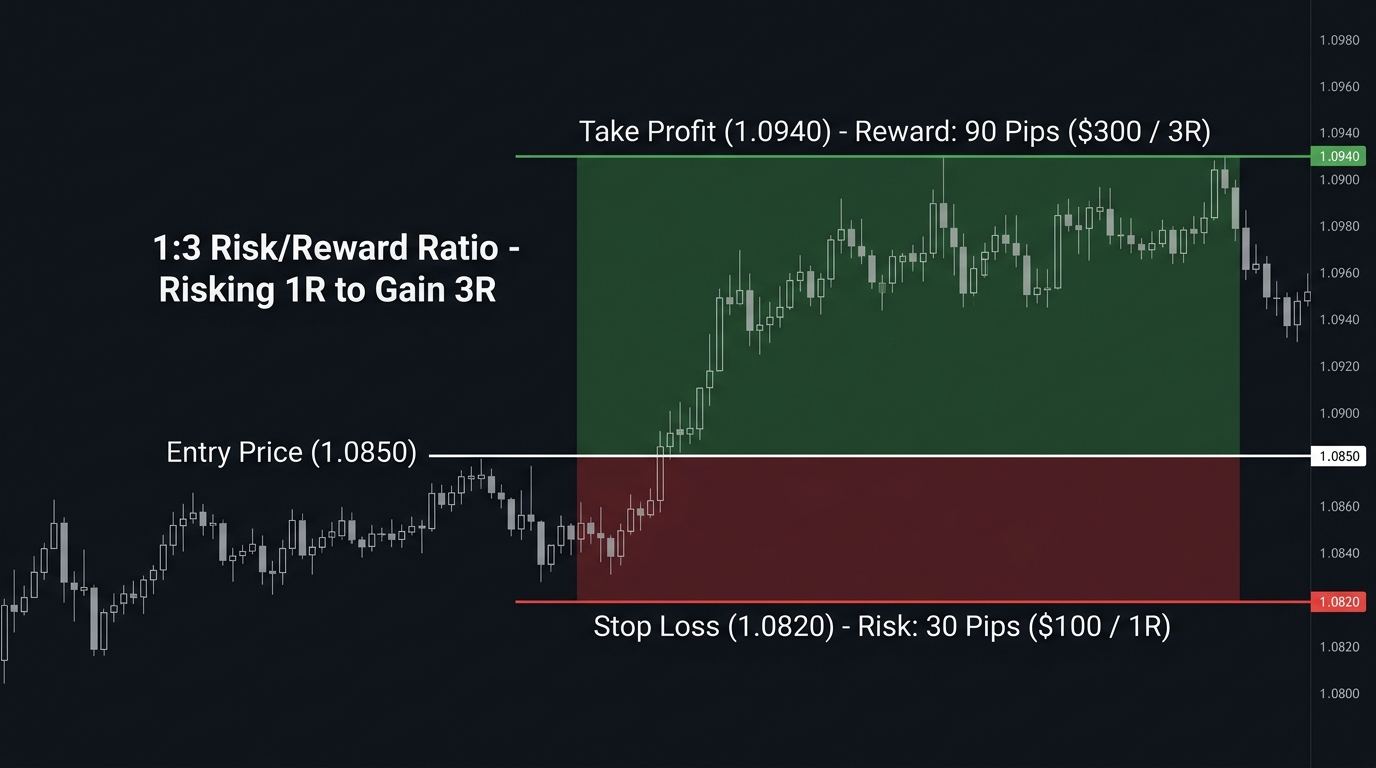
Structural placement — behind the nearest significant support or resistance level. If you’re going long on EUR/USD at 1.0850, your stop might go below the recent swing low at 1.0820 — because if price breaks that level, your rationale for the trade is invalidated.
ATR-based placement — using the Average True Range (ATR) indicator to set stops at a distance that reflects normal market volatility. A stop too close gets hit by normal noise; a stop too far means accepting an unacceptable loss.
Never move a stop against you — moving a stop to give a losing trade “more room” is the most common way small losses become account-threatening losses. If the market has moved against your stop, it means the trade setup was wrong.
Risk-Reward Ratio: The Other Half of the Equation
The risk-reward ratio (RRR) compares your potential gain to your maximum risk. A 1:2 RRR means you’re risking 1 unit to potentially gain 2.
At a 1:2 RRR, you only need a 34% win rate to break even (before costs). At 1:1, you need 50%+. Most experienced traders target a minimum of 1:2 on swing trades, and 1:1 or better on shorter-term setups with higher win rates.
The practical implication: don’t take trades where the nearest logical target offers less reward than you’re risking. If your stop is 40 pips and the nearest resistance is only 20 pips away, the math doesn’t support the trade regardless of how confident you feel.
Building a Money Management System
A complete money management framework covers:
Maximum account risk: Total percentage of account that can be at risk across all open positions simultaneously. Many professionals cap this at 5% total exposure regardless of the number of trades.
Lot sizing: Calculated from the 1% rule and stop-loss distance — never fixed at “1 mini lot per trade.”
Drawdown limit: A pre-defined threshold (e.g., 15% drawdown) at which you reduce position size or pause trading entirely to review your approach. Protecting against catastrophic drawdowns matters more than short-term performance.
Profit-taking rules: Where do you take partial profits, where do you trail your stop, and what’s the full target? Systematic answers to these questions prevent decisions being driven by the emotions of the moment.
Consistency in money management builds the compounding math that turns a modest edge into genuine long-term profitability. Without it, even excellent analysis produces inconsistent outcomes.
Next: How Forex Trading Works: Mechanics of Placing Trades
Previous: Sentiment Analysis
Related lessons: Risk Management Basics | Risk-Reward Ratio | Position Size Calculator
Related dictionary terms: Stop-Loss Order | Risk-Reward Ratio | Drawdown | Lot

Ready to Practice This Strategy?
Test what you learned on a free, risk-free demo account before risking real money.