Why Trade Forex? Real Advantages, Honest Disadvantages
Forex offers 24-hour access, high liquidity, and low entry costs — but also leveraged risk most beginners underestimate. A balanced comparison of forex vs. other markets.
Ask ten professional traders why they chose forex over stocks or futures, and you’ll get ten different answers. But most of them share a common thread: flexibility. Forex fits around life in a way that equity markets simply don’t. You can trade at 3am if that’s when your edge shows up. You can go short as easily as long. You can start with a few hundred dollars and scale from there.
That said, every advantage forex offers has a corresponding risk that isn’t mentioned in the broker pitch decks. Let’s look at both sides honestly.
The Real Advantages of Forex Trading
1. True 24-Hour Market Access
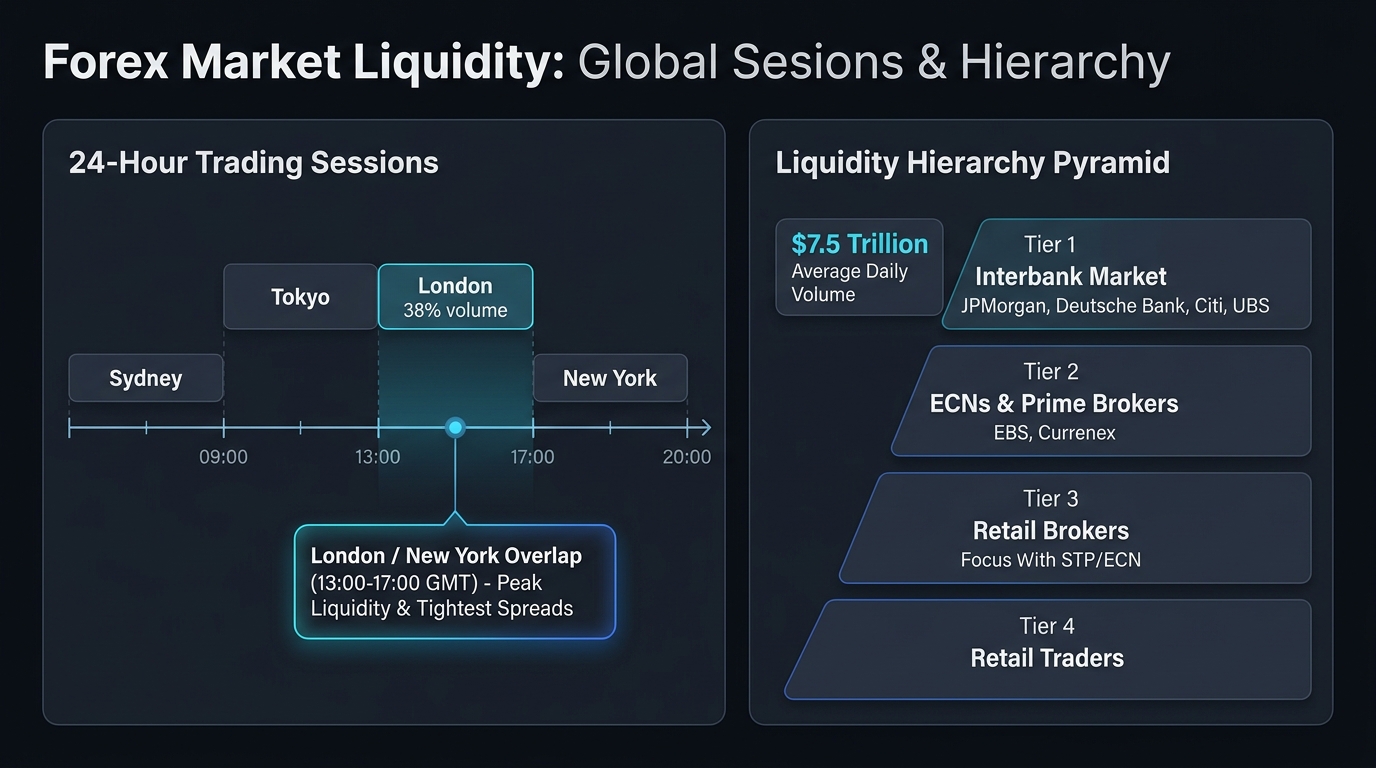
The forex market opens Sunday evening (22:00 UTC) and closes Friday evening (21:00 UTC). Unlike stock exchanges that shut at 4pm and leave you exposed to after-hours earnings surprises, forex moves continuously through Asian, European, and American sessions. If major news breaks at midnight, you can react — or protect your position — in real time.
For traders who work during normal business hours, the Asian session (midnight to 9am London time) offers quieter, range-bound conditions that some strategies exploit specifically. For aggressive day traders, the London-New York overlap (12pm–4pm UTC) delivers the highest volume and tightest spreads.
2. Liquidity That Almost Never Runs Out
The Bank for International Settlements measured global daily forex volume at $7.5 trillion in 2022. This dwarfs equities, futures, and commodities. What it means practically: you can buy or sell major pairs like EUR/USD or USD/JPY in sizes that would move a stock price, and the forex market absorbs it without flinching.
For retail traders, this translates to reliable execution. Slippage — the difference between the price you intended and the price you got — is minimal on major pairs during active sessions. Compare that to small-cap stocks where large orders can noticeably move the market against you.
3. Bidirectional Trading Without Borrowing Complexity
In stock markets, going short requires borrowing shares from your broker, paying borrowing fees, and navigating uptick rules. In forex, selling is structurally identical to buying. When you sell EUR/USD, you’re simultaneously buying USD. No special accounts, no borrowing fees — you just click sell.
This matters strategically. Half the market’s moves are downward. Traders who can only go long are leaving half the opportunity on the table.
4. Low Transaction Costs
Most forex brokers don’t charge commissions on standard accounts. Their revenue comes from the spread — the difference between the buy (ask) and sell (bid) price. On EUR/USD with a reputable broker, this spread is often 0.5–1 pip (roughly 0.005% of the trade value). Compare that to stock trading commissions of $5–10 per trade or futures contracts with fixed fees per contract.
For active traders who open and close dozens of positions per month, cost efficiency compounds significantly over time.
5. Leverage — Amplified Returns (and Losses)
Forex brokers offer leverage, allowing you to control a larger position than your account balance. A 1:100 leverage ratio means $1,000 controls a $100,000 position. A 1% move in your favor earns $1,000 — doubling your account. The same 1% move against you wipes it out.
Leverage is genuinely useful when used carefully as part of a disciplined position sizing strategy. It becomes catastrophic when treated as a way to turn small accounts into large ones quickly. The honest reality is that most retail traders who blow accounts do so because of excessive leverage — not poor trade selection.
Regulated brokers in the EU and UK are capped at 1:30 for major pairs. Australian and offshore brokers offer higher. Know what you’re working with before you deposit.
6. Low Capital Requirements
You can open a live forex account with as little as $50–100 at many brokers. Micro lots (1,000 units of currency) allow you to risk $0.10 per pip, making real money experience accessible without betting the rent. This low barrier means you can test your strategy with genuine stakes while keeping total risk manageable.
Stock trading requires at least $25,000 to day trade in the US under the Pattern Day Trader rule. Futures require margin of $1,000+ per contract. Forex’s flexibility on account size is a genuine structural advantage for those starting out.
The Honest Disadvantages
Leverage Cuts Both Ways
This deserves repetition. Leverage is the single biggest reason retail forex traders lose money. European regulators studied their own brokerage data and found that 74–89% of retail CFD accounts lose money over the long term. Not because forex is rigged, but because most people apply excessive leverage before they have a proven edge.
If you’re going to use leverage, start at 1:5 or 1:10 maximum until you have 6+ months of documented profitable trading history.
The Market Never Sleeps — Neither Does the Risk
24-hour trading sounds like an advantage until you’re asleep and a central bank announcement moves your open position 200 pips against you. Professional traders manage this with stop-loss orders and careful position sizing. Beginners often don’t, and they wake up to margin calls.
The solution isn’t to watch the market all night. It’s to size positions so that the worst realistic overnight move doesn’t meaningfully damage your account.
Counterparty Risk From Brokers
Unlike buying shares through a regulated exchange where your securities are legally segregated, many forex brokers operate as market makers — they take the other side of your trade. This creates a potential conflict of interest: your loss is their gain.
Choosing brokers regulated by the FCA (UK), ASIC (Australia), or CySEC (EU) provides meaningful protection: segregated client funds, negative balance protection, and dispute resolution mechanisms. Using an offshore broker registered in Vanuatu or the Seychelles means accepting that your recourse if they refuse withdrawal is effectively zero.
No Dividends, No Compounding Through Ownership
Stock investors benefit from dividends and the compounding power of reinvestment. Forex traders earn only from price movement. There’s no passive income component, no ownership stake, no underlying business growing in value while you hold it.
This isn’t a fatal flaw, but it shapes the mindset required. Forex trading is an active skill, not a passive investment.
Forex vs. Stocks vs. Futures: A Practical Comparison
| Feature | Forex | Stocks | Futures |
|---|---|---|---|
| Hours | 24/5 | Exchange hours only | Mostly 23/5 |
| Minimum capital | $50–500 | $25,000 (US day trading) | $1,000+ per contract |
| Leverage available | Up to 1:500 (offshore) | 1:2 to 1:4 | 1:10 to 1:20 |
| Going short | As easy as going long | Requires margin account | As easy as going long |
| Transaction costs | Spread only (often < 0.01%) | Commission + spread | Fixed fees per contract |
| Passive income | None | Dividends possible | None |
| Regulatory protection | Strong (FCA/ASIC) | Very strong | Very strong |
Is Forex Right For You?
Forex suits traders who want active, flexible, cost-efficient access to financial markets with the ability to trade in both directions. It’s a poor fit for those looking for passive investment, those unable to manage risk systematically, or those starting with the expectation of quick profits.
The traders who do well over years — not months — tend to share three traits: they have a specific, tested strategy; they manage risk before thinking about reward; and they treat losses as data rather than failures.
The rest of this module will give you the foundation to become one of them.
Next: Currency Pairs: Understanding What You’re Actually Trading
Previous: What Is Forex?
Related dictionary terms: Leverage | Spread | Margin | Stop-Loss Order
Ready to Practice This Strategy?
Test what you learned on a free, risk-free demo account before risking real money.