Spread
The spread is the difference between the bid price (what a broker will buy from you) and the ask price (what they'll sell to you). Quoted in pips, it is the primary transaction cost in forex trading and the main revenue source for market makers.
What Is the Spread in Forex?
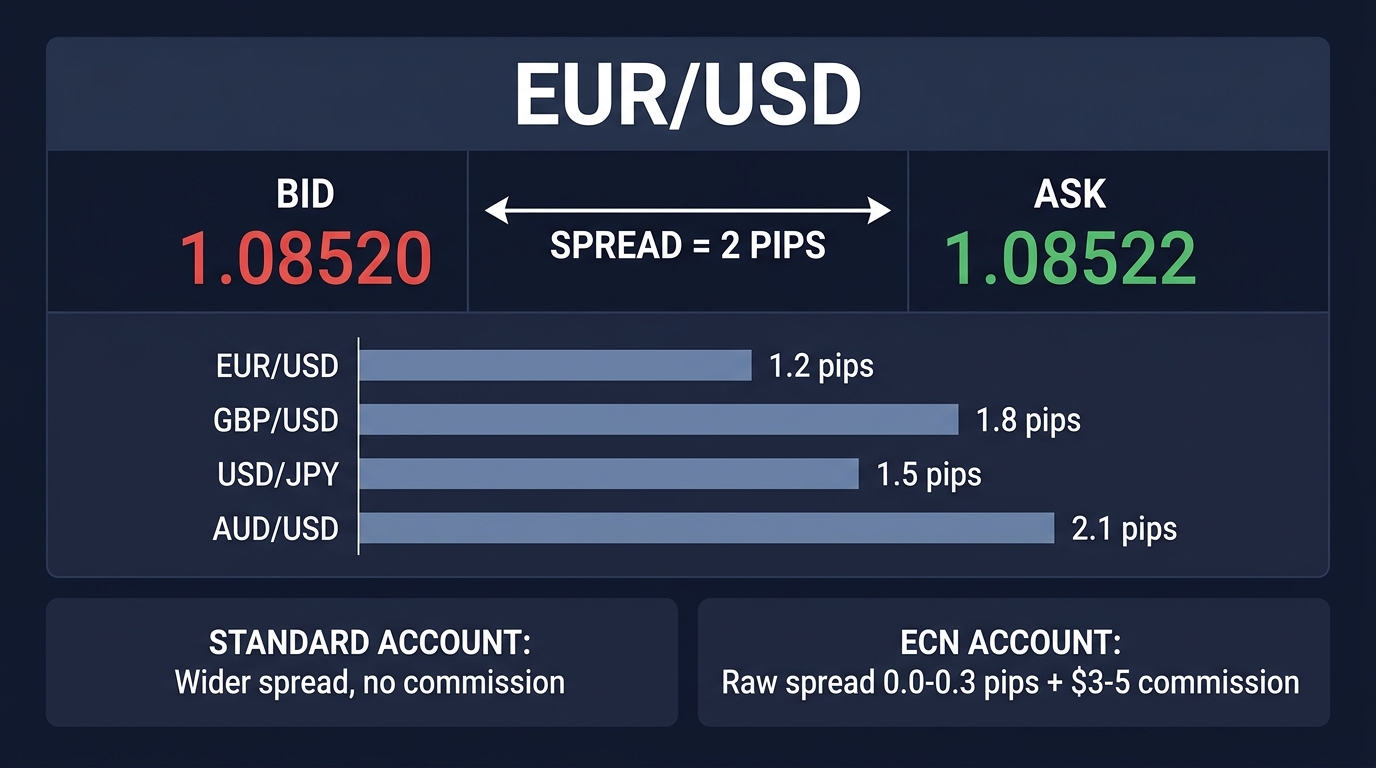
Every forex quote you see is actually two prices: the bid and the ask. The bid is what your broker will pay to buy the base currency from you. The ask is what they charge to sell it to you. The gap between these two numbers is the spread — and it comes out of your pocket the moment you enter any trade.
On EUR/USD with a quote of 1.0852 / 1.0854, the spread is 2 pips. That two-pip gap means you start every long position already 2 pips underwater. You need the market to move in your favor before you break even, let alone profit.
Fixed vs. Variable Spreads
Brokers offer two spread models, and which one you choose has real consequences depending on how you trade.
Fixed spreads stay constant regardless of market conditions. If EUR/USD normally has a 2-pip fixed spread, it stays at 2 pips during the New York session, the London open, and even during major news events. This predictability is useful for traders who need to plan entry and exit costs precisely — particularly scalpers using tight profit targets.
Variable (floating) spreads move with market liquidity. During peak trading hours when London and New York sessions overlap (roughly 13:00–17:00 UTC), major pairs like EUR/USD can trade with spreads as low as 0.1–0.3 pips at ECN brokers. After the New York close, or just before a major data release, that same spread can jump to 3–5 pips or more. During extreme volatility events like a surprise central bank rate decision, spreads can temporarily blow out to 20+ pips.
Variable spreads genuinely reflect market conditions. They’re typically lower on average than fixed spreads during normal hours, but the unpredictability during news events is a real risk for strategies that trade around announcements.
How Spread Affects Your Trading Costs
Here’s something many new traders don’t calculate: spread costs compound over time. A 1.5-pip spread sounds trivial. But if you’re a scalper placing 20 trades per day on a standard lot, you’re paying:
- 1.5 pips × 20 trades × $10/pip = $300 per day in spread costs alone
That’s $6,000 per month in transaction costs before you’ve made a single dollar of profit. Understanding your all-in transaction costs — spread plus any commission — is the first step toward building a strategy that can actually survive long-term.
For swing traders holding positions for days or weeks, spread costs matter much less. A 2-pip spread on a 150-pip target trade represents just 1.3% of the profit target. The math is very different.
Raw Spread vs. Commission-Based Accounts
At ECN and STP brokers, you’ll often encounter two account types:
Standard accounts — spread-only pricing. No separate commission. The broker profits entirely from the spread markup. Convenient, transparent, but typically wider spreads.
Raw/ECN accounts — near-zero spreads (sometimes 0.0 pips on EUR/USD) plus a per-trade commission, often $3–5 per standard lot per side. For active traders, raw accounts are almost always cheaper. A $3 commission plus a 0.2-pip spread beats a “commission-free” 1.5-pip spread on most trade sizes.
The break-even point: if your expected trades will have at least 10-pip profit targets and you trade multiple times per week, a raw account almost certainly saves money. Run your own numbers with your actual trade frequency before committing.
Spread as a Market Health Indicator
Experienced traders watch spread behavior the way a doctor reads a pulse. Spreads tighten when liquidity is deep and market makers are competing aggressively. They widen when liquidity dries up — ahead of major economic releases, during the Asian session for European pairs, or when geopolitical shocks hit overnight.
If you see spreads on a pair you normally trade suddenly doubling or tripling, that’s a signal: something is happening in that market. Sometimes the right trade is no trade at all.
Exotic pairs like USD/TRY or USD/ZAR carry structurally wider spreads — often 30–100+ pips — because liquidity is thinner and hedging costs for brokers are higher. That’s not a broker ripping you off; it reflects genuine market conditions.
Key Takeaways
- The spread is the difference between bid and ask prices, always quoted in pips
- It is the primary cost of every forex transaction
- Fixed spreads offer predictability; variable spreads are lower during liquid hours
- ECN raw spread accounts plus commission are usually cheaper for active traders
- Widening spreads signal reduced liquidity — treat it as market intelligence
FAQ
Is a lower spread always better? Generally yes, but context matters. A broker offering ultra-low spreads with poor execution (frequent requotes, slippage) may cost you more than one with slightly wider spreads and fast, clean fills.
Do spreads apply to both buy and sell trades? Yes. Whether you go long or short, you cross the spread on entry. On exit (closing the position), you’re crossing the spread again in the opposite direction — so you pay the spread twice per round trip.
Ready to trade forex?
Open a free demo account with a regulated broker. Practice with virtual funds before risking real money.