Central Banks Every Forex Trader Must Know
An essential guide to the world's major central banks: the Federal Reserve, ECB, Bank of England, Bank of Japan, and others, including their mandates, policy tools, and how their decisions move forex markets.
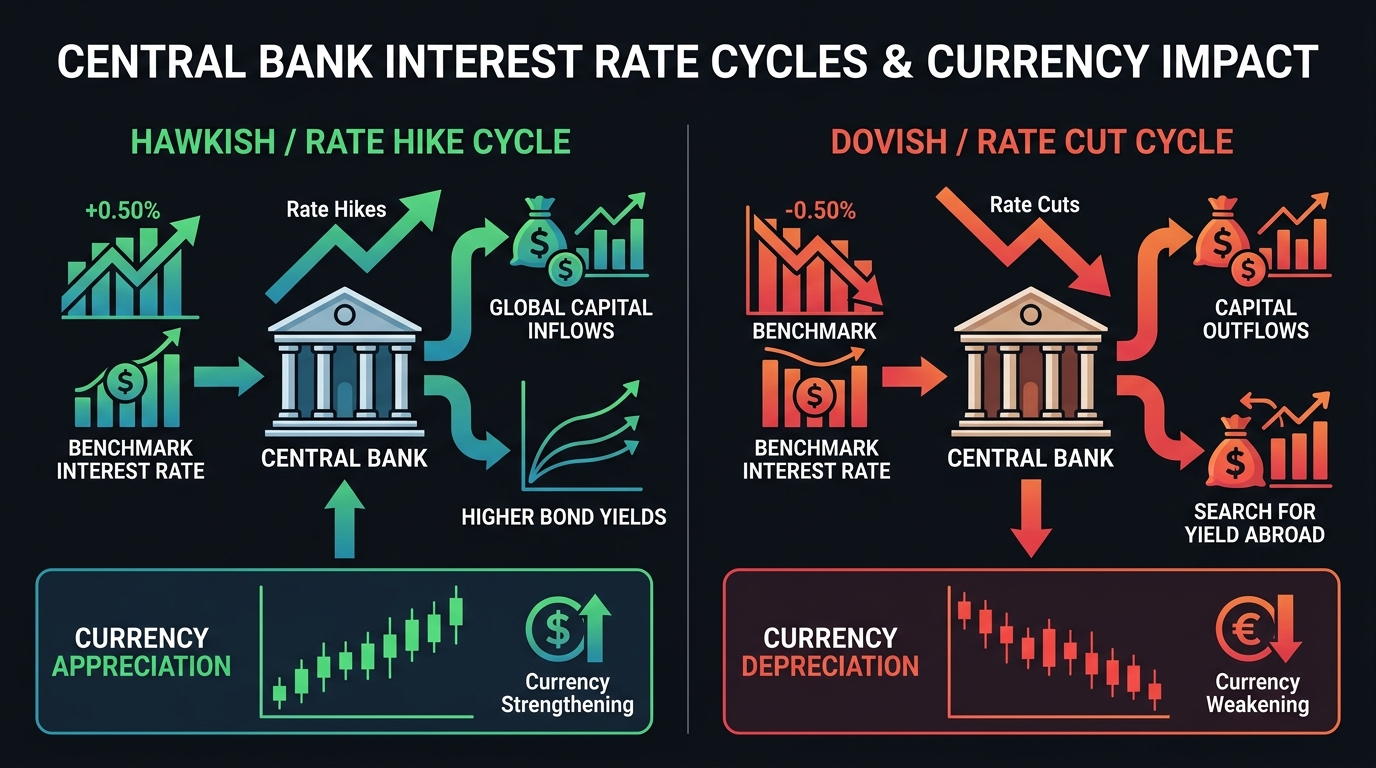
Central banks are the most powerful institutions in the forex market. They don’t trade currencies for profit. They manage entire economies. But their decisions, particularly around interest rates and monetary policy, create the largest, most sustained currency trends that forex traders can identify and follow.
Before you can use fundamental analysis effectively, you need to understand who these institutions are, what they’re trying to accomplish, and how their decisions translate into currency movements.
Why Central Banks Matter So Much to Forex Traders
Every major currency is controlled by a central bank. The US Dollar by the Federal Reserve. The Euro by the European Central Bank. The British Pound by the Bank of England. The Japanese Yen by the Bank of Japan.
When any of these institutions changes interest rates, adjusts its asset purchase programs, or shifts its public guidance about future policy, currency markets move — sometimes dramatically. A single Federal Reserve rate decision can move EUR/USD by 100 pips in minutes and set the tone for a multi-week trend.
The reason is straightforward: interest rate differentials between countries drive currency flows. When the Fed raises rates while the ECB holds steady, holding US Dollars in interest-bearing accounts becomes relatively more attractive than holding Euros. Investors convert euros to dollars to access that yield difference. Demand for USD rises. The dollar strengthens.
Learning which central banks matter, what their mandates are, and when they meet is foundational knowledge for any fundamental analysis approach.
The Federal Reserve (United States)
Mandate: The Fed has a dual mandate from Congress: maximum employment and stable prices (targeting 2% annual inflation). This makes the Fed unique among major central banks in that it officially balances two objectives rather than prioritizing inflation alone.
How it moves markets: Fed decisions are the single most globally impactful central bank events. Because the US Dollar is the world’s reserve currency and a component of virtually every major currency pair, Fed policy ripples through forex markets broadly. Even currencies not directly paired with USD (like EUR/GBP) can be affected if Fed decisions shift global risk sentiment.
Key communication channels: FOMC (Federal Open Market Committee) meetings occur eight times per year. After each meeting, a policy statement is released, followed by a press conference with the Fed Chair. Meeting minutes are published roughly three weeks later. The Chair’s semi-annual testimony to Congress (Humphrey-Hawkins testimony) is also closely watched.
Website: federalreserve.gov
The European Central Bank (ECB)
Mandate: The ECB has a singular mandate: price stability, defined as inflation “close to but below 2%” (revised to a symmetric 2% target in 2021). Unlike the Fed, the ECB does not have an explicit employment mandate, though it does consider broader economic conditions.
How it moves markets: ECB decisions directly affect EUR, which is the world’s second most traded currency. Because EUR is heavily weighted in the US Dollar Index, ECB policy shifts also influence DXY readings and can ripple into other dollar pairs. ECB President press conferences frequently produce the largest intraday EUR moves of the month.
Governing Council meetings occur roughly every six weeks, with press conferences following decisions where rates or forward guidance changes are expected. The ECB also publishes an Economic Bulletin eight times per year with detailed economic analysis.
Website: ecb.europa.eu
The Bank of England (BoE)
Mandate: The Bank of England targets 2% CPI inflation as its primary mandate, with a secondary objective of supporting the government’s economic objectives, including “output and employment.” It gained operational independence from the UK government in 1997.
How it moves markets: BoE decisions affect GBP directly, making them critical events for GBP/USD (Cable) and EUR/GBP traders. The BoE’s quarterly Monetary Policy Report (formerly the Inflation Report) includes detailed economic forecasts and is a major market-moving document. MPC (Monetary Policy Committee) members regularly give speeches that provide advance signal about policy direction.
The BoE’s history gives it context: founded in 1694, it’s one of the world’s oldest central banks and often referred to as “the Old Lady of Threadneedle Street,” a nickname derived from its London address.
Website: bankofengland.co.uk
The Bank of Japan (BoJ)
Mandate: The BoJ pursues price stability with a 2% inflation target, but has historically struggled with deflation rather than excessive inflation. Its policy has been characterized by prolonged ultra-low (and negative) interest rates and aggressive asset purchase programs that distinguish it from its Western counterparts.
How it moves markets: BoJ decisions affect JPY and, by extension, all JPY cross pairs (USD/JPY, EUR/JPY, GBP/JPY). Because Japan maintained near-zero or negative rates for decades while other central banks were hiking, JPY carry trades (borrowing cheap yen to invest in higher-yielding currencies) became a significant market phenomenon. When the BoJ signals any rate normalization, these carry trades unwind rapidly, causing sharp JPY strengthening.
Yield Curve Control (YCC) — the BoJ’s policy of targeting the 10-year Japanese government bond yield — was a distinctive tool that influenced global bond markets. Adjustments to YCC targets in 2022 and 2023 produced significant JPY volatility.
Website: boj.or.jp
The Swiss National Bank (SNB)
Mandate: The SNB targets price stability and considers the economic situation in Switzerland. It meets only four times per year (quarterly), which makes each meeting particularly significant.
How it moves markets: The SNB manages CHF, which is a classic safe-haven currency. During global risk-off periods, CHF tends to strengthen as investors seek safety. The SNB has historically intervened directly in forex markets to prevent excessive CHF appreciation, which would harm Swiss exports. This interventionist history makes CHF pairs (especially EUR/CHF and USD/CHF) occasionally subject to sudden large moves when SNB policy shifts.
Website: snb.ch
The Bank of Canada (BoC)
Mandate: The BoC targets 2% CPI inflation (the midpoint of a 1-3% control range) in coordination with the federal government’s economic objectives.
How it moves markets: BoC decisions affect CAD directly. Given Canada’s deep trade relationship with the United States (approximately 75% of Canadian exports go to the US), USD/CAD is also heavily influenced by US economic data and Fed policy. Oil prices are a secondary but significant CAD driver due to Canada’s oil export sector. CAD and oil prices have maintained a meaningful positive correlation over most market cycles.
Website: bankofcanada.ca
The Reserve Bank of Australia (RBA)
Mandate: The RBA targets 2-3% CPI inflation with additional objectives of full employment and economic prosperity.
How it moves markets: RBA decisions directly affect AUD. Australia’s commodity export sector (particularly iron ore and coal, predominantly to China) means AUD also responds to Chinese economic data and global commodity prices. AUD is generally considered a high-beta risk currency: it tends to outperform in risk-on environments and underperform when global risk appetite deteriorates.
The RBA meets eleven times per year, with meetings in every month except January.
Website: rba.gov.au
The Reserve Bank of New Zealand (RBNZ)
Mandate: The RBNZ targets 1-3% CPI inflation with a 2% midpoint, and since 2018 has had a secondary mandate to support maximum sustainable employment.
How it moves markets: RBNZ decisions affect NZD (often called the “Kiwi”). NZD and AUD are closely correlated due to New Zealand’s and Australia’s similar economic profiles, though NZD is smaller and less liquid. NZD is sensitive to dairy prices (New Zealand’s dominant export commodity) and to Chinese economic conditions.
Website: rbnz.govt.nz
How to Monitor Central Bank Activity
For ongoing monitoring, the most important practices:
Follow the scheduled meeting calendar. All major central banks publish their meeting schedules a full year in advance. Add the high-impact meetings for the pairs you trade to your calendar at the start of each year.
Read post-meeting statements carefully. The language shifts between statements are more important than any single statement in isolation. Analysts closely parse words like “patient,” “vigilant,” “gradual,” and “timely” for changes in tone.
Watch Governor speeches. Central bank governors and board members regularly speak publicly between meetings. These speeches can shift market expectations significantly when they deviate from the last official statement.
Use the economic calendar. Every major economic calendar tool flags central bank meeting dates and assigns them high-impact ratings. These are the events most likely to produce tradable moves.
Key Takeaways
- Central bank interest rate decisions are the most powerful driver of sustained currency trends in forex.
- The Federal Reserve has the greatest global influence because USD is the world’s reserve currency.
- Each major central bank has a specific mandate; the Fed’s dual mandate (employment + inflation) is unique among its peers.
- Rate differentials between countries drive capital flows and currency valuations.
- Follow scheduled meeting calendars, post-meeting statements, and Governor speeches to track policy direction in real time.
Continue this module: Interest Rates and Forex | Monetary Policies Explained

Ready to Practice This Strategy?
Test what you learned on a free, risk-free demo account before risking real money.