What Is Fundamental Analysis in Forex? The Beginner's Complete Guide
Fundamental analysis uses economic data, interest rates, and geopolitical events to determine the fair value of a currency. Learn how it works, which indicators matter most, and how to apply it in 2026.
Technical analysis looks at price charts. Fundamental analysis looks at what drives the price in the first place.
Every currency in the world has a value relative to every other currency. That value isn’t arbitrary — it reflects the economic health of the country that issues it, its interest rates relative to other countries, its inflation trajectory, its political stability, and the collective expectation of where all those factors are heading.
Fundamental analysis is the study of these underlying drivers. Traders who understand it can identify when a currency is structurally mispriced and position for multi-week or multi-month moves. Traders who ignore it trade blind to the most powerful forces in the market.
Technical vs. Fundamental Analysis: The Core Difference
| Aspect | Technical Analysis | Fundamental Analysis |
|---|---|---|
| Primary data source | Price charts | Economic reports, central bank data |
| Time horizon | Minutes to days | Days to months |
| What it identifies | Entry/exit timing | Direction and potential magnitude |
| What it ignores | Why price moved | When exactly to enter |
| Best combined with | Fundamentals for direction | Technicals for timing |
The majority of professional traders use both. Fundamentals determine the direction and duration of the trade thesis; technicals determine the entry and exit timing.
A pure fundamental trader might correctly identify that AUD should appreciate vs. JPY based on interest rate differentials — but if they enter at the wrong price or time, they may face a significant drawdown before the thesis plays out. A technical entry refined by fundamental context produces better trade quality.
The Three Pillars of Forex Fundamental Analysis
Pillar 1: Interest Rates
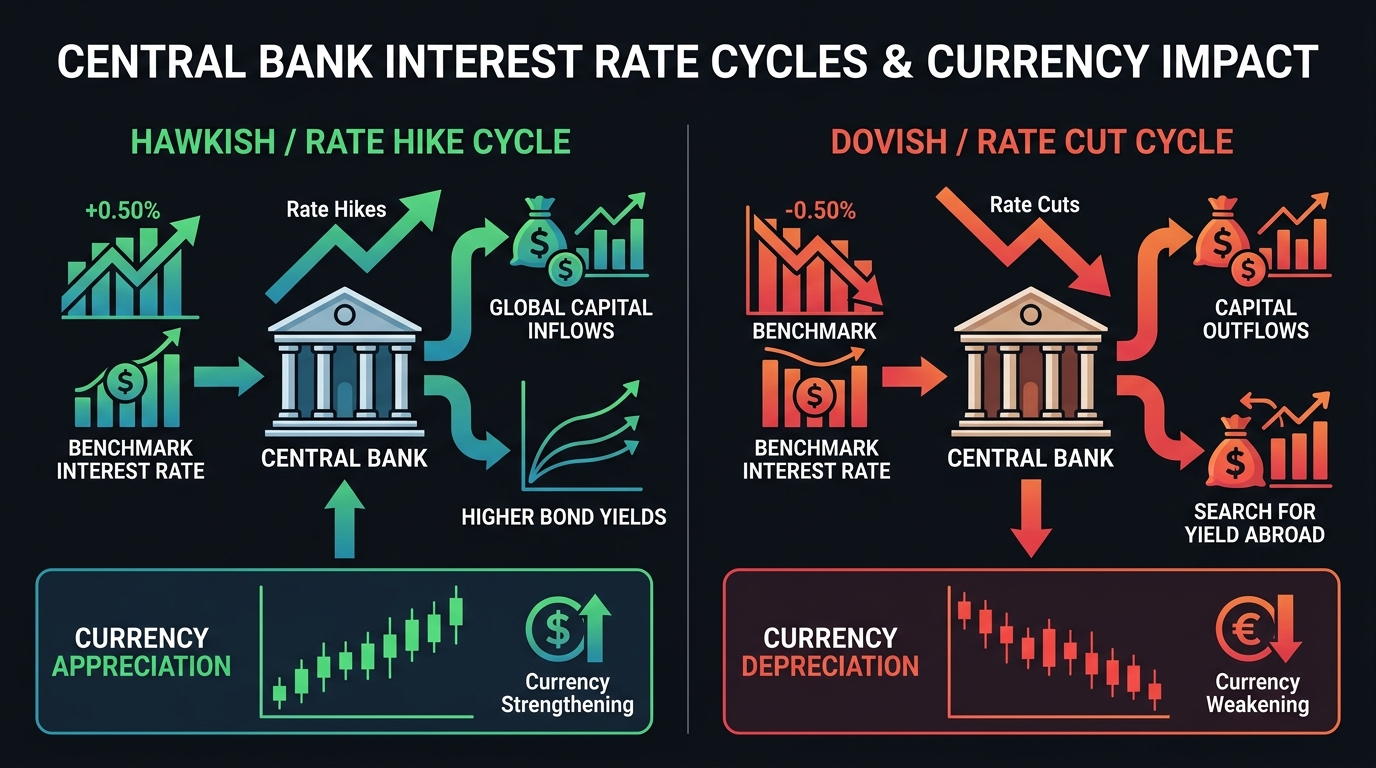
Interest rates are the single most powerful driver of currency values over the medium-to-long term. When a central bank raises rates, it makes holding that currency more attractive — capital flows in from yield-seeking investors, driving the currency up.
The full treatment is in the interest rates lesson. The summary: track the rate differential between two currencies in a pair. Wider differential = stronger directional bias toward the high-yield currency.
Key institutions to follow in 2026:
- Federal Reserve (USD) — fed.gov
- European Central Bank (EUR) — ecb.europa.eu
- Bank of England (GBP) — bankofengland.co.uk
- Bank of Japan (JPY) — boj.or.jp
Pillar 2: Economic Indicators
The economic health of a country determines its currency’s long-term direction. Key reports:
| Indicator | What It Measures | Release Frequency | Currency Impact |
|---|---|---|---|
| Non-Farm Payrolls (NFP) | US employment change | Monthly | Very High |
| CPI (Consumer Price Index) | Inflation rate | Monthly | High |
| GDP (Gross Domestic Product) | Total economic output | Quarterly | High |
| Retail Sales | Consumer spending | Monthly | Medium |
| PMI (Purchasing Managers’ Index) | Manufacturing/services activity | Monthly | Medium |
| Unemployment Rate | % of workforce unemployed | Monthly | Medium |
| Trade Balance | Export vs. import value | Monthly | Medium-Low |
| Current Account | Broader trade and financial flows | Quarterly | Medium |
How to read these: Each release comes with three numbers — the forecast (consensus expectation), the previous reading, and the actual result. The market has priced in the forecast. The impact comes from the deviation between actual and forecast:
- Actual beats forecast (for USD: NFP higher than expected) → USD strengthens
- Actual misses forecast → USD weakens
- Large beat or miss → Large move; small deviation → modest move
Pillar 3: Market Sentiment and Risk Appetite
Not all currency moves are driven by pure economic data. Global risk sentiment — the collective willingness of investors to take risk — has a powerful influence on several currency pairs.
Risk-on environment: Investors feel confident; they move into higher-yielding, higher-volatility assets. Commodity currencies (AUD, NZD, CAD) tend to strengthen; safe havens (JPY, CHF, USD to some extent) weaken.
Risk-off environment: Investors become fearful; they flee to safety. AUD, NZD, and EM currencies fall; JPY and CHF rally strongly.
Key risk sentiment indicators:
- VIX (CBOE Volatility Index): Fear gauge of US equity markets. VIX above 25 = elevated fear = risk-off
- S&P 500 direction: Equity market rallies often correlate with AUD/JPY and NZD/JPY uptrends
- 10-year Treasury yield: Rising US yields generally support USD
- Gold price: Gold rallying strongly often signals risk-off environment
The Economic Calendar: Your Primary Tool
Every significant economic release is scheduled in advance. The economic calendar lists:
- Date and time of each release
- Currency affected
- Importance level (low / medium / high)
- Previous reading
- Forecasted reading
Review the calendar every Sunday for the upcoming week. Highlight all high-impact events for the pairs you trade. This has two applications:
- Trading opportunity: High-impact events create volatility. Plan how you’ll approach them (pre-news, post-news, or avoid entirely).
- Risk management: Know when to reduce open position sizes or tighten stops ahead of a potential volatility spike.
Read the full guide in How to Read an Economic Calendar.
Fundamental Analysis in Practice: A Step-by-Step Framework
Weekly preparation (Sunday):
- Note all high-impact events for the week (central bank meetings, NFP, CPI releases)
- Identify the current rate stance for each major central bank
- Review the most recent GDP and inflation data for the currencies you trade
- Assess the broader risk environment (VIX level, equity market direction, recent geopolitical developments)
Directional bias formation:
- Which currency has the more supportive fundamental backdrop?
- Is the rate differential widening or narrowing?
- Is the recent data flow confirming or contradicting the current trend?
Trade thesis:
- “EUR/USD should decline over the next 2–3 weeks because: (a) the ECB is cutting rates while the Fed is holding, widening the USD rate advantage; (b) recent EU PMI data has missed expectations; (c) USD positioning is still net-long but not extreme.”
Technical entry:
- With this fundamental thesis in mind, look for technical setups on the 4H chart that allow you to short EUR/USD with a defined stop-loss and take-profit.
Fundamental vs. Technical: Which Is “Better”?
Neither is universally better. They answer different questions:
Technical analysis asks: “Given recent price behavior, where is price likely to go next?”
Fundamental analysis asks: “Given economic conditions, what is this currency’s fair value direction over the coming weeks?”
The combination is more powerful than either alone. When your technical entry signal aligns with a clear fundamental directional bias, your confidence — and typically your accuracy — is higher. When they conflict, it’s a reason to reduce position size or stand aside.
Key Takeaways
- Fundamental analysis studies the economic drivers behind currency prices: interest rates, economic data, and market sentiment
- Interest rates are the most important fundamental factor; higher rates attract capital inflows that strengthen the currency
- Economic indicators (NFP, CPI, GDP, PMI) move markets when they deviate from consensus forecasts — the actual vs. forecast gap drives the price reaction
- Market sentiment (risk-on vs. risk-off) affects commodity currencies vs. safe havens; VIX and equity market direction are useful proxies
- The economic calendar is your primary tool — review it every Sunday and plan around high-impact events for the week ahead
- Fundamentals provide directional bias and trade thesis; technical analysis provides entry and exit timing. Use both.
Next in this module: Interest Rates and Forex | How to Read an Economic Calendar
Related strategies: Carry Trade | News Trading

Ready to Practice This Strategy?
Test what you learned on a free, risk-free demo account before risking real money.