Inflation Indicators in Forex: CPI, PPI, and PCE Explained
Inflation data moves forex markets more than almost any other indicator. Learn what CPI, PPI, and PCE measure, why they drive central bank decisions, and how to trade around inflation releases in 2026.
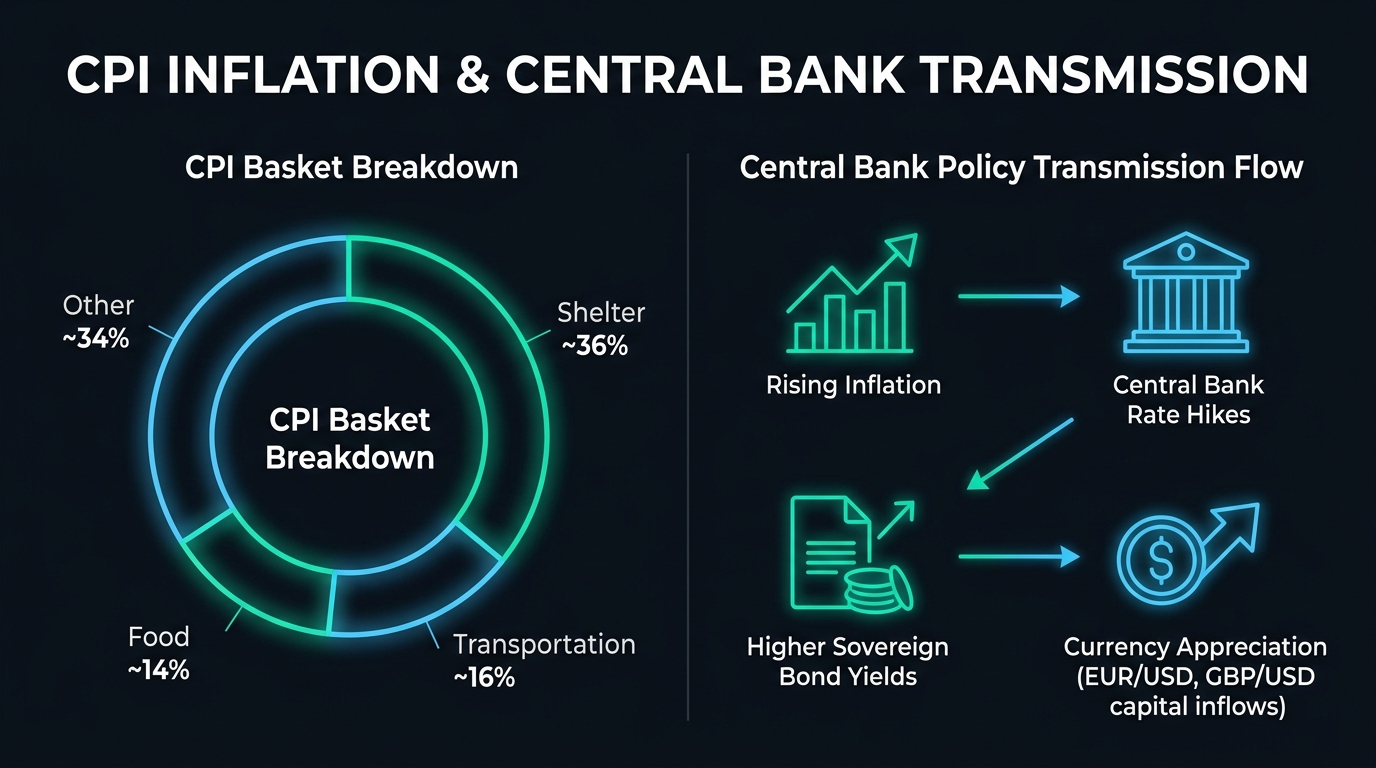
For most of the 2010s, inflation was irrelevant to forex traders. Rates were pinned near zero across all major economies. CPI data was released monthly, markets yawned, and nothing moved.
Then came 2021–2022. US CPI reached 9.1% in June 2022 — a 40-year high. Every inflation release became a major market event. Central banks raised rates at the fastest pace in decades. Inflation data went from a minor calendar entry to the single most market-moving monthly release for the US Dollar and Euro.
In 2026, while inflation has moderated from its peak, it remains the primary driver of central bank policy — and therefore one of the most important datasets for forex traders to understand.
The Three Major Inflation Indicators
CPI (Consumer Price Index)
What it measures: The average change in prices paid by consumers for a basket of goods and services. The basket includes food, housing, clothing, transportation, medical care, and recreation.
Reported as: Year-over-year (YoY) percentage change and month-over-month (MoM) change.
Release schedule (US): Monthly, typically on the second or third Tuesday or Wednesday of the month. Published by the Bureau of Labor Statistics (BLS).
Core CPI vs. Headline CPI:
| Type | What’s Included | Why It Matters |
|---|---|---|
| Headline CPI | All items including food and energy | The number reported in media; actual cost of living |
| Core CPI | All items EXCEPT food and energy | Fed’s preferred measure; strips volatile components |
| Super Core CPI | Services excluding housing and energy | Recently watched closely by the Fed |
The Fed focuses on Core CPI because food and energy prices are volatile and often mean-revert. A spike in oil prices distorts headline CPI without necessarily reflecting sustained inflationary pressure.
Market impact: CPI is the most market-moving monthly US data release aside from NFP. A surprise to the upside (actual > forecast) typically strengthens USD because it raises expectations for higher rates. Downside surprise weakens USD.
PPI (Producer Price Index)
What it measures: The average change in selling prices received by domestic producers for their output. It measures inflation at the production stage, before costs pass through to consumers.
Why it matters for forex: PPI is a leading indicator for CPI. When producer costs rise, businesses eventually pass those costs to consumers in the form of higher retail prices. A rising PPI often predicts a future CPI increase — and therefore potential central bank action.
Release schedule (US): Monthly, typically one business day before CPI.
Trading application: PPI is useful for anticipating CPI surprise direction. If PPI beat expectations last month, this month’s CPI has a higher probability of also surprising to the upside.
PCE (Personal Consumption Expenditures Price Index)
What it measures: Similar to CPI but calculated using different methodology. PCE measures the prices paid for goods and services by US households from the producer’s perspective rather than the consumer’s.
Why it matters: The Federal Reserve’s official inflation target (2%) is measured using Core PCE — not CPI. This makes it the technically most important inflation measure for USD pairs.
| Feature | CPI | Core PCE |
|---|---|---|
| Reported by | BLS | Bureau of Economic Analysis |
| Fed’s preferred measure | No | Yes |
| Basket methodology | Fixed basket, consumer survey | Updated basket, broader coverage |
| Typical level vs. CPI | Higher | Lower by ~0.3–0.5% historically |
| Market sensitivity | Very High | High |
| Release date | Mid-month | End of month |
Trading application: Core PCE data surprises drive significant USD moves, particularly when they diverge from what CPI implied earlier in the month.
Reading an Inflation Release: The Three Numbers
Every inflation release presents three numbers:
- Previous: The last month’s reading (already known and priced in)
- Forecast / Consensus: What economists expected this month
- Actual: What was reported
Market reaction is driven by the actual-versus-forecast gap:
| Result | Typical FX Reaction |
|---|---|
| Actual > Forecast (hot print) | Currency strengthens; rate hike expectations rise |
| Actual = Forecast | Minimal reaction; “priced in” |
| Actual < Forecast (cool print) | Currency weakens; rate cut expectations rise |
| Actual significantly different | Large spike; potential reversal after initial reaction |
The revision factor: Every monthly release also revises the previous month’s figure. A downward revision to last month’s CPI can partially offset a slightly above-forecast current reading. Watch for revisions — the market does.
How Inflation Data Connects to Currency Prices
The transmission mechanism:
Inflation Data
     ↓
Central Bank Rate Expectations
     ↓
Interest Rate Differential Between Countries
     ↓
Capital Flows (investors seeking higher yield)
     ↓
Currency Appreciation / Depreciation
This chain means that an unexpected inflation print doesn’t just move the currency in the next hour — it can establish a directional bias for weeks if it significantly shifts rate expectations.
Example (2024): US CPI for January 2024 came in at 3.1% YoY, above the 2.9% forecast. The market repriced Fed rate cut expectations: instead of a March cut, traders now expected no cuts until June. EUR/USD fell 150+ pips on the day and continued lower for the next week.
Central Bank Inflation Targets (2026)
Understanding what each bank is targeting contextualizes each release:
| Central Bank | Inflation Target | Current Rate (Sep 2026, approx.) | Policy Direction |
|---|---|---|---|
| Federal Reserve | 2% PCE | 4.75% | Holding; watching for PCE toward 2.5% |
| European Central Bank | 2% HICP | 3.25% | Cutting cycle; inflation declining |
| Bank of England | 2% CPI | 4.50% | Holding; services inflation sticky |
| Bank of Japan | 2% CPI | 0.25% | First rate hike cycle in 17 years |
| Reserve Bank of Australia | 2–3% CPI | 4.25% | Holding; monitoring |
| Swiss National Bank | <2% CPI | 1.25% | Cutting; inflation below target |
When a country’s inflation is above target, the central bank is under pressure to keep rates high (or raise them). When inflation is at or below target, they have room to cut. This dynamic drives the rate differential — and the currency pair direction.
Trading Around Inflation Releases
Pre-release: Review the consensus forecast. Note whether the previous month surprised in any direction. Consider reducing open position sizes in affected pairs if you have no directional view.
At the release: Do not trade the initial spike. The first 30–60 seconds are chaotic, slippage is high, and initial moves often reverse as the full data (including revisions) is absorbed.
Post-release (5–15 minutes later): The market begins to establish a direction based on the full picture. This is the earliest practical entry point for a directional trade.
Key filter: Ask whether the release changes rate expectations significantly. A 0.1% CPI beat typically moves markets less than the same beat when the market is already finely balanced on whether the central bank will cut or hold.
Key Takeaways
- The three main inflation indicators are CPI (consumer prices), PPI (producer prices — a leading indicator for CPI), and PCE (the Fed’s official target measure)
- The Fed targets 2% Core PCE, not CPI — Core PCE releases are the highest-impact inflation data for USD pairs
- Market reaction is driven by the actual vs. consensus gap, not the absolute level; a 3.5% CPI meeting a 3.5% forecast moves markets far less than a 3.5% print against a 3.2% forecast
- Also watch the revision to the previous month’s figure — downward revisions can partially offset a hot print
- The transmission chain: inflation data → rate expectations → interest rate differential → capital flows → currency direction
- In 2026, UK services CPI and US PCE are the two most closely watched inflation sub-components by their respective central banks
Next: Macroeconomic Indicators | Role of Central Banks
Related lessons: Interest Rates and Forex | News Trading Strategy

Ready to Practice This Strategy?
Test what you learned on a free, risk-free demo account before risking real money.