Monetary Policy and Its Impact on Forex Markets
How central bank monetary policies drive currency valuations, the difference between hawkish and dovish policy stances, and how to interpret policy targets across major economies.
No single force shapes long-term currency values more consistently than monetary policy. Interest rate decisions, inflation targets, money supply management, and forward guidance from central banks are the engine behind the multi-month trends that technical traders often ride without fully understanding why they exist.
Learning to read monetary policy is not about becoming an economist. It’s about understanding the framework central banks operate within so you can anticipate how they’ll respond to incoming data, and position yourself before the market fully prices in the shift.
What Monetary Policy Is
Monetary policy is the set of tools a central bank uses to influence the money supply, borrowing costs, and overall economic conditions in a country. The primary instrument in most modern economies is the benchmark interest rate, the rate at which commercial banks borrow from the central bank overnight.
By raising this rate, the central bank makes borrowing more expensive throughout the economy. Loans become costlier, spending slows, and inflation cools. By cutting the rate, borrowing becomes cheaper, spending increases, and economic activity picks up.
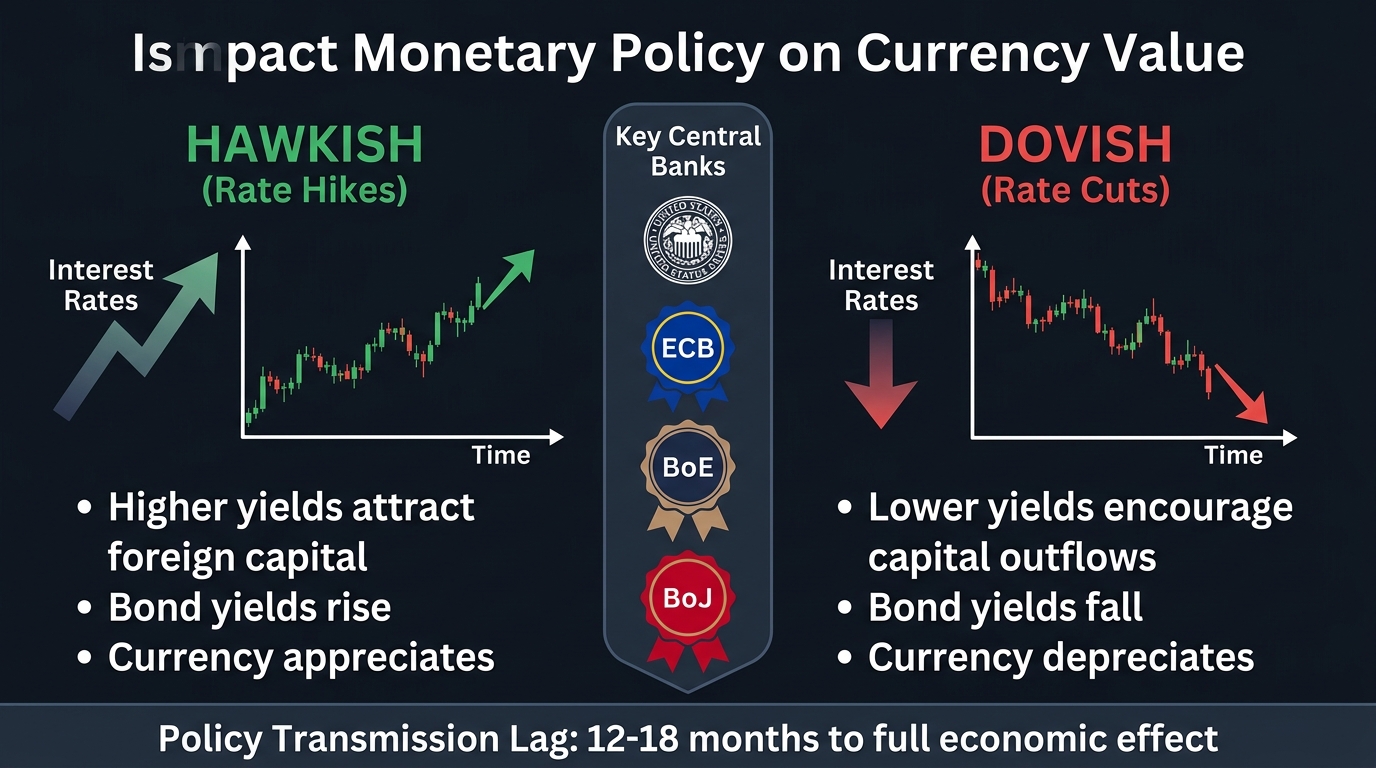
For forex traders, the critical insight is this: when a country’s interest rates rise, holding assets denominated in that currency becomes more attractive to foreign investors. They move capital into the country to access higher yields, which means buying the local currency. Demand rises, the currency strengthens.
The reverse is equally reliable. Rate cuts push investors toward higher-yielding alternatives elsewhere. Capital flows out, the local currency weakens.
Monetary Policy Goals
While the specific mandates vary by institution, most major central banks share a core set of objectives:
- Price stability: Keeping inflation near a target level (typically around 2% annually in developed economies)
- High employment: Maximizing labor market participation consistent with stable prices
- Economic growth: Supporting sustainable GDP expansion
- Interest rate stability: Avoiding erratic rate movements that create uncertainty
- Financial market stability: Preventing asset bubbles and systemic financial risk
- Exchange rate stability: (For some countries) Maintaining a competitive or stable currency value
The relative weight given to each goal differs. The US Federal Reserve has a dual mandate: maximum employment and stable prices. The European Central Bank has a singular mandate: price stability. These differences in priority mean central banks can respond differently to identical economic conditions.
Types of Monetary Policy Frameworks
Different countries use different frameworks for setting and communicating monetary policy. Understanding which framework a central bank uses helps you predict how it will respond to incoming data.
Inflation Targeting is the most common framework among developed economies. The central bank sets an explicit inflation target (usually 2% CPI) and adjusts rates to keep actual inflation close to that target. Countries using inflation targeting include Australia, Canada, the Eurozone, the UK, New Zealand, Norway, Sweden, and many others.
Mixed Policy (used by the United States) balances multiple objectives. The Fed responds to both inflation and unemployment data without a single numerical anchor. This makes Fed policy somewhat harder to predict and US Dollar movements more sensitive to a broader range of economic data.
Monetary Targeting involves controlling the growth rate of money supply rather than setting an interest rate target directly. China historically used this approach, though its policy framework has evolved significantly.
Fixed Exchange Rate / Currency Board means the central bank ties its currency to another currency (usually USD) and maintains the peg by holding sufficient reserves. Hong Kong’s peg to the US Dollar is a long-running example. Currency boards have no independent monetary policy; rate movements follow whatever the anchor currency does.
Gold Standard (largely historical) tied currency value to a fixed quantity of gold. No major economy currently uses this framework.
Exchange Rate Targeting involves managing the currency’s exchange rate as the primary policy variable. Singapore’s Monetary Authority targets the Singapore Dollar exchange rate against a basket of trading partners as its primary monetary policy tool, a relatively unique approach.
Hawkish vs. Dovish Policy Stances
In forex commentary, two terms appear constantly: hawkish and dovish. These describe the directional lean of a central bank’s policy stance.
A hawkish central bank is one that prioritizes fighting inflation and is inclined toward raising interest rates or keeping them elevated. Hawkish signals include:
- Statements emphasizing inflation risks
- Upward revisions to inflation forecasts
- Acknowledgment that rate cuts are not imminent
- Concerns about an overheating labor market
Hawkish signals tend to strengthen the associated currency because rate hike expectations attract capital inflows.
A dovish central bank prioritizes supporting growth and employment and is inclined toward cutting rates or maintaining accommodative policy. Dovish signals include:
- Statements emphasizing downside risks to growth
- Downward revisions to inflation forecasts
- Language suggesting rate cuts are on the table
- Concerns about rising unemployment
Dovish signals typically weaken the currency as investors seek better returns elsewhere.
The interesting cases are policy pivots, when a central bank shifts from a hawkish to dovish stance (or vice versa). These transitions often produce the largest sustained currency moves. The 2021-2022 Fed pivot from ultra-dovish (near-zero rates, quantitative easing) to aggressively hawkish (the fastest rate hiking cycle in 40 years) drove USD to multi-decade highs against most major currencies.
How to Track Policy Changes
Central banks communicate through several channels:
Policy meeting statements are released immediately after each meeting. Read the language carefully, particularly any changes from the previous statement. A single word change (“patient” becoming “monitoring closely,” for example) can signal a policy shift.
Press conferences by central bank governors or chairs follow major meetings. Prepared remarks matter less than the Q&A session, where off-script responses often reveal the true policy lean.
Meeting minutes are published weeks after the meeting and show the internal debate among policy committee members. Significant dissent within a committee can indicate the next policy shift is closer than the public statement implied.
Forward guidance is explicit communication about the likely path of future policy. When the Fed says “we anticipate keeping rates elevated for longer,” that is forward guidance and it moves markets immediately.
For a deeper understanding of how specific central banks set rates and communicate policy, read the Central Banks lesson and the Interest Rates lesson in this module.
Key Takeaways
- Monetary policy, primarily through interest rate setting, is the most powerful long-term driver of currency exchange rates.
- Rate hikes attract capital inflows and strengthen currencies; rate cuts do the opposite.
- Most major economies use inflation targeting frameworks with a 2% annual CPI target.
- Hawkish signals (inflation concern, rate hike lean) strengthen currencies. Dovish signals (growth concern, rate cut lean) weaken them.
- Policy pivots, from dovish to hawkish or vice versa, produce the largest sustained currency moves.
- Follow policy meeting statements, press conferences, and meeting minutes to track central bank sentiment in real time.
Continue this module: The Role of Central Banks | Interest Rates and Forex

Ready to Practice This Strategy?
Test what you learned on a free, risk-free demo account before risking real money.