Different Forex Broker Types: Market Makers, STP, and ECN Explained
There are three main forex broker types: market makers, STP, and ECN. Learn how each executes your orders, where the differences matter, and which type suits your trading style.
When you place a trade with your forex broker, what actually happens? Who takes the other side of your position? Where does your order go? The answer depends entirely on which type of broker you’re using — and the difference affects your execution quality, spreads, and the potential for conflicts of interest.
The Three Broker Models
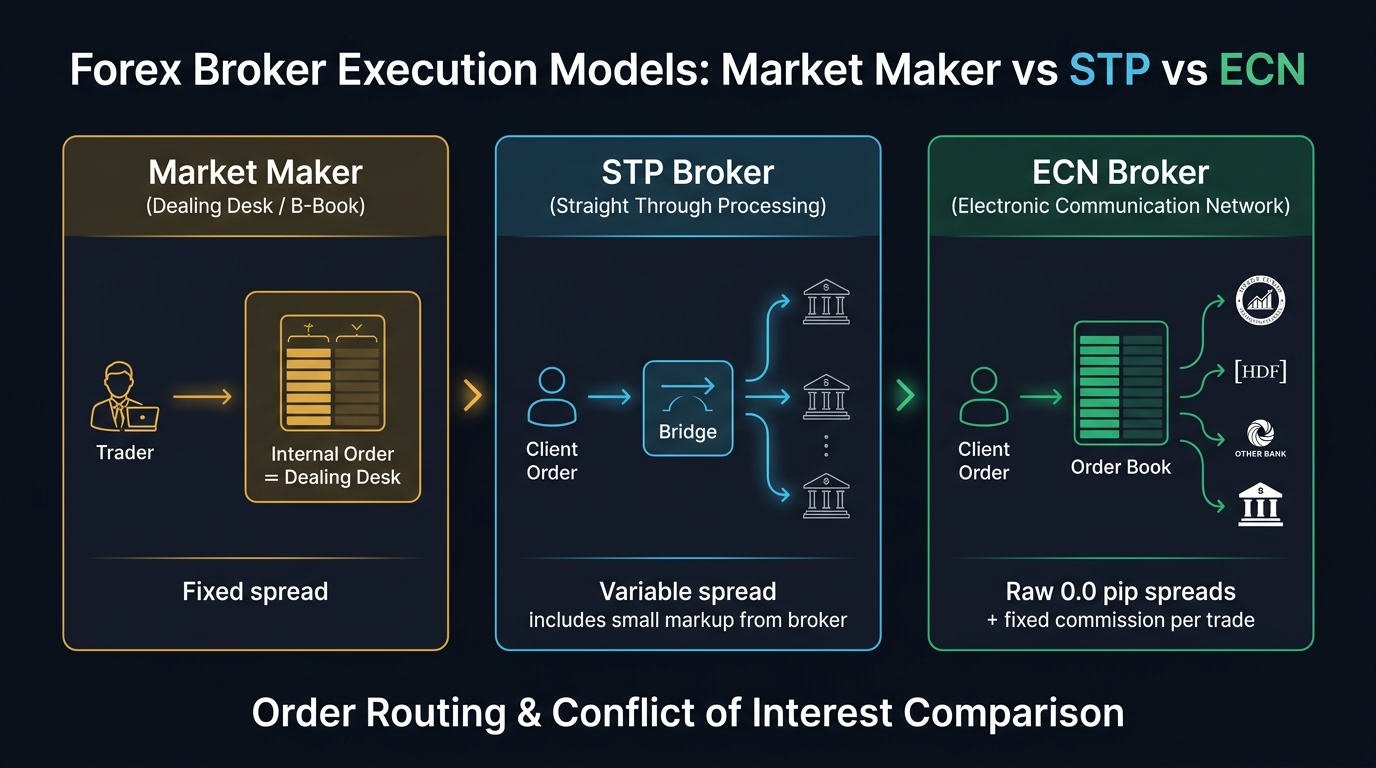
1. Market Maker (Dealing Desk)
How it works: The broker creates a two-way market internally. When you buy EUR/USD at 1.0850, the broker may take the opposite position (short EUR/USD) within their own book. They profit from the spread between bid and ask prices.
Key characteristics:
| Feature | Detail |
|---|---|
| Order execution | Internally; no external liquidity provider |
| Spread type | Fixed (doesn’t change with market conditions) |
| Typical spread | 1.5–3 pips on EUR/USD |
| Commission | None (spread includes the broker’s fee) |
| Conflict of interest | Yes — broker profits when client loses |
| Minimum deposit | Often low ($50–$500) |
The conflict of interest: A market maker theoretically profits when clients lose, since they hold the opposite position. Regulated market makers manage this risk through internal hedging (offloading large positions to external liquidity providers) rather than profiting from client losses directly. However, this conflict remains a structural feature.
Who it suits: Beginners with smaller accounts ($200–$2,000), traders who prefer fixed spreads for predictable cost calculation, and low-frequency swing traders where the spread cost per trade is a minor factor.
2. STP (Straight Through Processing)
How it works: Client orders are routed directly to external liquidity providers (banks, other brokers, institutional market makers) without passing through the broker’s dealing desk. The broker typically adds a small markup to the liquidity provider’s spread.
Key characteristics:
| Feature | Detail |
|---|---|
| Order execution | Passed to external liquidity providers |
| Spread type | Variable (reflects real market conditions) |
| Typical spread | 0.8–1.5 pips on EUR/USD |
| Commission | None or very small; markup built into spread |
| Conflict of interest | Minimal; broker earns from markup, not client losses |
| Minimum deposit | $200–$1,000 typically |
Who it suits: Intermediate traders who want better execution than a market maker but don’t need the tightest ECN spreads. STP is a good middle ground for swing traders making 3–15 trades per week.
3. ECN (Electronic Communications Network)
How it works: Client orders enter a network where they can be matched with other participants — banks, institutional traders, hedge funds, and other retail traders. The broker charges a flat commission per trade rather than making money on spread markup.
Key characteristics:
| Feature | Detail |
|---|---|
| Order execution | Matched with external participants in the network |
| Spread type | Near-zero variable (often 0.0–0.3 pips on EUR/USD) |
| Commission | $3–$7 per standard lot, each way |
| Conflict of interest | None (broker earns fixed commission regardless of outcome) |
| Order transparency | Your order may be filled partially at different prices |
| Minimum deposit | $500–$2,000 typically |
The true cost of ECN: The spread is tight, but add the commission. A $6 round-turn commission on EUR/USD with a 0.1-pip spread is equivalent to approximately 0.7 pips total cost. Compare this to a market maker charging 1.5–2 pips with no commission. For large lot sizes, ECN is significantly cheaper. For very small lots (micro accounts), the commission may exceed the spread savings.
Who it suits: Active traders making 15+ trades per week, scalpers (where the spread cost per trade is critical), and traders managing larger accounts where commission costs are proportionally smaller relative to position size.
Side-by-Side Comparison
| Feature | Market Maker | STP | ECN |
|---|---|---|---|
| Spread EUR/USD | 1.5–3 pips (fixed) | 0.8–1.5 pips (variable) | 0.0–0.3 pips (variable) |
| Commission | None | None / minimal | $3–7/lot per side |
| Execution | Internal | External (with markup) | External (network) |
| Conflict of interest | Yes (structural) | Minimal | None |
| Requotes possible? | Yes (less common now) | Rare | Very rare |
| Best for | Beginners; small accounts | Intermediate; swing trading | Active traders; scalpers |
| Price slippage | Low (fixed spread) | Moderate | Low during liquid hours |
Does Execution Type Matter in Practice?
For a beginner placing 5–10 swing trades per month on EUR/USD:
With a 1.5-pip spread (market maker):
- 10 trades × 0.1 lot each × 10 pips/trade profit target
- Spread cost per trade: 1.5 pips × $1/pip (for 0.1 lot) = $1.50
- Monthly spread cost: 10 × $1.50 = $15
With a 0.2-pip spread + $3 commission (ECN):
- Spread cost per trade: 0.2 pips × $1/pip = $0.20
- Commission per trade: $3
- Total per trade: $3.20
- Monthly total: 10 × $3.20 = $32
At low trading frequency, the ECN is actually more expensive. The math changes at higher frequency and larger position sizes.
Crossover point: At approximately 15+ trades per month on 1 lot sizes, ECN typically becomes cheaper than a market maker with a 1.5-pip spread.
Hybrid Models
Most modern brokers use hybrid execution — acting as a market maker for smaller orders and routing larger orders to liquidity providers. A broker advertising “ECN” may actually use STP routing for retail orders. Check the actual execution policy, not just the marketing label.
How to verify: Ask the broker specifically: “Do you route all my orders to external liquidity providers, or do you internalize smaller orders?” A transparent broker will answer directly.
Key Takeaways
- Three broker types: market maker (internal dealing desk, fixed spreads, inherent conflict of interest), STP (external routing, variable spreads, small markup), ECN (true network matching, near-zero spreads, flat commission)
- Market makers suit beginners and low-frequency traders where the spread cost is a minor factor; ECN suits active traders and scalpers where spread cost per trade is significant
- The true ECN cost = spread + commission; compare this total against a market maker’s all-in spread before assuming ECN is cheaper
- Regulated market makers manage the conflict of interest through internal hedging; the risk is in unregulated market makers who may trade against clients
- Most “ECN brokers” use hybrid models — ask explicitly about their execution policy for retail order sizes
- Verify execution type through demo account testing, not marketing language
Next: Dealing Desk vs. Non-Dealing Desk
Related: Forex Broker Due Diligence

Ready to Practice This Strategy?
Test what you learned on a free, risk-free demo account before risking real money.