Forex Broker Due Diligence: How to Choose a Safe, Regulated Broker
Not all forex brokers are equal. Learn the non-negotiable regulatory requirements, account types to consider, warning signs of fraudulent brokers, and the specific checks every trader should run before depositing funds.
Your trading capital sits in your broker’s account. If that broker is fraudulent, insolvent, or unregulated, retrieving your funds may be impossible. The broker selection decision is not a matter of preference — it is a risk management decision that precedes every trade you will ever make.
This lesson covers the minimum standards for broker selection, how to verify regulatory status, what to check in the fine print, and the warning signs that consistently precede broker fraud.
The Non-Negotiable: Regulatory Oversight
A regulated broker operates under the supervision of a government-sanctioned financial authority. This supervision requires the broker to:
- Segregate client funds from operational funds (your money cannot be used for business expenses)
- Maintain minimum capital reserves
- Provide negative balance protection (in most jurisdictions)
- Report to regulators and submit to audits
- Follow specific conduct rules for order execution and pricing
An unregulated broker has none of these requirements. The single most important filter in broker selection is: Is this broker regulated by a reputable authority?
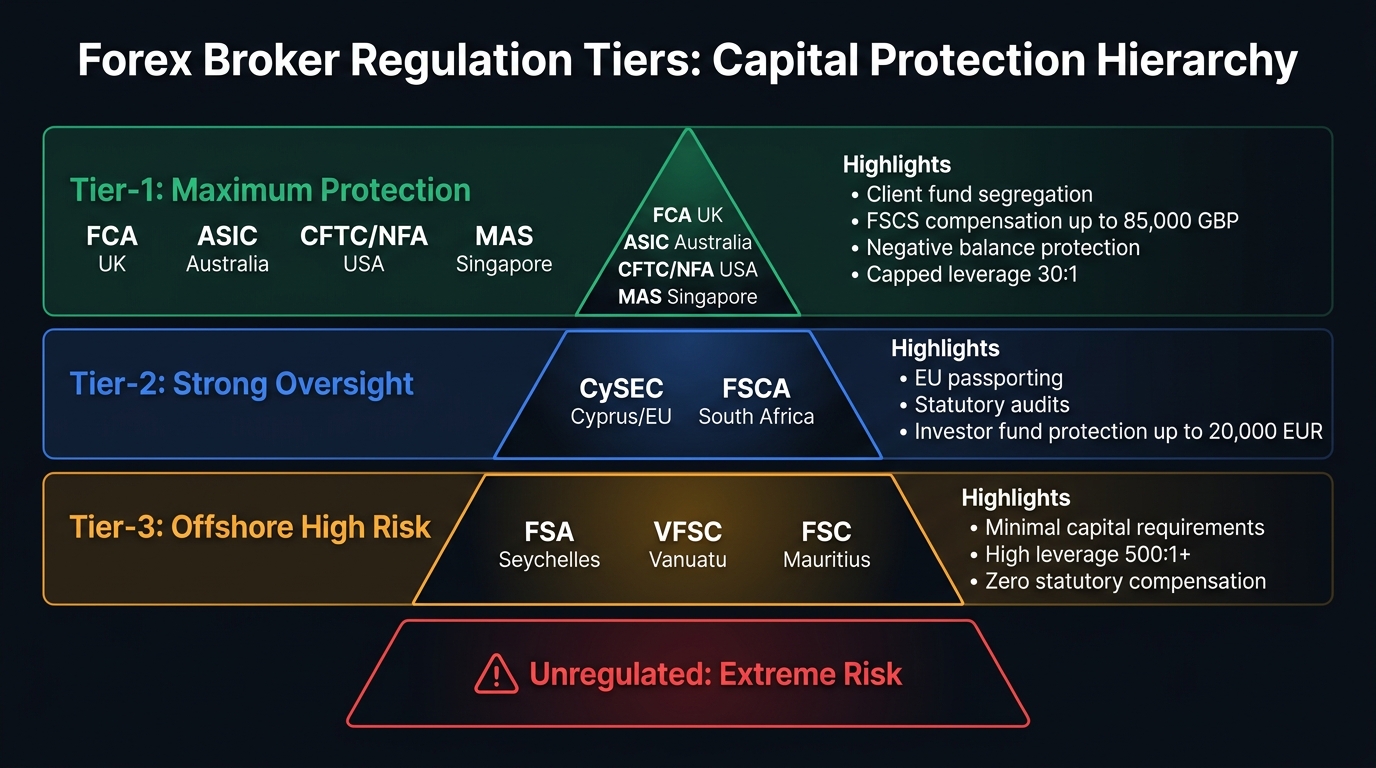
Regulatory Bodies by Region
| Regulator | Region | Tier |
|---|---|---|
| FCA (Financial Conduct Authority) | United Kingdom | Top Tier |
| ASIC (Australian Securities and Investments Commission) | Australia | Top Tier |
| CFTC / NFA | United States | Top Tier |
| CySEC (Cyprus Securities and Exchange Commission) | EU (passported) | Second Tier |
| MAS (Monetary Authority of Singapore) | Singapore | Top Tier |
| FSCA (South Africa) | South Africa | Second Tier |
| JFSA (Japan Financial Services Agency) | Japan | Top Tier |
| VFSC, FSA Seychelles, FSC Mauritius | Offshore | Low Tier |
How to verify: Every regulated broker lists their registration number on their website. Go directly to the regulator’s website (e.g., register.fca.org.uk for FCA) and search for the broker by name or registration number. Never rely on the broker’s own claim of regulation — verify independently.
Offshore regulators: Brokers regulated exclusively in Seychelles, Vanuatu, Mauritius, or similar offshore jurisdictions operate with minimal oversight. These brokers often offer very high leverage and bonuses — features that attract inexperienced traders precisely because the regulatory environment doesn’t restrict them. This is a significant risk factor.
Account Types to Understand
| Account Type | Spread Structure | Commission | Best For |
|---|---|---|---|
| Standard/Classic | Built-in (e.g., 1–2 pips) | None | Beginners; low-frequency |
| ECN/Raw | Near-zero (0.0–0.2 pips) | Per lot ($3–$7) | Active traders; scalpers |
| STP (Straight Through Processing) | Low spread (0.5–1 pip) | Sometimes | Intermediate traders |
| Islamic/Swap-Free | Variable | No swap; may have admin fee | Muslim traders |
| Demo | Virtual money | N/A | Practice; system testing |
ECN accounts offer the tightest spreads but charge a per-lot commission. For high-frequency traders, the math often favors ECN (0.2-pip spread + $5 commission) over standard (1.8-pip spread, no commission). For low-frequency traders, the standard account may be simpler.
Always open a demo account first with any broker you’re considering. Verify that the execution quality, platform stability, and spreads match what the broker advertises.
Key Checks Before Depositing
Check 1: Regulatory Status (Mandatory)
- Go to the regulator’s official website
- Search the broker by name or license number
- Verify the license is active, not expired or revoked
- If the broker lists two regulators, verify both
Check 2: Fund Segregation Policy
- Confirm client funds are held in segregated accounts at Tier-1 banks
- This means your money is separate from the broker’s operating funds
- Ask the broker directly if this is not clearly stated on their website
Check 3: Withdrawal Process
- Read all reviews specifically mentioning withdrawals
- Test the withdrawal process by depositing a small amount and withdrawing before committing larger capital
- A broker that processes small withdrawals efficiently is a positive signal
- A broker with withdrawal delays, excessive “verification” requirements, or unexplained freezes is a major red flag
Check 4: Execution Type
- Market maker: The broker takes the other side of your trade. There is an inherent conflict of interest, but legitimate market makers manage this through internal hedging
- ECN/STP: Your order is passed to external liquidity providers. No conflict of interest on the pricing side
- Neither is inherently better — regulated market makers are legitimate; the issue is unregulated market makers
Check 5: Trading Costs
- Compare actual spread (not just the advertised minimum) using the demo account
- Check swap rates for the pairs you plan to trade
- Look for inactivity fees, deposit/withdrawal fees, and any account maintenance charges
- Calculate total cost per trade: spread (in pips × pip value) + commission (if ECN)
Check 6: Platform Stability
- Test the platform (MT4, MT5, cTrader, or proprietary) during peak hours (London/NY overlap)
- Verify that stop-losses execute correctly on demo before going live
- Check for any reports of platform freezing during high-volatility events (NFP releases)
Warning Signs of Fraudulent or Problem Brokers
| Warning Sign | What It Indicates |
|---|---|
| Unrealistic return guarantees | Fraud; no legitimate broker guarantees returns |
| “Managed account” offers with guaranteed profit | Common scam structure |
| Pressure to deposit quickly / bonuses expiring | Manipulative sales tactics |
| No verifiable regulatory license | Unregulated; no recourse if funds disappear |
| Withdrawal requests repeatedly delayed or denied | Strong fraud indicator |
| Spreads significantly wider than advertised on demo | Potential price manipulation |
| No physical address or contact information | High fraud risk |
| CEO or “account manager” contacts you unsolicited | Common fraud pattern (“pig butchering”) |
The pig butchering scam (prevalent in 2024–2026): A fraudulent actor (often via social media or messaging apps) builds a relationship, introduces forex trading, and guides victims to a fraudulent “broker” platform. The platform shows impressive fake profits. When the victim tries to withdraw, fees are demanded, then the platform disappears. This is the most common forex-related financial crime in 2026. Never trade on a platform you were introduced to by a romantic or social connection.
Questions to Ask Before Opening an Account
- Where are client funds held? At which banks?
- What is your regulatory license number and in which jurisdiction?
- Does the platform operate under negative balance protection?
- What is the typical spread on EUR/USD during the London open?
- What is your order execution policy — market maker, ECN, or STP?
- What is the withdrawal processing time, and what documentation is required?
Any legitimate broker will answer all these questions directly. Evasiveness or deflection to marketing materials is a red flag.
Key Takeaways
- Regulatory status is the non-negotiable first filter: verify directly on the regulator’s official website, not from the broker’s claim
- Top-tier regulators: FCA (UK), ASIC (Australia), CFTC/NFA (US), MAS (Singapore), JFSA (Japan)
- Offshore regulators (Seychelles, Vanuatu, Mauritius) provide minimal protection — avoid brokers regulated only in these jurisdictions
- Test withdrawal with a small deposit before committing real capital
- The pig butchering scam is the most common forex fraud in 2026: never trade on a platform introduced through a social or romantic contact
- ECN accounts have tighter spreads but charge commissions; match account type to your trading frequency
Next: Different Forex Broker Types | Dealing Desk vs. Non-Dealing Desk

Ready to Practice This Strategy?
Test what you learned on a free, risk-free demo account before risking real money.