Forex Scalping: How to Trade the London and New York Opens
Forex scalping means targeting 5–20 pip moves with tight stops and high frequency. Learn the session windows, pair selection, setup rules, and the psychological requirements that make scalping viable in 2026.
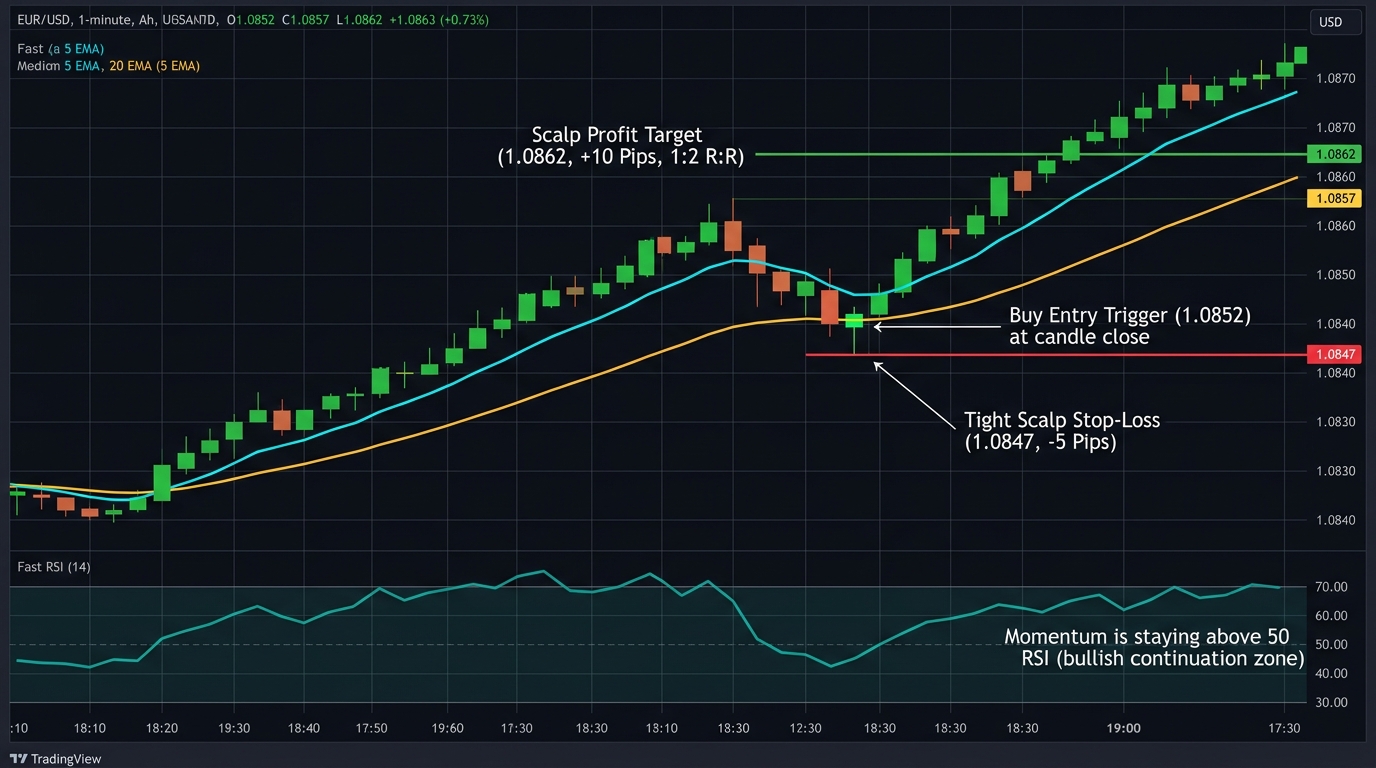
Scalping is the most technically demanding and psychologically intensive form of forex trading. Positions are held for seconds to minutes. Targets are 5–20 pips. The cumulative effect of many small wins — and the discipline to cut small losses immediately — compounds into meaningful returns over time.
It’s not for beginners. The technical skill floor is high, execution requirements are stringent, and the margin for psychological error is essentially zero. But for traders who develop the necessary proficiency, scalping offers a style that produces consistent, measurable results in any market condition because it doesn’t require sustained trends.
This lesson addresses scalping seriously — not as an exciting shortcut, but as a skill set that requires specific conditions to be viable.
Is Scalping Right for You? Honest Prerequisites
Before reading further, consider these requirements honestly:
| Prerequisite | Why It’s Non-Negotiable |
|---|---|
| ECN/raw spread account | Scalping economics don’t work with 1.5+ pip spreads on every trade |
| Ultra-low latency execution | Delays of even 100ms affect fill prices on 10-pip targets |
| Minimum $2,000–$5,000 capital | Micro-lot sizing constraints make smaller accounts structurally impractical |
| Ability to act in 1–3 seconds | Hesitation in scalping is a losing trade |
| High tolerance for fast decisions | Mental fatigue in 1–2 hours of scalping is significant |
| Proven swing trading competence | You cannot build scalping skills without established trading discipline first |
If any of these conditions don’t apply, scalping is not currently viable for you. Swing trading first, scale down timeframes second.
The Best Session Windows for Scalping
Not all sessions offer scalping opportunities. You need:
- Tight spreads (available only during high liquidity hours)
- Directional movement (ranging sessions produce false signals at high frequency)
- Clear price action (technical setups work when enough participants are trading)
| Session Window | GMT | Best Pairs | Spread Quality |
|---|---|---|---|
| London open | 07:00–09:30 | EUR/USD, GBP/USD | Excellent |
| London midday | 10:30–12:00 | EUR/USD | Good |
| NY open | 13:30–15:00 | EUR/USD, GBP/USD, USD/JPY | Excellent |
| London/NY overlap | 13:30–16:00 | All major pairs | Best of day |
| After NY overlap | 17:00+ | Avoid for scalping | Spreads widen |
The London open and NY open are the two primary scalping windows. The first 90 minutes of each session provides directional momentum, tight spreads, and the highest probability of clean setups.
EUR/USD Scalping: The Primary Pair
EUR/USD is the optimal scalping pair:
- Tightest spreads on any ECN account (0.0–0.2 pips during peak sessions)
- Highest liquidity: 22% of global forex volume (2024 BIS data)
- Deep technical clarity: S/R levels, pivot points, and moving averages are more respected on EUR/USD than almost any other pair
- Consistent volatility: 70–110 pip daily range provides scalping opportunities without excessive unpredictability
Scalping Setups
Setup 1: Momentum Scalp at London Open
The London open often establishes the day’s directional bias in the first 30–60 minutes:
| Step | Action |
|---|---|
| 1. Pre-open | Mark yesterday’s high, low, and close on the 5M chart |
| 2. Session open | Watch the first 15M candle’s direction |
| 3. Signal | A strong 5M candle in one direction after a brief consolidation |
| 4. Entry | Enter in the direction of the momentum with a 5M candle close confirmation |
| 5. Stop-loss | Below the consolidation low (long) or above the consolidation high (short) |
| 6. Take-profit | 10–15 pips (or 1.5× the stop distance) |
| 7. Max time in trade | 15 minutes; exit regardless of profit/loss |
Setup 2: Pullback to EMA (5M Chart)
When the session is trending:
| Step | Action |
|---|---|
| 1. Establish trend | 5M candles consistently above/below the 20 EMA |
| 2. Wait for pullback | Price retraces to the 20 EMA on 5M chart |
| 3. Confirmation | Rejection candle at the 20 EMA |
| 4. Entry | Next 5M candle open |
| 5. Stop-loss | 8–12 pips beyond the 20 EMA |
| 6. Take-profit | 12–18 pips (1.5–2× stop distance) |
Setup 3: Pivot Level Bounce
Using daily pivot levels as targets and trigger zones:
- When price approaches S1 during a session downtrend, wait for a rejection
- Enter long toward PP as the take-profit
- Stop below S1 (8–10 pips)
- Target: PP (10–30 pips depending on the spread between S1 and PP)
Detailed pivot levels: Pivot Points lesson.
Scalping Risk Management
The fundamental difference: with 10-pip targets and 8-pip stops, traditional 1% account risk per trade at low lot sizes produces negligible dollar returns. Scalping typically uses higher frequency with smaller per-trade risk:
Scalping position sizing framework:
| Account Size | Per-Trade Risk | Trade Size (8-pip stop, EUR/USD) |
|---|---|---|
| $2,000 | 0.5% = $10 | 0.12 lots (12 mini lots) |
| $5,000 | 0.5% = $25 | 0.31 lots |
| $10,000 | 1% = $100 | 1.25 lots |
Daily loss limit for scalping: 2% of account. Scalping produces a higher number of decisions per session — the daily limit is proportionally important as a circuit breaker.
Maximum consecutive losses before stopping: 3. After 3 consecutive losses, stop for the session and review. Consecutive losses in scalping often indicate the market has entered a choppy, unpredictable condition that renders setups invalid.
The Psychological Demands of Scalping
Scalping is the most emotionally demanding trading style because:
Speed eliminates deliberation: In swing trading, you analyze, wait, reconsider, and then enter. In scalping, the decision window is seconds. Hesitation costs pips.
Loss frequency is higher: Even a profitable scalping system loses on 40–50% of trades. At high frequency, that means several losses within every session. Each loss must be accepted immediately and the next setup approached fresh.
Screen time and mental fatigue: After 60–90 minutes of active scalping, decision quality degrades significantly for most traders. Profitable scalpers typically trade specific windows (90–120 minutes) and then stop — not out of constraint, but because they recognize their performance degrading.
The revenge trade problem: After a losing trade in scalping, the next setup appears within minutes. The urge to “get it back” immediately — by taking a substandard setup — is the most common failure pattern. The rule: skip the first setup after a loss. Let the emotional reset happen before re-engaging.
Scalping and Broker Selection
Scalping is only viable with specific broker conditions:
- ECN/raw spread account (spreads below 0.5 pips on EUR/USD during peak hours)
- Market maker brokers explicitly allow scalping in their terms (some restrict it)
- Fast execution: sub-100ms average fill time
- No trade minimum hold time (some brokers restrict trades held under 30 seconds)
Verify all of these conditions before scalping a live account with any broker.
Key Takeaways
- Scalping targets 5–20 pip moves with 8–12 pip stops, held for seconds to minutes; the edge comes from high frequency and strict discipline, not wide moves
- Only viable on ECN/raw spread accounts during London open (07:00–09:30 GMT) and NY open (13:30–15:00 GMT) with EUR/USD as the primary pair
- Three main setups: London open momentum, 5M EMA pullback, pivot level bounce
- Daily loss limit of 2%; stop after 3 consecutive losses — choppy conditions signal the setups are invalid for that session
- Mental fatigue is a real constraint: limit active scalping to 90–120 minutes per session maximum
- Scalping requires prior swing trading competence; it cannot be the starting point for developing trading discipline
Next: Day Trading | Swing Trading
Related strategies: Forex Scalping Strategies
Tools: Position Size Calculator

Ready to Practice This Strategy?
Test what you learned on a free, risk-free demo account before risking real money.