Popular Moving Average Time Periods in Forex: Which Periods Actually Matter
Not all moving average periods are equally significant. Learn which MA periods are institutionally significant, why certain numbers attract more order flow, and how to choose the right periods for your trading style.
There are infinite possible moving average periods — from 3 to 1000. In practice, a small number of periods are used by the majority of traders, institutions, and algorithmic systems. This concentration of attention is what makes these specific periods significant: when enough market participants watch the same MA, it creates self-reinforcing price behavior at those levels.
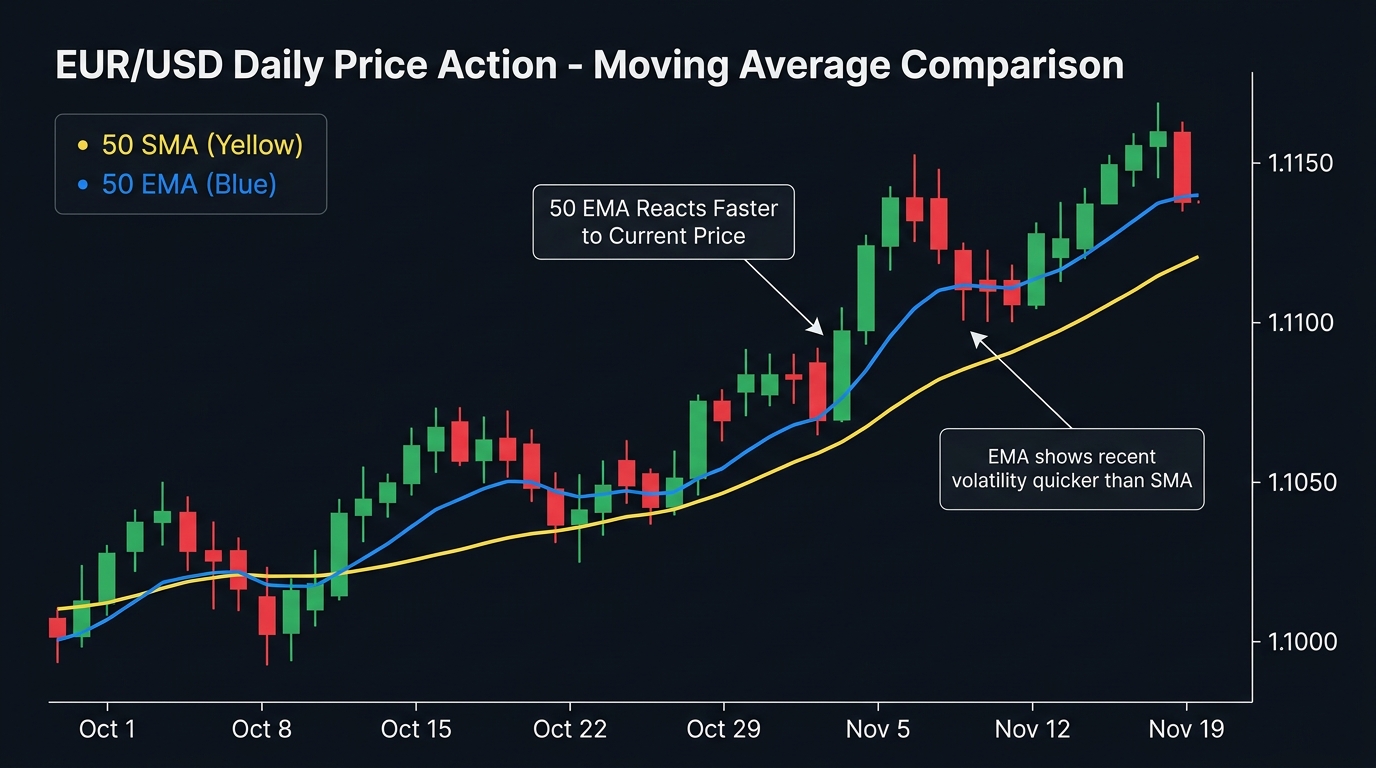
The Most Significant Periods and Why
The 200-Period MA (SMA or EMA)
The most important MA in existence. The 200 SMA on the daily chart is referenced by virtually every institutional trader, algorithm, and analysis system in the global forex market.
What it measures: The average closing price over approximately 200 trading days — approximately 10 months of price history. It’s the clearest separator between long-term bull and bear conditions.
Why it matters beyond math: When the daily 200 SMA is tested for the first time after a multi-month trend, it attracts enormous media coverage, institutional positioning, and algorithmic responses. The resulting order concentration creates real price reactions.
Cross-market significance: The 200-day SMA is referenced identically in forex, equities, commodities, and crypto. It’s not forex-specific — it’s the global financial markets’ most universal trend reference.
The 50-Period MA (SMA or EMA)
The second most significant MA, often called the “medium-term trend” indicator.
What it measures: The 50-day MA covers approximately 2.5 months of trading history. On the 4H chart (50 periods = 200 hours ≈ 8 trading days), it tracks the recent short-term trend.
Institutional significance: The 50 SMA is widely cited in institutional analysis. “Price is above/below the 50-day moving average” appears in professional FX research reports as a routine trend descriptor.
The 50/200 relationship: When the 50 SMA crosses above the 200 SMA, it’s called a Golden Cross — a major long-term bullish signal widely covered by financial media. The Death Cross is the inverse (50 crosses below 200). These crossovers produce real market responses from participants who act on them.
The 20-Period MA (SMA as basis for Bollinger Bands; EMA for short-term trading)
20 SMA: The basis for Bollinger Bands (upper/lower bands are 2 standard deviations from the 20 SMA). Widely watched for short-term trend context.
20 EMA: A dynamic support/resistance level in active short-term trends. Many day traders and scalpers use the 20 EMA as their primary reference for pullback entries.
What it measures: The average of the last 20 periods — one full trading month on the daily chart; the last 80 hours (about 3.5 trading days) on the 4H chart.
The 9 and 21-Period EMAs
These are the short-term, fast-moving EMAs widely used for crossover signals and entry timing:
9 EMA: The fastest commonly used EMA. Responds quickly to price changes. Used as the “signal line” in many crossover systems.
21 EMA: A slightly slower period that provides a cleaner pullback entry zone than the 9 EMA. The 21 EMA is particularly popular among swing traders on the 4H chart for bounce entries.
Why 21 instead of 20? The Fibonacci sequence includes 21 (not 20). Some traders favor 21-period MAs for this reason. In practice, the difference between a 20 and 21-period EMA is negligible.
The 12 and 26-Period EMAs
These are the MACD inputs. The MACD line is calculated as the 12-period EMA minus the 26-period EMA. By extension, anyone using MACD is implicitly watching the 12 and 26 EMA relationship.
Significance: Because MACD is one of the most widely used indicators globally, the 12 and 26 EMA are among the most-watched short-to-medium-term MAs without most traders explicitly knowing it.
Summary: MA Periods by Significance and Use
| Period | Type | Primary Role | Timeframe |
|---|---|---|---|
| 200 | SMA | Long-term trend; bull/bear divide | Daily |
| 50 | SMA | Medium-term trend; institutional reference | Daily, 4H |
| 26 | EMA | MACD slow line | 4H, Daily |
| 21 | EMA | Swing trade pullback entry; trailing stop | 4H |
| 20 | SMA/EMA | Bollinger Bands basis; short-term S/R | 1H, 4H |
| 12 | EMA | MACD fast line | 4H, Daily |
| 9 | EMA | Fast crossover signal line | 1H, 4H |
Choosing Periods for Your System
Two MA maximum for most strategies: Define one MA as the trend filter and one as the dynamic entry level. More than two MAs creates clutter and conflicting signals.
Higher period for the trend filter: Use the 50 or 200 SMA for the “should I be long or short” question.
Lower period for the entry level: Use the 9, 20, or 21 EMA for “where do I enter within the trend” question.
Don’t use arbitrary periods: A 47-period MA is not more accurate than a 50-period MA. It’s just less watched, which makes it less significant as a self-reinforcing level. Stick to commonly referenced periods — you want to trade at the same levels where institutional order flow concentrates.
Key Takeaways
- Significance of an MA period comes from how many participants use it — the most-watched periods (200, 50, 20, 9/21) attract the most institutional order flow
- The 200 SMA daily is the most important technical indicator in global financial markets; the 50 SMA is the second most cited institutional reference
- The 12 and 26 EMAs are the inputs to MACD — anyone using MACD is watching these periods implicitly
- Use a maximum of two MA periods: one for trend direction (50/200 SMA), one for entry timing (9/20/21 EMA)
- Don’t use arbitrary periods (47, 63, etc.); the self-reinforcing significance of MA levels depends on institutional recognition of the same period
- The 9/21 EMA crossover and the 50/200 SMA Golden/Death Cross are the most actionable MA-based signals by period popularity
Previous: SMA Explained | EMA Explained | SMA vs. EMA
Related strategies: Moving Averages Crossover

Ready to Practice This Strategy?
Test what you learned on a free, risk-free demo account before risking real money.