Settlement Date
The designated business day on which a financial trade must be formally concluded through the irrevocable exchange of funds and assets between counterparties; functionally identical to the 'Value Date' in foreign exchange and banking.
What Is a Settlement Date?
The settlement date (known universally in foreign exchange and money markets as the value date) is the official calendar day on which a financial contract must be consummated. On this date, the buyer must deliver the designated currency or payment, and the seller must deliver the corresponding securities, foreign exchange, or commodities, permanently extinguishing all outstanding obligations.
The settlement date must be strictly distinguished from the trade date ($T$):
- Trade Date: The day the agreement is legally struck between buyer and seller regarding price, quantity, and terms.
- Settlement Date: The day legal title, beneficial ownership, and central bank funds are actually transferred.
In the global foreign exchange market, settlement dates govern when currency balances hit commercial bank nostro accounts, dictate the calculation of forward swap points, and drive the application of daily overnight rollover debits and credits.
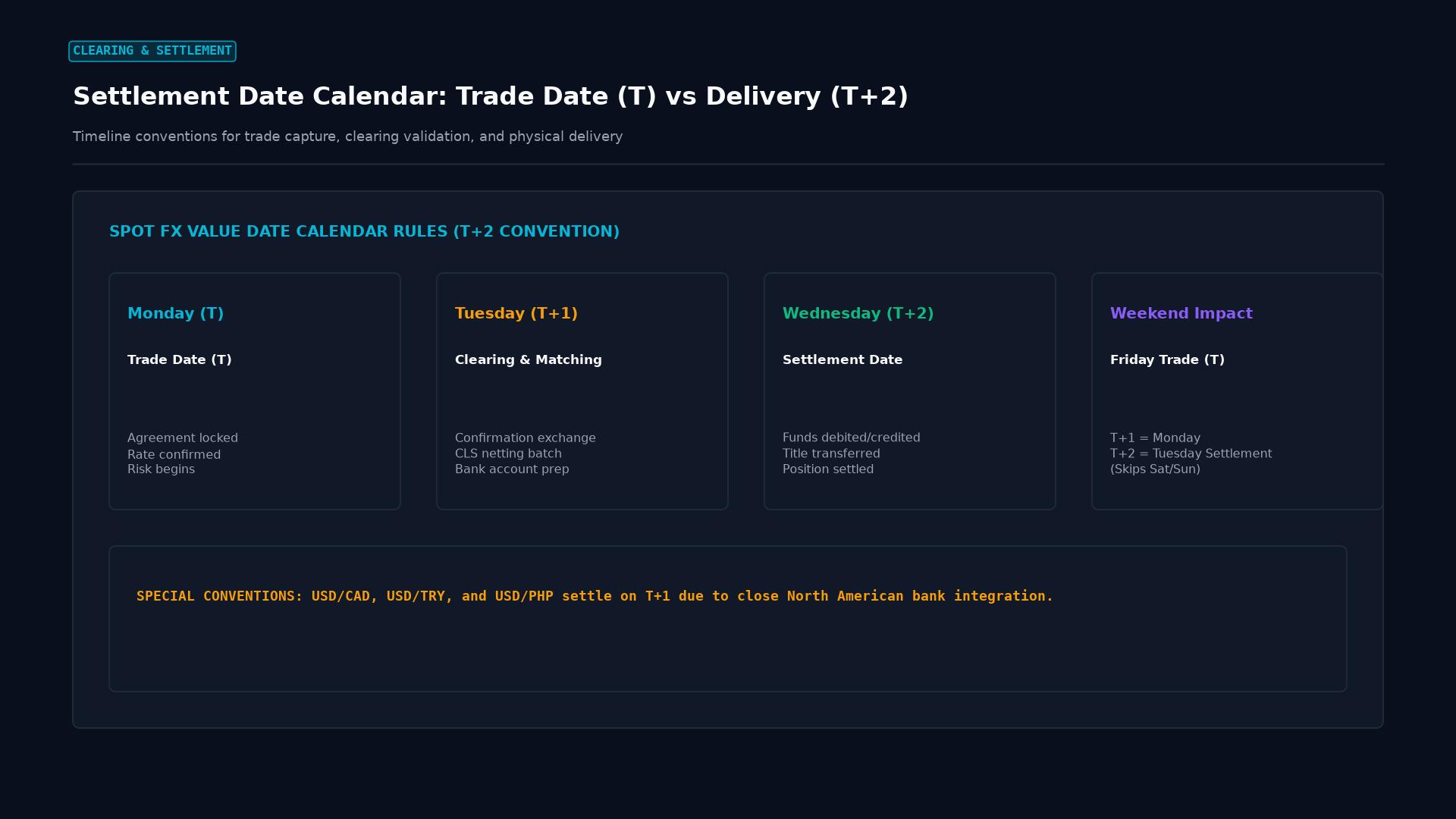 Figure: Spot foreign exchange clearing calendar: trade agreement on Day T, clearing and netting on T+1, and simultaneous delivery on T+2.
Global Market Conventions: Standard Settlement Horizons
The elapsed duration between trade date and settlement date varies by asset class, regulatory regime, and geographic location:
| Market / Instrument | Standard Horizon | Typical Settlement Rule | Key Exceptions / Details |
|---|---|---|---|
| Major Spot FX | $T+2$ | Two business days after trade date | EUR/USD, GBP/USD, USD/JPY, AUD/USD, NZD/USD |
| North American Cross FX | $T+1$ | One business day after trade date | USD/CAD, USD/MXN, USD/TRY, USD/PHP |
| US & Canadian Equities | $T+1$ | One business day after trade date | Adopted in May 2024 (compressed from historical $T+2$) |
| European Equities | $T+2$ | Two business days after trade date | Exploring transition to $T+1$ by 2027 |
| Sovereign Treasury Bills | $T+1$ / $T+0$ | Next business day or same day | Depends on secondary auction vs repo settlement |
| FX Forward Contracts | Variable | Custom dates (1 week to 5+ years) | Broken-date forwards structured to match corporate cash flows |
The Rules Governing Settlement Dates: Holidays and Rolls
In wholesale foreign exchange, establishing an accurate settlement date requires navigating multi-jurisdictional banking calendars. If an agreed date falls on a weekend or bank holiday, financial markets apply standardized date-rolling conventions:
                  MULTI-JURISDICTIONAL HOLIDAY LOGIC

            Trade: USD/JPY Spot (T+2 Standard Convention)
            Trade Date: Monday

   Tuesday (T+1): Tokyo Bank Holiday (Emperor's Birthday)
   Wednesday:     Normal banking day in New York
   Thursday:      Normal banking day in both New York and Tokyo

   Rule: BOTH central bank payment networks (BOJ-NET and Fedwire)
         must be open for settlement to occur.

   Outcome: Settlement Date rolls from Wednesday to THURSDAY (T+3).
1. The Multi-Currency Joint Holiday Rule
For a spot foreign exchange settlement to occur, the central bank payment systems of both currencies must be operational. If a EUR/USD trade is executed on Wednesday, but Thursday is an official Eurozone banking holiday (e.g., Ascension Day), settlement rolls to Monday because funds cannot be transferred across the TARGET2 network on Thursday.
2. The Modified Following Business Day Convention
When adjusting future maturity dates (e.g., 1-month or 3-month forward contracts), if the target settlement date lands on a weekend or public holiday, it automatically rolls to the next following business day. However, if that following day falls into the subsequent calendar month, the settlement date instead rolls backward to the preceding business day to prevent crossing month-end financial reporting periods.
Settlement Date vs. Trade Date vs. Ex-Dividend Date
| Metric | Trade Date ($T$) | Ex-Dividend Date | Settlement Date ($T+X$) |
|---|---|---|---|
| Primary Meaning | Date transaction is executed and price is locked | Cutoff date determining entitlement to dividend or interest | Date financial assets and cash are legally delivered |
| Balance Sheet Impact | Off-balance-sheet commitment | None on trading ledger | On-balance-sheet cash and asset adjustment |
| Overnight Rollover | Starts applying when trade is held past 5 PM EST | Irrelevant for spot FX; critical for equity CFDs | Physical cash transfer date pushed forward via Tom-Next |
| Market Risk | Trader assumes 100% directional market risk | Dictates asset price adjustment (dividend drop) | Eliminates counterparty settlement exposure |
Real-World Institutional Case Study: The May 2024 U.S. $T+1$ Transition Shock
On May 28, 2024, the U.S. Securities and Exchange Commission (SEC) enacted the long-awaited compression of U.S. equity settlement from $T+2$ to $T+1$. While domestic stock brokers prepared smoothly, the structural mismatch created severe friction for international asset managers:
       GLOBAL TIME-ZONE SETTLEMENT BOTTLENECK ($T+1$)

 Monday 16:00 EST:  London fund manager buys $50,000,000 in U.S. technology stocks.
 Tuesday 14:00 EST: U.S. stock trade MUST settle (T+1 Deadline).

 The Cross-Border Problem:
 1. Standard GBP/USD spot FX settles on a T+2 basis (Wednesday).
 2. If the fund executes standard spot FX on Monday, the dollars arrive
    24 hours AFTER the stock settlement deadline, triggering a SETTLEMENT FAIL.

 Institutional Solution:
 London desk forced to execute same-day (T+0) or next-day (T+1) FX swaps,
 paying an annualized liquidity premium to fund stock purchases on time.
This landmark regulatory shift illustrated how settlement dates in one financial market directly ripple across global foreign exchange liquidity, forcing international custodians to alter operational shifts and adopt automated algorithmic currency execution.
Practical Trading Rules: Settlement Dates and the Retail Trader
Although retail margin traders never receive physical banknotes, settlement dates directly influence retail account operations:
- The Origin of the Wednesday Triple Swap: Because spot FX settlement rolls from Friday to Monday over the weekend, trades open on Wednesday evening undergo three days of settlement extension, incurring or earning 3x rollover rates.
- Holiday Swaps: Ahead of major bank holidays (such as Christmas or New Year’s Day), settlement dates roll forward multiple additional days, causing brokers to assess four-day or five-day rollover debits or credits on a single session.
- Month-End Capital Flows: The final settlement dates of each calendar month witness heavy corporate and institutional “fixing” flows, as global pension funds rebalance multi-currency currency hedges to align with month-end accounting valuations.
Frequently Asked Questions
Can a buyer and seller negotiate a custom settlement date?
Yes. In the over-the-counter (OTC) institutional market, counterparties regularly structure FX Forward contracts with custom settlement dates—known as “broken dates” or “odd dates” (e.g., 42 days in the future)—to match specific commercial payment deadlines or corporate bond maturity dates.
How does the settlement date affect stock dividend payments?
In equity markets, an investor must be the registered owner of the stock on the Record Date. Due to the $T+1$ settlement cycle, an investor must execute their buy order on or before the business day prior to the Ex-Dividend Date so that the trade reaches settlement in time to be registered on company ledgers.
What is the “Value Spot” date?
“Value Spot” is the universal market shorthand for the settlement date of a standard spot foreign exchange transaction. For the vast majority of currency pairs, Value Spot is two business days after the trade date ($T+2$), provided both banking centers are open for business.
Ready to trade forex?
Open a free demo account with a regulated broker. Practice with virtual funds before risking real money.