ABL
ABL stands for Asset-Based Lending in corporate finance, referring to loans or revolving credit facilities secured by company assets such as receivables and inventory; in South Asian banking, it also designates Allied Bank Limited, one of Pakistan's premier commercial financial institutions.
What Does ABL Stand For?
ABL primarily stands for Asset-Based Lending across international commercial finance and corporate treasury. In regional retail and commercial banking within South Asia, ABL also refers to Allied Bank Limited, one of Pakistan’s largest and oldest commercial banking institutions.
In corporate finance, Asset-Based Lending represents a specialized debt facility where a business secures working capital loans or revolving credit lines using its balance sheet assets as collateral. Unlike cash-flow loans that evaluate historical earnings before interest, taxes, depreciation, and amortization (EBITDA), an ABL facility evaluates the liquidation value of tangible assets, primarily accounts receivable and unencumbered inventory.
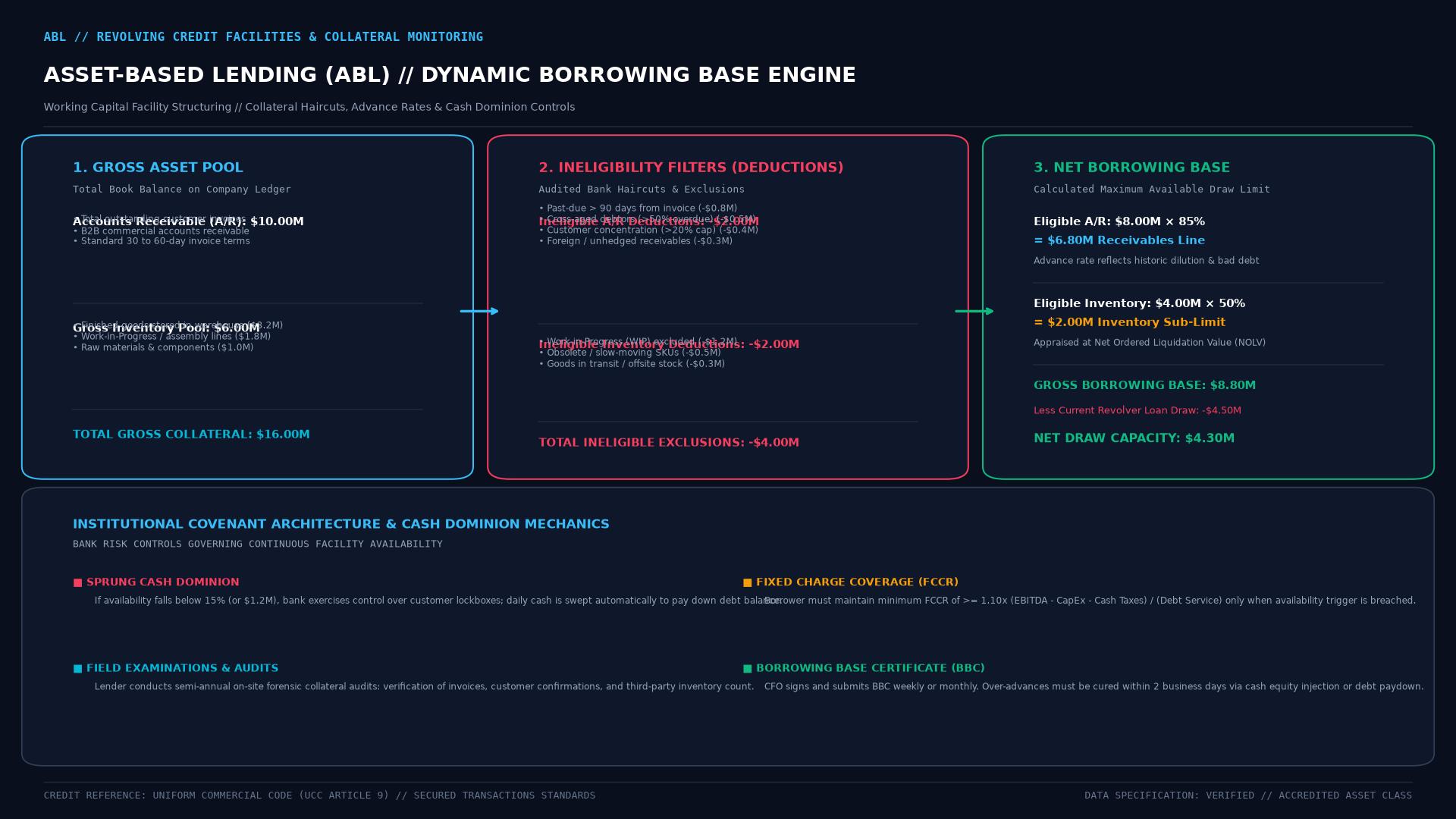 Figure: Asset-Based Lending (ABL) dynamic borrowing base formula showing collateral eligibility haircuts across gross receivables and inventory, advance rates, and sprung cash dominion risk covenants.
Technical Mechanics of Asset-Based Lending
Asset-Based Lending facilities function on a dynamic calculation model known as the Borrowing Base. Instead of receiving a fixed lump sum, the borrower draws funds against an actively fluctuating limit that updates weekly or monthly:
1. The Borrowing Base Formula
Lenders establish advance rates against verified, unencumbered assets:
Borrowing Base = (Eligible Accounts Receivable × Advance Rate) + (Eligible Inventory × Advance Rate) - ReservesStandard advance rates range from 80% to 85% for qualified commercial accounts receivable and 50% to 65% for finished goods inventory. Raw materials typically receive lower advance rates (30% to 40%), while work-in-progress (WIP) inventory is almost universally excluded due to low resale value in liquidation.
2. Collateral Eligibility Exclusions
Commercial lenders enforce strict eligibility haircuts. Ineligible accounts receivable include:
- Invoices past due beyond 90 days from the original billing date.
- Concentration accounts where a single customer represents more than 20% to 25% of total receivables.
- Foreign cross-border receivables lacking credit insurance or letters of credit.
- Cross-aging disqualification: if more than 50% of an account’s balances exceed 90 days, the entire customer balance becomes ineligible.
3. Covenants and Dominion of Funds
In an ABL structure with “springing cash dominion,” customer payments route directly into a blocked deposit account controlled by the lender. When the borrower’s excess availability falls below a preset minimum threshold (such as 10% to 15% of the total facility size), the lender triggers full cash dominion, sweeping daily cash receipts directly to pay down outstanding loan balances.
Allied Bank Limited (Pakistan Banking Context)
In the context of international trade and South Asian foreign exchange markets, Allied Bank Limited (ABL) is a major commercial institution:
- Founding and Heritage: Established in 1942 as Australasia Bank in Lahore before the independence of Pakistan, it is recognized as the first Muslim bank established in the region.
- Operations: Operates over 1,425 branches across Pakistan and international commercial presences, providing commercial trade financing, currency exchange services, and foreign remittances.
- Forex and Remittances: ABL is a core participant in the State Bank of Pakistan’s foreign exchange settlement network, facilitating trade finance, letter-of-credit issuance, and international remittances through programs like the Roshan Digital Account (RDA) for expatriate workers.
Comparative Matrix: Asset-Based Lending vs. Cash-Flow Loans
| Operational Dimension | Asset-Based Lending (ABL) | Cash-Flow Revolver | Mezzanine Debt |
|---|---|---|---|
| Underwriting Focus | Orderly liquidation value of balance sheet assets | Sustainable corporate EBITDA and free cash flow | Future enterprise valuation and equity upside |
| Financial Covenants | Minimal (typically a single Fixed Charge Coverage Ratio) | Strict (Leverage ratios, debt-to-EBITDA ceilings) | Subordinated covenants, board observation rights |
| Borrower Profile | Asset-rich, seasonal, turnaround, or rapidly expanding firms | High-margin software, service, or recurring-revenue firms | Leveraged buyouts, sponsor-backed growth funding |
| Cost of Capital | Moderate (SOFR + 175 to 300 bps) | Low to moderate (SOFR + 150 to 250 bps) | High (10% to 14% interest plus equity warrants) |
| Field Audits | Quarterly on-site collateral inspections and audits | Annual CPA financial review, minimal physical audit | Minimal operational asset auditing |
Real-World Case Study: Seasonal Retailer Liquidity Management
In May 2024, a consumer electronics distributor faced liquidity constraints ahead of the fourth-quarter holiday surge. Although the firm held $22 million in accounts receivable and $18 million in warehouse inventory, its EBITDA had declined temporarily due to supply-chain restructuring, disqualifying it from traditional cash-flow bank revolvers.
A commercial syndicate structured a $25 million ABL facility with an 85% advance rate on eligible receivables and a 60% advance rate on finished inventory. During September, as the distributor ramped up inventory purchases, the borrowing base expanded to $21.5 million, allowing full fulfillment of retailer purchase orders. By January 2025, collection of customer receivables paid down the outstanding facility balance to zero, demonstrating how ABL provides liquidity flexibility without diluting equity or breaching EBITDA leverage covenants.
Frequently Asked Questions (FAQ)
What types of businesses benefit most from Asset-Based Lending?
Companies with heavy working capital requirements, significant invoice volume, and inventory cycles benefit most. These include wholesale distributors, manufacturing enterprises, logistics operators, staffing agencies, and retailers preparing for seasonal peaks.
How does an ABL facility differ from factoring?
In factoring, a business sells its invoices outright to a factor who assumes collection responsibilities and credit risk. In an ABL credit line, the borrower retains ownership of the invoices, continues collecting directly from customers, and simply uses the receivables portfolio as collateral to secure the line.
Can intellectual property and brand assets be included in an ABL borrowing base?
Traditional commercial ABL lenders exclude intangible assets from the formula. However, specialized private debt funds offer enterprise-value ABL facilities that appraise registered trademarks, software patents, and recurring subscription licenses, applying conservative advance rates (often 15% to 25% of appraised value) to supplement working capital lines.
Ready to trade forex?
Open a free demo account with a regulated broker. Practice with virtual funds before risking real money.