Accounts Receivable Financing
Accounts Receivable Financing is a commercial working capital solution where a business obtains immediate liquidity by pledging or selling its unpaid customer invoices to a commercial lender or factoring company, accelerating cash conversion cycles.
What Is Accounts Receivable Financing?
Accounts Receivable Financing (often referred to as AR financing, invoice financing, or receivables factoring) is a commercial lending arrangement in which an enterprise unlocks immediate working capital by converting its outstanding customer invoices into ready cash.
In traditional business-to-business (B2B) trade, companies routinely sell goods and services on net-30, net-60, or net-90 day payment terms. While these deferred payment terms attract commercial buyers, they trap corporate liquidity in the balance sheet as unpaid receivables. For growing enterprises, high invoice volumes can create dangerous cash flow deficits, making it difficult to meet weekly payroll, purchase raw materials, or fulfill new purchase orders. Accounts receivable financing bridges this operational gap by allowing businesses to borrow against or sell their unpaid debtor book to specialized financial institutions.
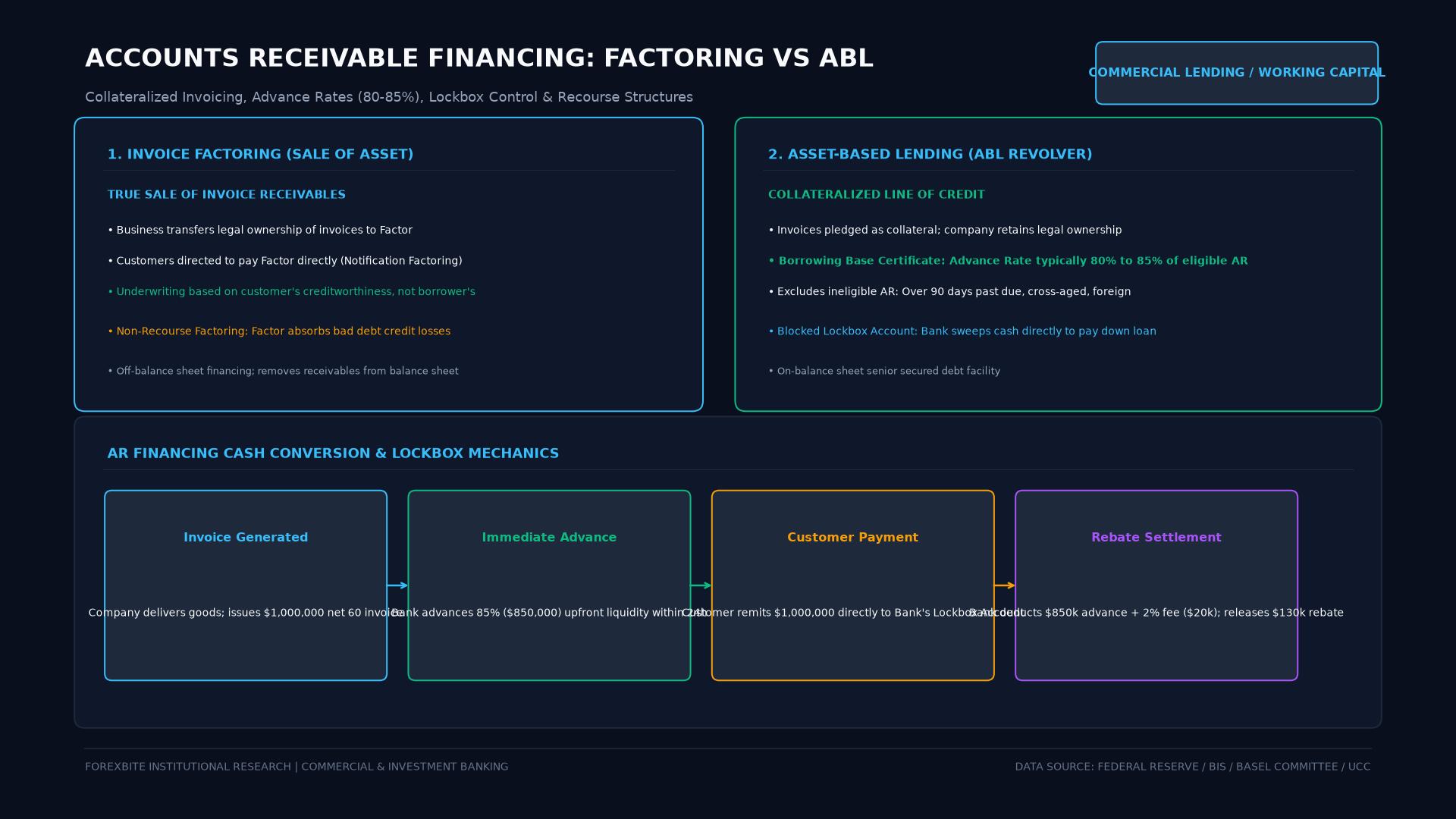 Figure: Asset-based lending mechanics contrasting invoice factoring with accounts receivable pledging, advance rates, and collateral liquidation rights.
Technical Mechanics & Core Structures
Accounts receivable financing is delivered through two distinct legal and operational structures:
1. Invoice Factoring (Sale of Asset)
Under a factoring agreement, the business sells ownership of its invoices outright to a third party (the factor):
- Notification: The debtor is legally notified to direct future payments to the factor’s lockbox.
- Advance Rate: The factor transfers an immediate advance (typically 80% to 90% of the gross invoice face value) to the seller within 24 to 48 hours.
- Reserve Rebate: Once the debtor pays the invoice in full, the factor remits the remaining 10% to 20% reserve balance back to the seller, minus a factoring discount fee (typically 1.0% to 3.5% per 30-day period).
- Recourse vs. Non-Recourse: In recourse factoring, if the debtor defaults, the seller must buy back the uncollected invoice. In non-recourse factoring, the factor absorbs the credit loss if the debtor enters formal insolvency, charging a higher discount fee for assuming credit risk.
2. Invoice Discounting (Asset-Pledged Loan)
Under invoice discounting (often integrated into a broader Asset-Based Lending facility):
- Confidentiality: The facility remains confidential. Customers continue paying the seller directly into a designated collection account without knowing a financing provider is involved.
- Legal Form: The invoices are pledged as collateral rather than sold, and the seller retains complete responsibility for credit control and collections.
Comparative Matrix: Factoring vs. Discounting vs. Bank Line of Credit
| Operational Feature | Invoice Factoring | Invoice Discounting | Traditional Bank Line of Credit |
|---|---|---|---|
| Underwriting Focus | Creditworthiness of the customer (debtor) | Overall operational health and invoice tracking | Historical company profitability and balance sheet |
| Customer Notification | Transparent; customer pays factor directly | Confidential; customer unaware of financing | Confidential; bank holds general UCC lien |
| Credit Control | Handled by factor’s collection team | Retained internally by the business | Retained internally by the business |
| Speed to Funding | Fast (2 to 5 business days for setup) | Moderate (1 to 2 weeks for facility review) | Slow (4 to 8 weeks of underwriting) |
| Effective APR | Higher (12% to 28% annualized) | Moderate (8% to 18% annualized) | Lowest (SOFR + 200 to 450 bps, 6% to 10%) |
Real-World Case Study: Commercial Food Distributor Growth
In early 2024, a specialized frozen seafood distributor secured a $6 million annual delivery contract with a nationwide supermarket chain. The contract mandated 75-day payment terms, while the distributor was required to pay seafood processing plants within 14 days of shipment.
With existing cash reserves capped at $450,000, the distributor faced a severe working capital deficit after shipping the first $1.2 million in inventory. Traditional commercial banks declined an unsecured loan due to the company’s brief two-year operating track record.
The distributor secured a non-notification invoice discounting facility with an 85% advance rate ($1,020,000 advanced within 24 hours of invoice generation) and a 1.25% discount fee per 30-day cycle. When the supermarket settled the $1.2 million invoice on day 68, the lender deducted $34,000 in financing fees and remitted the remaining $146,000 reserve. The immediate cash flow enabled the distributor to fulfill subsequent monthly orders without missing supplier discounts or surrendering company equity.
Frequently Asked Questions (FAQ)
Does accounts receivable financing create balance sheet debt?
It depends on the legal structure. Invoice discounting and recourse factoring are categorized as debt on the corporate balance sheet because the company retains liability for repayment. True-sale, non-recourse invoice factoring is classified as an off-balance-sheet asset sale, converting accounts receivable directly into cash without increasing reported liabilities.
What causes an invoice to be rejected for AR financing?
Lenders reject invoices associated with disputed goods, pre-billing (billing before delivery is verified), progress billing (milestone construction payments), invoices past due beyond 90 days, or customers with adverse credit judgments and bankruptcy filings.
How does concentration risk affect AR financing terms?
Lenders prefer a diversified debtor base. If a single customer accounts for more than 25% to 30% of a company’s total accounts receivable, the financing provider will cap funding on that specific debtor or require specialized trade credit insurance to hedge default risk.
Ready to trade forex?
Open a free demo account with a regulated broker. Practice with virtual funds before risking real money.