ABM
ABM stands for Activity-Based Management in corporate finance, a managerial methodology using process data to eliminate waste and optimize profitability; in retail banking, it also designates Automated Banking Machines, the primary electronic self-service banking terminals.
What Does ABM Stand For?
ABM stands for Activity-Based Management in corporate accounting, operational analysis, and enterprise financial planning. In retail banking and consumer payment infrastructure, particularly across Canada and international Commonwealth networks, ABM is also the standard regulatory and commercial term for Automated Banking Machines (synonymous with ATMs).
In financial management, Activity-Based Management is an analytical discipline that evaluates operational business processes through the lens of cost causation. Rather than allocating overhead expenses arbitrarily across broad departments, ABM leverages detailed data from Activity-Based Costing (ABC) systems to identify which specific activities generate value, which generate waste, and how corporate capital should be allocated to maximize enterprise operating margins.
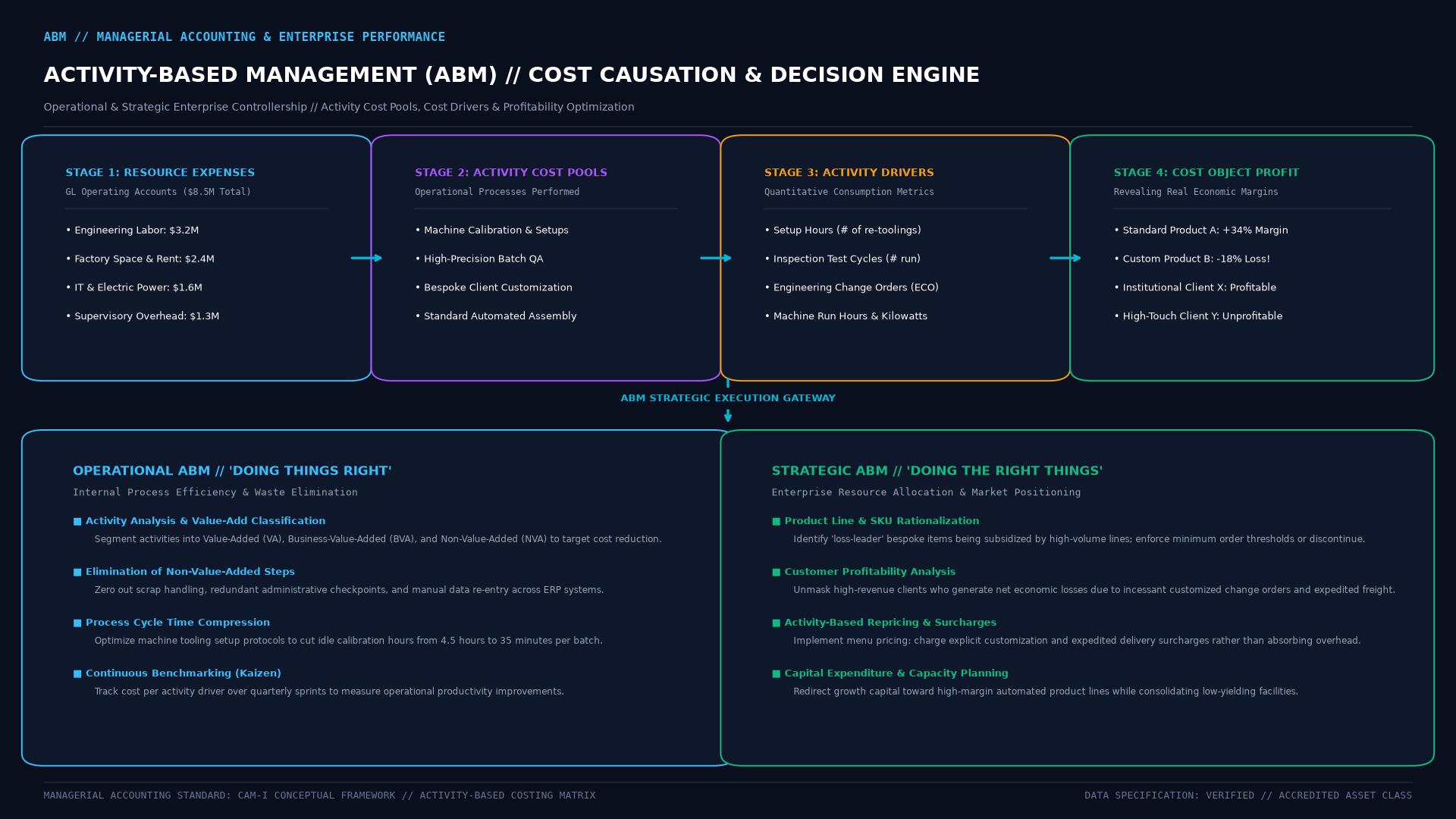 Figure: Activity-Based Management (ABM) architecture illustrating how general ledger resources are mapped into activity cost pools via cost drivers to expose true product profitability and guide operational vs. strategic decisions.
Technical Mechanics of Activity-Based Management
Activity-Based Management operates on two distinct dimensions: operational ABM and strategic ABM:
1. Operational ABM (Doing Things Right)
Operational ABM targets process efficiency, throughput speed, and quality control. Management assesses business activities against three classifications:
- Value-Added Activities: Steps essential to customer satisfaction or regulatory compliance that customers are willing to pay for (such as core product assembly or software code development).
- Non-Value-Added Activities: Unnecessary tasks that generate cost without improving product utility (such as duplicate invoice approvals, rework due to defects, or transit delays between production cells).
- Activity Drivers: Measurable units of work that trigger cost consumption, including machine setup hours, procurement orders processed, customer service calls received, or engineering change notices.
2. Strategic ABM (Doing the Right Things)
Strategic ABM uses activity cost data to alter the company’s product mix, pricing models, and client portfolio:
Activity Cost per Driver = Total Cost of Activity Pool / Total Practical Capacity of DriverWhen firms quantify true activity costs, they frequently discover that 20% of custom, low-volume product lines consume 80% of administrative and testing capacity, masking severe economic losses beneath misleading gross-margin calculations.
Automated Banking Machines (Retail Banking Context)
In consumer financial services and interbank networks, an Automated Banking Machine (ABM) represents a computer terminal enabling bank customers to perform transactions without a human teller:
- Terminology: While American banking predominantly uses the acronym ATM (Automated Teller Machine), Canadian and select Commonwealth banking regulations formally designate these devices as ABMs.
- Network Architecture: ABMs connect through secure interbank transaction switches such as Interac in Canada, NYCE in the United States, and global card networks like Visa Plus and Mastercard Cirrus.
- Capabilities: Modern ABMs handle smart cash deposits, instant foreign currency exchange dispensing, electronic fund transfers between linked accounts, and contactless biometric authentication.
Comparative Matrix: Activity-Based Management vs. Traditional Costing
| Dimension | Activity-Based Management (ABM) | Traditional Standard Costing |
|---|---|---|
| Overhead Allocation | Multiple activity cost pools tied to specific operational drivers | Single broad allocation base (direct labor hours or machine hours) |
| Cost Distortions | Low; exposes hidden subsidies between products | High; over-costs simple products and under-costs complex ones |
| Focus Area | Business processes, waste reduction, continuous improvement | Variance analysis against static budgetary standards |
| Implementation Cost | High initial investment in data collection and tracking systems | Low; relies on standard general ledger accounting data |
| Strategic Utility | Identifies unprofitable customers, channels, and product variants | Focuses primarily on quarterly inventory valuation for GAAP compliance |
Real-World Case Study: Industrial Valve Manufacturer Restructuring
In early 2024, an industrial manufacturing company generating $85 million in annual revenue experienced falling operating profits despite record top-line sales. The executive team deployed an Activity-Based Management framework across four production plants.
The ABM audit tracked 14 operational activity pools and revealed that custom batch setups were costing $3,400 per production run, yet the sales team had been pricing custom orders based on standard direct labor hours alone. While high-volume standard valves generated an actual net profit margin of 26%, custom small-batch valves were operating at an effective loss of 18% per unit.
Management responded by introducing a mandatory $2,500 setup surcharge on custom orders and automated three manual quality testing stages. Within nine months, the company eliminated 22 unprofitable product variations, improving consolidated EBITDA margin by 410 basis points ($3.5 million in incremental annualized operating profit).
Frequently Asked Questions (FAQ)
What is the primary difference between Activity-Based Costing (ABC) and Activity-Based Management (ABM)?
Activity-Based Costing is the underlying measurement and calculation methodology that calculates accurate costs for activities, products, and services. Activity-Based Management is the strategic and operational decision-making framework that uses ABC data to restructure operations, reprice contracts, and eliminate business waste.
Why do some companies struggle with ABM implementation?
ABM requires tracking granular process data across departments, demanding cooperation between accounting, engineering, and frontline operations. Many initiatives falter when organizations create excessively complex tracking models with hundreds of micro-activities that become too costly to maintain.
How does ABM influence customer relationship management?
By calculating the true cost-to-serve each customer (accounting for custom packaging, expedited shipping, and excessive service inquiries), ABM identifies unprofitable clients. Businesses can then negotiate minimum order sizes, introduce service fees, or terminate destructive accounts to protect operating margins.
Ready to trade forex?
Open a free demo account with a regulated broker. Practice with virtual funds before risking real money.