Activity Based Costing
Activity-Based Costing (ABC) is a managerial accounting methodology that assigns indirect overhead costs to specific operational activities, allocating expenses to products and services based on their actual consumption of resources.
What Is Activity-Based Costing (ABC)?
Activity-Based Costing (ABC) is an advanced managerial cost accounting methodology designed to assign indirect overhead expenses to products, services, customer accounts, and distribution channels with high mathematical accuracy.
Pioneered in the late 1980s by Harvard Business School professors Robert Kaplan and Robin Cooper, ABC was developed to resolve a dangerous flaw in traditional volume-based cost accounting. In legacy manufacturing accounting, indirect factory overhead (such as machine maintenance, quality inspections, engineering redesigns, and procurement logistics) is pooled together and allocated across products using a single broad metric, most commonly direct labor hours or machine hours.
This legacy approach severely distorts product profitability through cost cross-subsidization: simple, high-volume products consume very little engineering or setup support, yet they are burdened with massive overhead allocations simply because they involve many machine hours. Conversely, complex, low-volume custom products consume massive administrative, testing, and retooling resources, yet traditional accounting makes them appear deceptively profitable. ABC eliminates this distortion by tracking expenses through a two-stage allocation process.
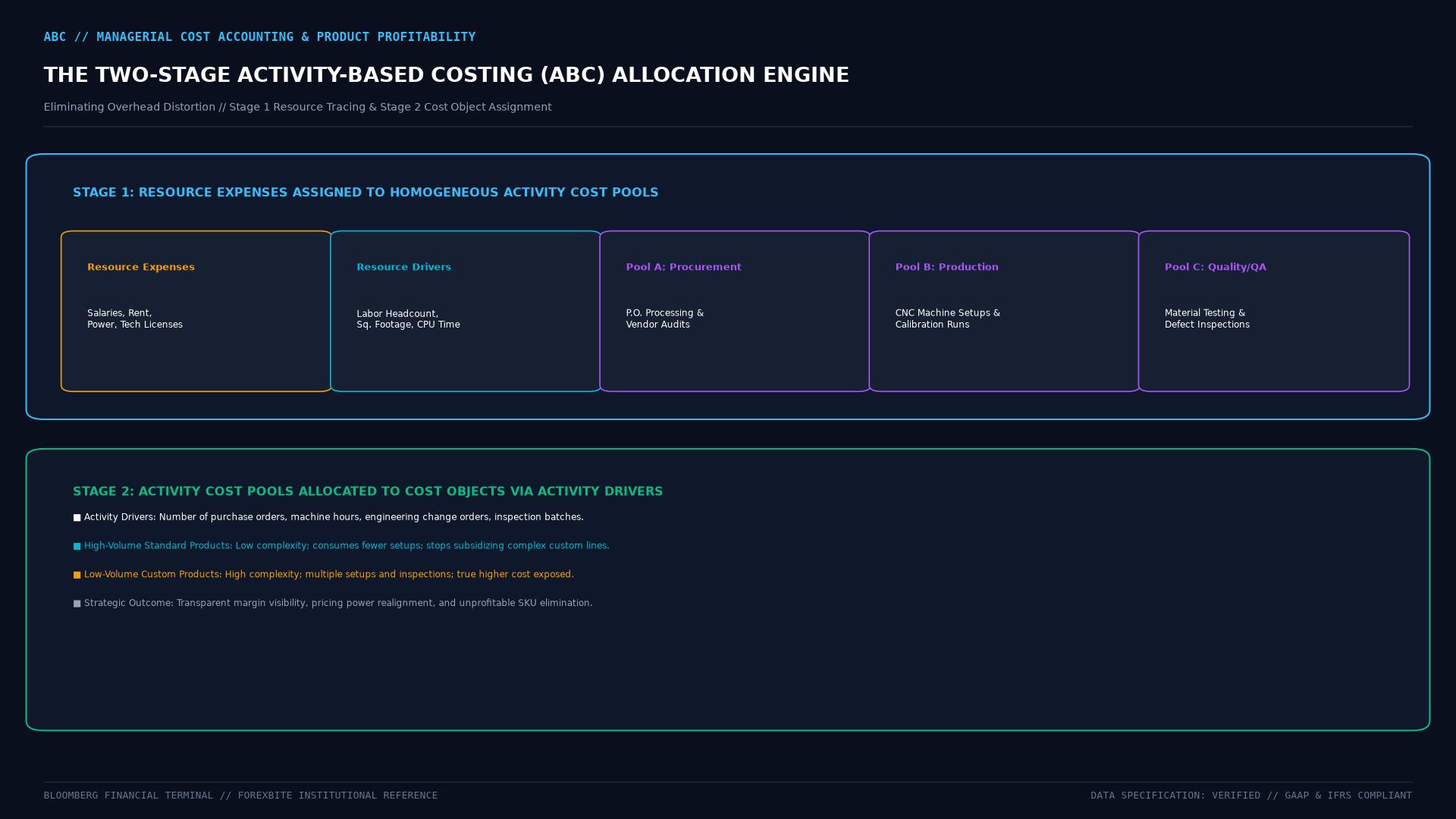 Figure: Structural comparison between Traditional Overhead Allocation (single volume-based cost pool) and Activity-Based Costing (ABC) with multiple cost pools and distinct cost drivers to eliminate product cross-subsidization.
Technical Mechanics & The Cost Hierarchy
Activity-Based Costing categorizes all organizational business activities into a structured four-level Cost Hierarchy:
1. The Four Activity Levels
- Unit-Level Activities: Performed each time a single unit is produced (e.g., direct electrical power consumption, stamping a metal part). Costs scale in direct linear proportion to production volume.
- Batch-Level Activities: Performed each time a batch of goods is handled or processed, regardless of the number of units in the batch (e.g., setting up machine tooling, ordering raw materials, cleaning production lines).
- Product-Sustaining Activities: Performed to support specific product lines regardless of volume or batches (e.g., engineering change notices, developing specialized testing software, securing patent licenses).
- Facility-Sustaining Activities: Factory infrastructure costs that sustain the overall enterprise and cannot be logically traced to individual products (e.g., factory building rent, heating, plant manager salary, grounds security).
2. The Activity Rate Calculation Formula
Corporate accountants calculate the cost rate for each activity pool using practical capacity:
Activity Cost Driver Rate = Total Cost in Activity Pool / Total Practical Capacity of Activity DriverIf an enterprise spends $450,000 annually managing the quality inspection department and has the practical capacity to execute 1,500 formal inspections, the activity rate is $300 per inspection ($450,000 / 1,500).
When a batch of customized medical instruments requires 8 separate quality inspections, the job is allocated exactly $2,400 ($300 × 8) in quality overhead, reflecting true economic consumption.
Comparative Matrix: Activity-Based Costing vs. Traditional Volume Costing
| Dimension | Activity-Based Costing (ABC) | Traditional Volume-Based Costing |
|---|---|---|
| Cost Pools | Multiple distinct activity pools (often 10 to 30) | Single plant-wide pool or a few departmental pools |
| Allocation Drivers | Non-financial volume & batch drivers (setups, POs) | Direct labor hours, machine hours, or material cost |
| Treatment of Overhead | Traces both manufacturing and corporate sales overhead | Traces strictly factory overhead; treats sales as period cost |
| Cost Distortions | Extremely low; mirrors actual operational consumption | High; cross-subsidizes complex products at expense of simple |
| GAAP Compliance | Used for internal decision-making (not GAAP compliant) | Mandated for external financial reporting and tax returns |
| Strategic Insight | Identifies unprofitable customers, channels, SKUs | Focuses strictly on financial statement inventory valuation |
Real-World Case Study: Commercial Printing Corporation Pricing Overhaul
In 2023, a commercial offset printing corporation with $60 million in revenue was losing market share on high-volume catalog print runs to foreign competitors, while experiencing record demand for short-run custom corporate brochures. Surprisingly, despite high order volume, company operating margins fell from 14% to 4.2%.
The CFO deployed an Activity-Based Costing model across the plant:
- The Discovery: Traditional volume costing had allocated pressroom overhead based on machine hours ($120 per hour). Because large catalog runs ran on presses for 40 hours, they were burdened with $4,800 in overhead, forcing the sales team to quote high prices that lost contracts.
- The ABC Reality: The ABC audit showed that 70% of pressroom costs were driven by plate setups, ink washes, and color proofing tests, representing batch activities that occurred on every print job regardless of volume.
- True Profitability Revealed:
- A short-run custom brochure job that took 2 hours of press time but required 6 complete color washdowns consumed $2,200 in true activity costs, yet traditional costing had billed it for only $240 in overhead. The company was losing $1,960 on every custom brochure it printed.
- High-volume catalog runs required only one initial setup, consuming only $600 in true batch overhead.
- Strategic Outcome: Management lowered prices on high-volume catalogs by 18%, regaining $12 million in commercial contracts, while instituting a mandatory $800 setup surcharge on custom short runs. The company’s operating margin rebounded to 15.6% within 14 months.
Frequently Asked Questions (FAQ)
Why is Activity-Based Costing rarely used for external GAAP financial reporting?
US GAAP and IFRS require inventory valuation for financial reporting to include only manufacturing product costs, excluding administrative, selling, and customer-service expenses. ABC includes non-manufacturing overhead (such as customer service and order processing) in product costs while excluding unused facility capacity, making it an internal managerial decision tool rather than an external statutory reporting system.
What is Time-Driven Activity-Based Costing (TDABC)?
Developed by Robert Kaplan and Steven Anderson to simplify classic ABC, Time-Driven ABC eliminates the need to interview employees regarding time percentages. Instead, TDABC requires only two estimates: the unit cost of supplying resource capacity (e.g., $2.00 per minute of engineering time) and the time required to perform one transaction of the activity (e.g., 25 minutes per custom quote), making the model dramatically faster to deploy and maintain.
How does ABC assist in customer profitability analysis?
ABC allows companies to calculate the Cost-to-Serve individual clients. By tracking activities such as expedited freight requests, custom packaging requirements, manual order modifications, and frequent return processing, ABC reveals which major revenue customers are actually draining net profits through high operational service demands.
Ready to trade forex?
Open a free demo account with a regulated broker. Practice with virtual funds before risking real money.