Accounting
Accounting is the comprehensive and systematic process of identifying, recording, measuring, classifying, verifying, summarizing, interpreting, and communicating financial transactions and economic performance metrics of an individual, corporation, or public institution.
What Is Accounting?
Accounting, frequently termed the “language of business,” is the structured discipline of recording, classifying, analyzing, and reporting financial and operational data for commercial enterprises, sovereign governments, and non-profit institutions.
Through standard accounting principles—most notably Generally Accepted Accounting Principles (US GAAP) and International Financial Reporting Standards (IFRS)—accounting translates thousands of disparate daily commercial transactions into standardized financial statements: the Balance Sheet, Income Statement, Statement of Cash Flows, and Statement of Changes in Shareholders’ Equity.
Accounting provides internal decision-makers (executives, departmental managers) with real-time operational insights while delivering transparent, auditable disclosures to external stakeholders, including equity investors, bondholders, tax authorities (such as the IRS or HMRC), and regulatory bodies (such as the SEC).
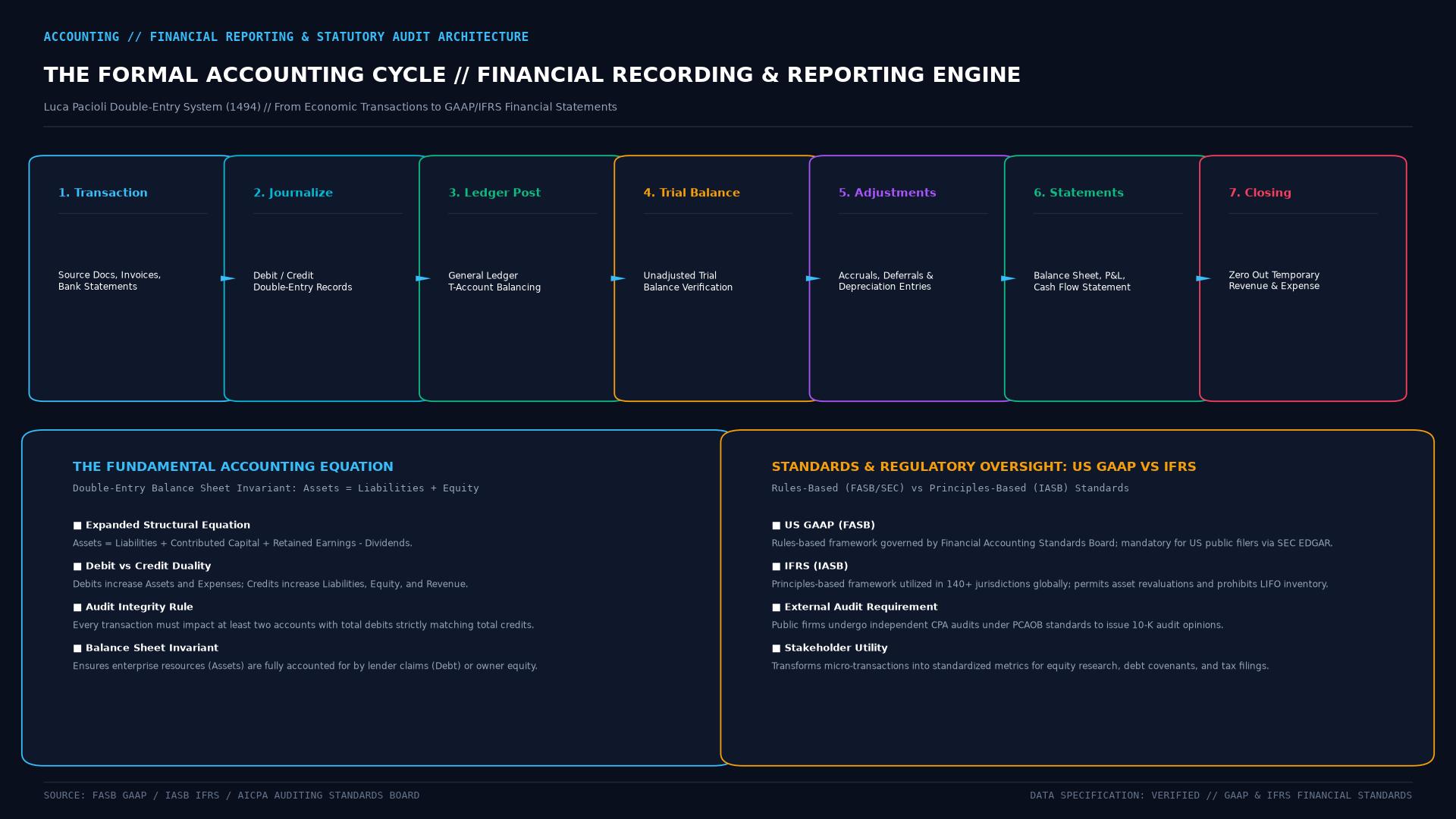 Figure: The complete 7-step accounting cycle workflow under US GAAP and IFRS, illustrating the progression from source transaction to financial statement publication, the double-entry fundamental equation ($Assets = Liabilities + Equity$), and closing entry procedures.
Technical Mechanics & Core Governing Equations
Modern accounting operates on the double-entry bookkeeping methodology formalized by Luca Pacioli in 1494, where every financial transaction impacts at least two accounts with equal debits and credits.
1. The Fundamental Accounting Equation
The structural foundation of the Balance Sheet: $$\text{Assets} = \text{Liabilities} + \text{Shareholders’ Equity}$$ Where Shareholders’ Equity ($\text{SE}$) decomposes into: $$\text{SE} = \text{Contributed Capital} + \text{Retained Earnings}_{\text{Beginning}} + \text{Net Income} - \text{Dividends Distributed}$$
2. The Net Income Identity
The core operational equation of the Income Statement: $$\text{Net Income} = \text{Revenues} - \text{Cost of Goods Sold (COGS)} - \text{Operating Expenses (OPEX)} - \text{Interest} - \text{Taxes}$$
3. Cash Flow Reconciliation Equation
Connecting net accrual income to physical liquidity: $$\text{Operating Cash Flow} = \text{Net Income} + \text{Non-Cash Charges (D&A)} \pm \Delta \text{Working Capital}$$
Comparative Matrix: Major Accounting Sub-Disciplines
| Discipline | Primary Audience | Standard Framework | Time Orientation | Legal & Audit Requirement |
|---|---|---|---|---|
| Financial Accounting | External investors, lenders, regulators | US GAAP / IFRS | Historical (Quarterly / Annual) | Mandatory for publicly traded companies; external CPA audit |
| Managerial Accounting | Internal executives, board, department heads | Custom management metrics (EBITDA, margin targets) | Forward-looking (Budgets, forecasts) | Voluntary; internal operational use only |
| Tax Accounting | Government revenue services (IRS, HMRC) | Internal Revenue Code (IRC) | Historical statutory tax year | Mandatory; subject to government tax audits |
| Forensic Accounting | Courts, law enforcement, fraud investigators | Legal evidentiary standards + GAAP rules | Investigative reconstruction | Commissioned for litigation, disputes, or insolvency |
Real-World Case Study: The 2002 WorldCom Accounting Fraud
The extreme manipulation of standard accounting rules was vividly demonstrated in the 2002 collapse of telecom giant WorldCom:
- The Fraudulent Technique: Faced with crashing telecommunications bandwidth prices, WorldCom management improperly capitalized operational line costs (network lease expenses) instead of expensing them on the Income Statement. Over $3.8 billion in everyday operating costs were treated as capital expenditures on the Balance Sheet.
- The Financial Illusion: This accounting deception falsely suppressed operating expenses and artificially inflated Net Income and EBITDA, transforming real operational losses into reported profits.
- The Resolution: Internal auditors uncovered the entries, triggering an $11 billion restatement, the largest corporate bankruptcy in US history at the time, and directly accelerating the passage of the Sarbanes-Oxley Act of 2002 (SOX) to mandate rigorous internal financial controls.
Frequently Asked Questions (FAQ)
What is the primary difference between cash accounting and accrual accounting?
Cash accounting recognizes revenue and expenses only when cash physically enters or exits a bank account. Accrual accounting recognizes revenue when earned and expenses when incurred, irrespective of when payment is exchanged, providing a more accurate economic picture of business operations.
What does “double-entry bookkeeping” mean in practice?
Double-entry bookkeeping dictates that every single transaction requires both a debit entry in one account and a corresponding credit entry in another. Because total debits must always equal total credits, this mechanism prevents mathematical errors and guarantees that the balance sheet equation remains in equilibrium.
Why are GAAP and IFRS rules updated continuously?
Accounting standard boards (FASB and IASB) continuously update standards to reflect emerging commercial realities—such as software-as-a-service (SaaS) subscription models, complex derivative hedging instruments, digital asset holdings, and lease obligation capitalization rules.
Ready to trade forex?
Open a free demo account with a regulated broker. Practice with virtual funds before risking real money.