Activity Based Management
Activity-Based Management (ABM) is an executive management discipline that utilizes Activity-Based Costing data to streamline business processes, eliminate non-value-added activities, and optimize strategic pricing and customer profitability.
What Is Activity-Based Management (ABM)?
Activity-Based Management (ABM) is a comprehensive, data-driven executive management discipline that leverages granular cost insights from Activity-Based Costing (ABC) to optimize operational business processes, eliminate waste, and make informed strategic decisions.
While Activity-Based Costing functions as the diagnostic measurement engine that calculates the true cost of activities and products, Activity-Based Management is the decision-making framework that uses those calculations to transform corporate strategy.
ABM shifts managerial focus away from arbitrary line-item cost cutting (such as freezing travel budgets or firing frontline staff) and directs attention toward understanding cost causation. By identifying why activities are performed, what resources they consume, and what value they deliver to external customers, ABM empowers leadership to reprice contracts, redesign workflows, optimize product portfolios, and systematically eliminate non-value-added overhead.
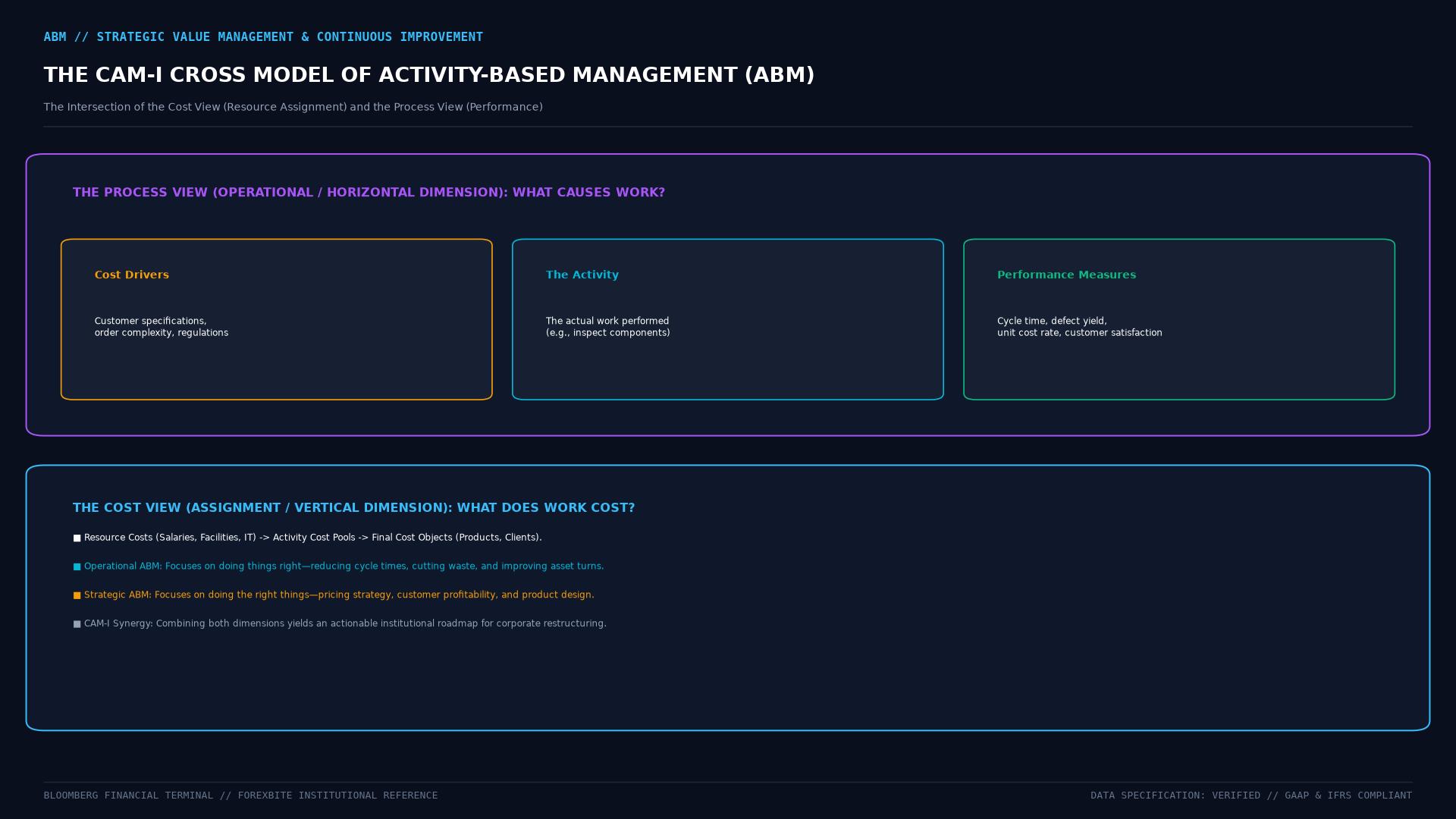 Figure: Two-dimensional Activity-Based Management (ABM) framework displaying the Cost Dimension (resources, activities, cost objects) and the Process Dimension (process triggers, activity analysis, performance measures).
Technical Mechanics: Operational vs. Strategic ABM
Developed through the Consortium for Advanced Management-International (CAM-I), Activity-Based Management functions along two distinct operational dimensions:
1. Operational ABM (Doing Things Right)
Operational ABM targets process efficiency, throughput speed, and quality control:
- Root-Cause Analysis: Identifies the fundamental triggers that generate repetitive work. If a customer service team spends 400 hours monthly handling billing dispute calls, operational ABM does not hire more call operators; it fixes the software glitch in the automated invoicing engine that generated the customer confusion.
- Elimination of Non-Value-Added (NVA) Waste: Dissects operational tasks to eradicate redundant handoffs, duplicate management approvals, material transit delays, and post-production quality rework.
- Cycle Time Reduction: Measures the total elapsed time required to complete an activity from trigger to completion, driving Lean six-sigma continuous improvement.
2. Strategic ABM (Doing the Right Things)
Strategic ABM uses activity cost data to alter the company’s market positioning, pricing models, and client portfolio:
- Strategic Product Mix: Discontinues unprofitable, custom product variations that consume disproportionate engineering and setup resources without adequate commercial markups.
- Customer Profitability Management: Segregates customers by true Cost-to-Serve. Clients who demand frequent order changes, customized packaging, manual paperwork, and rapid deliveries are identified, allowing sales teams to institute minimum order sizes, charge specialized service fees, or drop destructive accounts.
- Target Costing: When designing new products, engineering teams use ABM activity benchmarks to design products that conform to strict market-driven cost ceilings before factory tooling begins.
Comparative Matrix: Operational ABM vs. Strategic ABM
| Dimension | Operational ABM (Process View) | Strategic ABM (Cost Assignment View) |
|---|---|---|
| Core Objective | Maximize process efficiency and eliminate waste | Optimize product mix, pricing, and client margins |
| Primary Question | “How can we perform this activity cheaper and faster?” | “Should we continue performing this activity at all?” |
| Typical Initiatives | Lean manufacturing, workflow automation, Six Sigma | Repricing contracts, dropping SKUs, outsourcing |
| Key Metrics | Cycle time, error rates, capacity utilization | Customer net margin, product gross margin, ROIC |
| Department Focus | Operations, engineering, plant management, logistics | Executive suite, corporate strategy, sales, finance |
Real-World Case Study: Commercial Bank Corporate Lending Turnaround
In 2023, a regional commercial bank with $12 billion in assets experienced shrinking net interest margins across its corporate lending division. While loan origination volume was at an all-time high, operating profits declined by 16%.
The bank launched an Activity-Based Management initiative:
- The Investigation: The ABM team analyzed the complete lending workflow across 35 discrete banking activities, tracking commercial underwriting, legal review, KYC sanction vetting, and collateral appraisal.
- Cost-to-Serve Discrepancy: The data revealed that small commercial loans (under $500,000) consumed nearly identical administrative underwriting hours and legal documentation costs ($6,800 per loan file) as middle-market loans ($5,000,000), resulting in an effective operating loss on small loans after loan-loss reserves.
- Strategic Action:
- Operational ABM: Automated small-business loan underwriting using digital tax transcript APIs and credit-score decision engines, reducing loan processing time from 21 days to 48 hours and cutting file processing cost from $6,800 to $650.
- Strategic ABM: Implemented a mandatory $2,500 underwriting documentation fee on complex middle-market credit lines that required custom covenants.
- Result: Within 12 months, the corporate lending division boosted operating net income by $8.4 million while reducing customer loan approval turnaround times by 65%.
Frequently Asked Questions (FAQ)
What is the CAM-I Cross Model in Activity-Based Management?
The CAM-I Cross Model is the conceptual architecture of ABM developed by the Consortium for Advanced Management-International. It illustrates that ABC/ABM possesses two intersecting axes: a horizontal Process View (analyzing cost drivers, activities, and operational performance) and a vertical Cost Assignment View (tracing resource costs to activities and assigning them to cost objects).
How does ABM prevent across-the-board budget slashing?
Traditional across-the-board budget cuts (such as cutting all department budgets by 10%) punish efficient departments while starving essential customer-facing operations. ABM provides visibility into which activities directly generate customer value, allowing executives to cut wasteful non-value-added activities aggressively while protecting or expanding high-value activities.
Can ABM be integrated with Lean Six Sigma?
Yes. ABM and Lean Six Sigma are highly complementary. Lean Six Sigma provides the statistical problem-solving tools and cultural discipline to eliminate process variation and defects, while ABM provides the precise financial metrics to quantify the dollar savings achieved by those process improvements.
Ready to trade forex?
Open a free demo account with a regulated broker. Practice with virtual funds before risking real money.