Accept
In contract law and commercial banking, to accept means to unconditionally agree to the terms of an offer, or for a drawee to formally sign and validate a negotiable instrument (such as a bill of exchange or time draft), transforming it into a legally binding unconditional payment obligation.
What Does It Mean to Accept in Finance and Law?
In commercial contract law, international trade finance, and capital markets trading, the term accept represents the decisive legal act of manifesting unconditional assent to an outstanding offer or financial instrument:
- Contract Law Formation: The mirror-image manifestation of agreement to the specific terms proposed by an offeror. Acceptance creates privity of contract, binding both parties under mutual legal consideration.
- Negotiable Instruments & Commercial Paper: Under the Uniform Commercial Code (UCC § 3-409), to accept means the formal act whereby the drawee of a draft or bill of exchange signs the instrument (traditionally writing “Accepted” across the face of the document), thereby undertaking the primary, unconditional liability to pay the instrument upon maturity.
- Electronic Financial Exchanges: In electronic order routing, to accept means an exchange matching engine acknowledging and executing an incoming market or limit order against an opposing bid or offer on the central limit order book (CLOB).
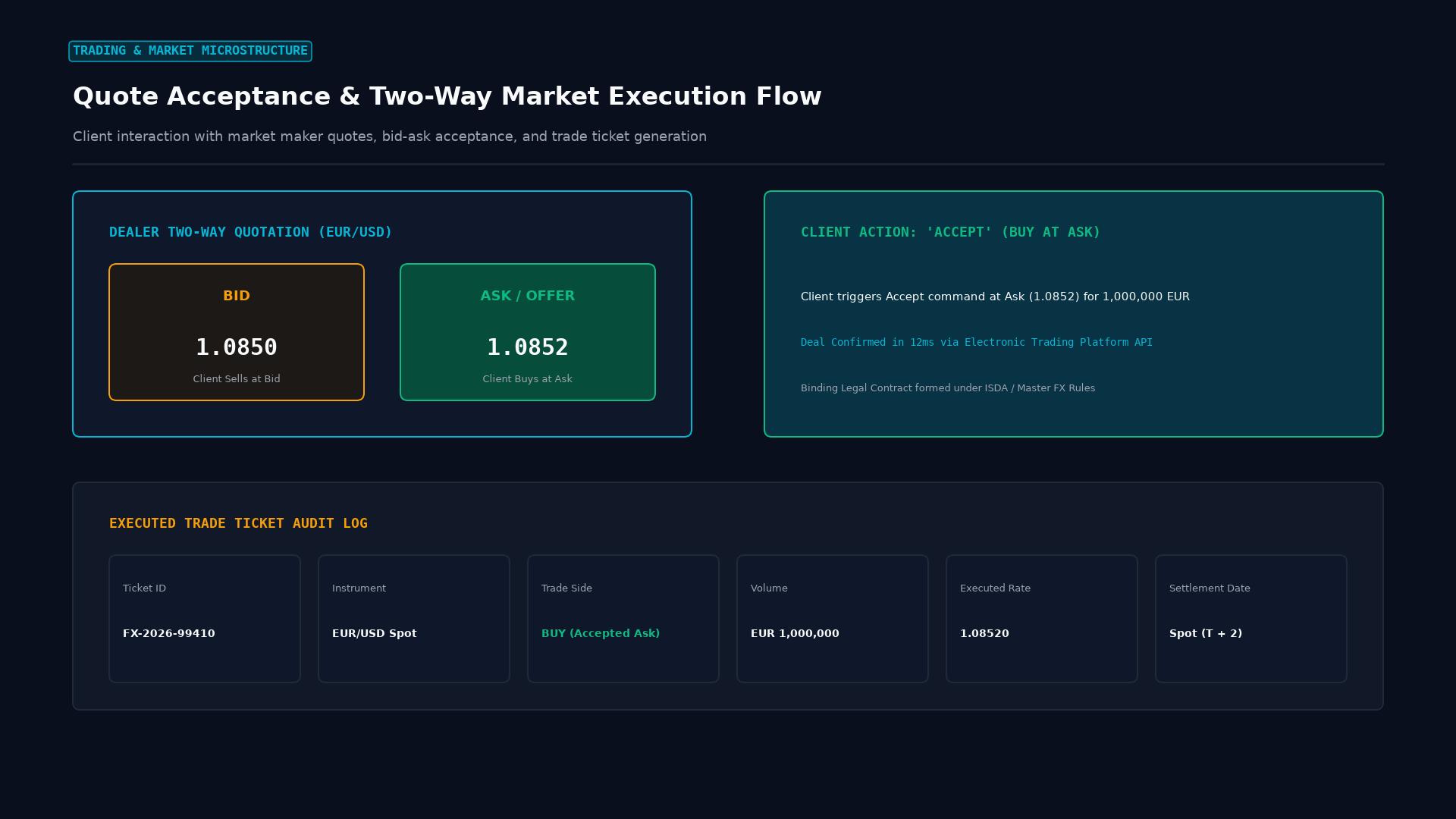 Figure: Direct execution against dealer two-way quotations: hitting the bid vs accepting the ask, sub-millisecond API order matching, and trade blotter ticket generation.
Technical Mechanics Under the Uniform Commercial Code (UCC)
In banking and institutional money markets, the legal act of accepting a time draft converts third-party credit risk into direct institutional liability:
1. The Drawee-to-Acceptor Transformation
Prior to acceptance, the drawee (often a commercial bank) has no direct liability on a bill of exchange. The drawer (exporter) issues a time draft instructing the bank to pay funds at a future date:
- Once the authorized bank officer writes “Accepted”, appends the date, and signs the document, the drawee legally becomes the Acceptor.
- By accepting, the bank assumes primary liability to pay the holder in due course at maturity, regardless of whether the original drawer reimburses the bank.
2. The “Mirror Image” Rule in Trading
In financial derivatives and over-the-counter (OTC) master agreements (such as ISDA Master Agreements), acceptance must strictly conform to the mirror image rule. Any variation, added condition, or alteration in settlement date does not constitute an acceptance; legally, it operates as a rejection coupled with a counteroffer, leaving no enforceable contract until the counteroffer is accepted.
Comparative Matrix: Contractual and Banking Actions
| Term | Legal Function | Initiated By | Financial Liability Created | Reversibility |
|---|---|---|---|---|
| Accept | Assents unconditionally to terms or assumes draft liability | Offeree or Drawee Bank | Primary, direct, and unconditional | Irrevocable once communicated |
| Acknowledge | Confirms receipt of document or notice without assenting to liability | Recipient | None (procedural only) | Non-binding |
| Endorse | Signs back of instrument to negotiate/transfer title | Holder / Payee | Secondary liability if acceptor defaults | Binding upon transfer |
| Ratify | Confirms and adopts a prior unauthorized or voidable act | Principal | Retroactive full legal responsibility | Irrevocable |
Real-World Case Study: Executing a Cross-Border Trade Acceptance
A Malaysian rubber exporter contracted to deliver $1.5 million worth of vulcanized rubber to an industrial tire manufacturer in Germany with payment deferred for 90 days after bill-of-lading issuance:
- The Time Draft: The exporter presented shipping documents and drew a 90-day time draft on the importer’s bank, Deutsche Bank AG.
- The Act of Acceptance: Upon verifying that shipping manifests, customs declarations, and quality inspection certificates matched letter-of-credit covenants exactly, Deutsche Bank stamped “Accepted - Payable at 90 Days” with authorized signatures.
- Secondary Market Monetization: Because Deutsche Bank formally accepted the draft, it became a Banker’s Acceptance (BA). The Malaysian exporter did not want to wait 90 days for cash; they sold the accepted draft in the Singapore money market at a tight discount yield of 3.85%, immediately receiving $1,485,562 in liquidity.
- Final Maturity: At Day 90, the institutional money market fund holding the accepted paper presented it to Deutsche Bank, which paid the full $1.5 million face value without recourse.
Frequently Asked Questions (FAQ)
Can an acceptance be revoked after it is sent?
Under common-law contract rules (the Mailbox Rule), an acceptance becomes effective and forms a binding contract the instant it is dispatched by an authorized medium (e.g., posted by mail or transmitted via electronic trade messaging), making unilateral revocation impossible once sent.
What is a “qualified acceptance” in banking?
A qualified acceptance occurs when a drawee agrees to pay only upon specified deviations from the original draft (such as altering the payment amount, changing the currency, or extending the maturity date). A drawer or holder has the legal right to reject a qualified acceptance and treat the draft as dishonored.
How does an electronic exchange matching engine accept an order?
In algorithmic equity and currency trading, order acceptance occurs when the exchange matching engine’s order routing system verifies margin requirements, matches the bid with an ask via price-time priority, and transmits a FIX protocol ExecutionReport (35=8) message confirming trade execution.
Ready to trade forex?
Open a free demo account with a regulated broker. Practice with virtual funds before risking real money.