Acceptance
In commercial banking and international trade finance, an acceptance is a negotiable time draft or bill of exchange that has been formally signed and validated by the drawee, establishing an unconditional legal commitment to pay the instrument's face value to the holder upon maturity.
What Is an Acceptance?
In money markets, commercial banking, and international trade finance, an acceptance refers to a specialized financial draft—most commonly a Banker’s Acceptance (BA) or a Trade Acceptance—that has been formally accepted by the entity upon whom it was drawn (the drawee).
When an exporter or seller draws a time draft on a financial institution or buyer requiring payment at a specific future date (typically 30, 60, 90, or 180 days), the instrument is merely an unverified payment order. However, once the drawee bank inspects the accompanying shipping bills of lading, approves the credit arrangement, and signs the document with the word “Accepted”, the instrument is transformed into an acceptance: a negotiable, credit-enhanced, liquid money market instrument that can be held to maturity or immediately traded at a discount in institutional secondary markets.
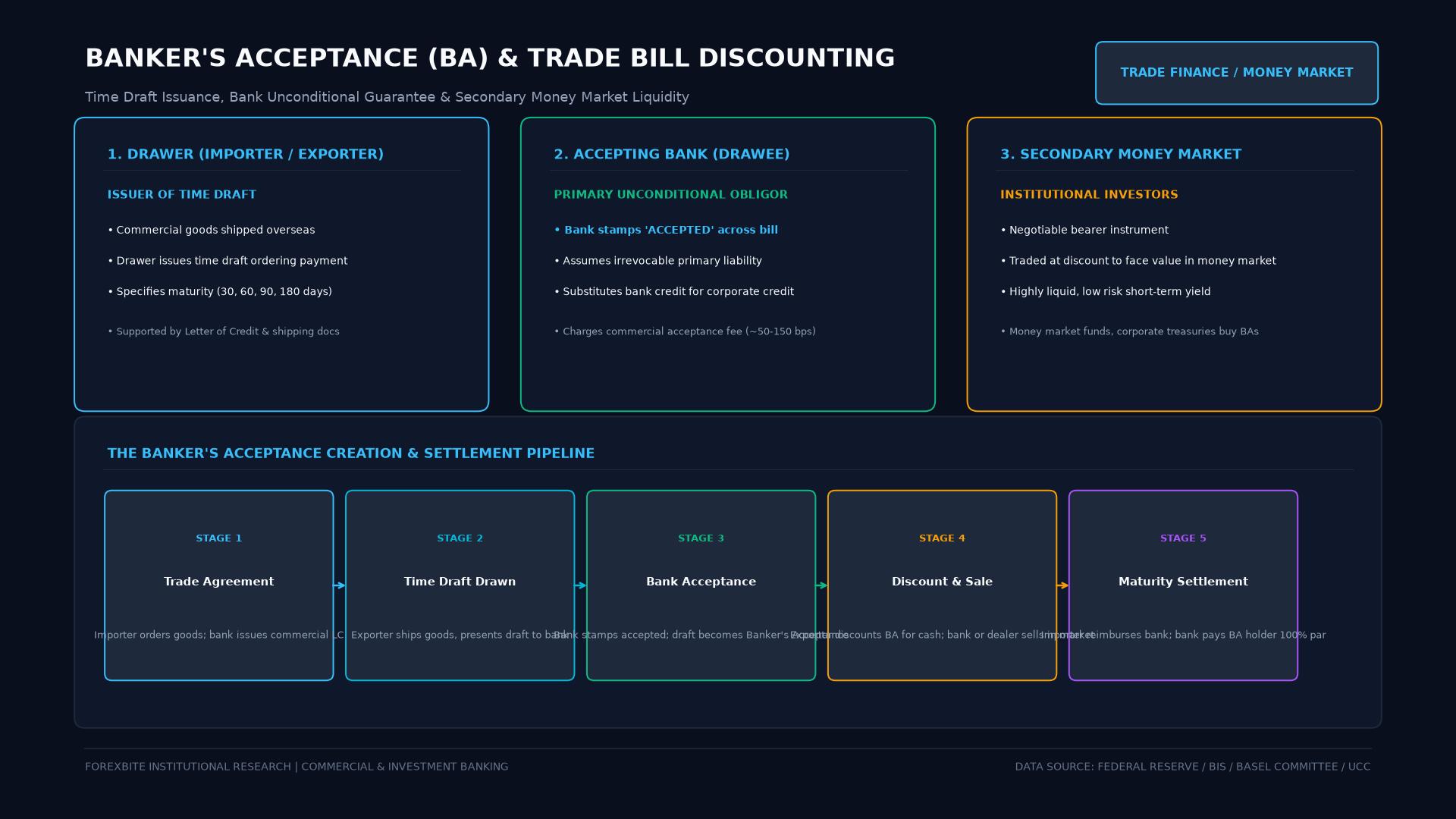 Figure: Lifecycle of a Banker’s Acceptance (BA) across cross-border trade: bill of exchange issuance, bank unconditional payment guarantee, discounting, and maturity settlement.
Technical Mechanics & Valuation Formulas
Because acceptances pay no periodic coupon interest, they trade as discount paper in short-term money markets, priced similarly to US Treasury bills and commercial paper on an actual/360-day basis:
1. Discount Price Formula
The purchase price ($P$) of an acceptance is calculated as:
$$P = F \times \left(1 - \frac{d \times t}{360}\right)$$
Where:
- $P$ = Dollar purchase price
- $F$ = Par / face value of the acceptance
- $d$ = Quoted annualized discount rate (decimal)
- $t$ = Actual number of days remaining until maturity
2. Money Market Yield (MMY) Calculation
To compare the annualized return of an acceptance against coupon-bearing money market securities, investors convert the discount rate into a Money Market Yield:
$$\text{MMY} = \frac{360 \times d}{360 - (d \times t)}$$
If a 90-day $1,000,000 Banker’s Acceptance is quoted at a 4.00% discount rate: $$P = $1,000,000 \times \left(1 - \frac{0.04 \times 90}{360}\right) = $1,000,000 \times 0.99 = \mathbf{$990,000}$$ $$\text{MMY} = \frac{360 \times 0.04}{360 - (0.04 \times 90)} = \frac{14.4}{356.4} \approx \mathbf{4.04%}$$
Comparative Matrix: Money Market Debt Instruments
| Instrument | Primary Obligor | Credit Risk Profile | Secondary Market Liquidity | Backing Collateral |
|---|---|---|---|---|
| Banker’s Acceptance (BA) | Tier-1 Commercial Bank | Very Low (Bank credit + Underlying goods) | High (Institutional money markets) | Physical commodities & shipping titles |
| Trade Acceptance (TA) | Commercial Corporate Buyer | Moderate to High (Corporate credit rating) | Low (Typically held by seller) | Commercial invoice |
| Commercial Paper (CP) | Investment-Grade Corporation | Low to Moderate (Unsecured corporate debt) | Very High | Unsecured general corporate credit |
| Treasury Bill (T-Bill) | Sovereign Government | Risk-Free (Full faith and credit of sovereign) | Exceptionally High | Sovereign taxing power |
Real-World Case Study: Financing a $10 Million Coffee Shipment
A specialty coffee importer in the United States contracted with an agricultural cooperative in Colombia for a $10,000,000 shipment of green coffee beans:
- The Letter of Credit & Draft: The US buyer arranged an irrevocable Letter of Credit through JPMorgan Chase. Upon loading the coffee onto container vessels at Cartagena, the Colombian cooperative drew a 120-day time draft on JPMorgan Chase for $10,000,000.
- Acceptance Stamped: JPMorgan Chase examined the bills of lading, agricultural health certificates, and maritime insurance policies. Satisfied, the bank stamped the draft as “Accepted”, creating a $10M Banker’s Acceptance.
- Immediate Liquidity: The Colombian cooperative did not wait 120 days to pay its local coffee farmers; it sold the BA to a New York money market liquidity fund at a 4.50% discount rate, immediately receiving $9,850,000 in cash.
- Final Settlement: 120 days later, the coffee beans arrived in California, were roasted and distributed to supermarkets, generating retail cash flow. The US importer paid JPMorgan Chase $10,000,000, and JPMorgan Chase redeemed the mature BA presented by the money market fund in full.
Frequently Asked Questions (FAQ)
What is the difference between a Banker’s Acceptance and a Trade Acceptance?
In a Banker’s Acceptance (BA), a commercial bank acts as the drawee and accepts the draft, substituting the bank’s prime creditworthiness for that of the corporate buyer. In a Trade Acceptance (TA), the corporate buyer itself is the drawee and acceptor; the instrument carries corporate credit risk and rarely trades in public money markets.
Are Banker’s Acceptances eligible for Federal Reserve rediscounting?
Yes. Under Section 13 of the Federal Reserve Act, “eligible” Banker’s Acceptances that arise from self-liquidating commercial import/export transactions or domestic commodity storage can be rediscounted (pledged as collateral for liquidity advances) at the Federal Reserve discount window, making them among the safest private debt instruments in existence.
What happens if the buyer defaults before an acceptance matures?
Because the accepting bank assumed primary, irrevocable liability when stamping the instrument, the bank must pay the holder in due course 100% of the face value at maturity from its own capital reserves. The bank then pursues recovery against the defaulting buyer through its security interest in the underlying cargo or warehouse receipts.
Ready to trade forex?
Open a free demo account with a regulated broker. Practice with virtual funds before risking real money.