Facility Fee
A facility fee is a non-usage fee charged by a syndicated bank lender to a borrower for the total committed credit line of a revolving credit facility, payable regardless of whether the borrower draws down any funds, compensating the lender for reserving capital capacity.
What Is a Facility Fee?
In corporate banking, leveraged finance, and syndicated lending, a facility fee (also called a commitment fee or line fee) is a recurring periodic charge levied by a lender or bank syndicate on the entire committed principal amount of a revolving credit facility or term loan commitment — irrespective of how much of that committed capacity the borrower actually draws down and utilizes.
Unlike traditional loan interest, which is calculated exclusively on outstanding borrowed balances, the facility fee is assessed on the total facility size — including both the drawn (utilized) and undrawn (available but uncommitted) portions. This fee structure exists because the lender must hold regulatory capital against the committed (but undrawn) facility, creating real economic costs even when the borrower does not access the funds.
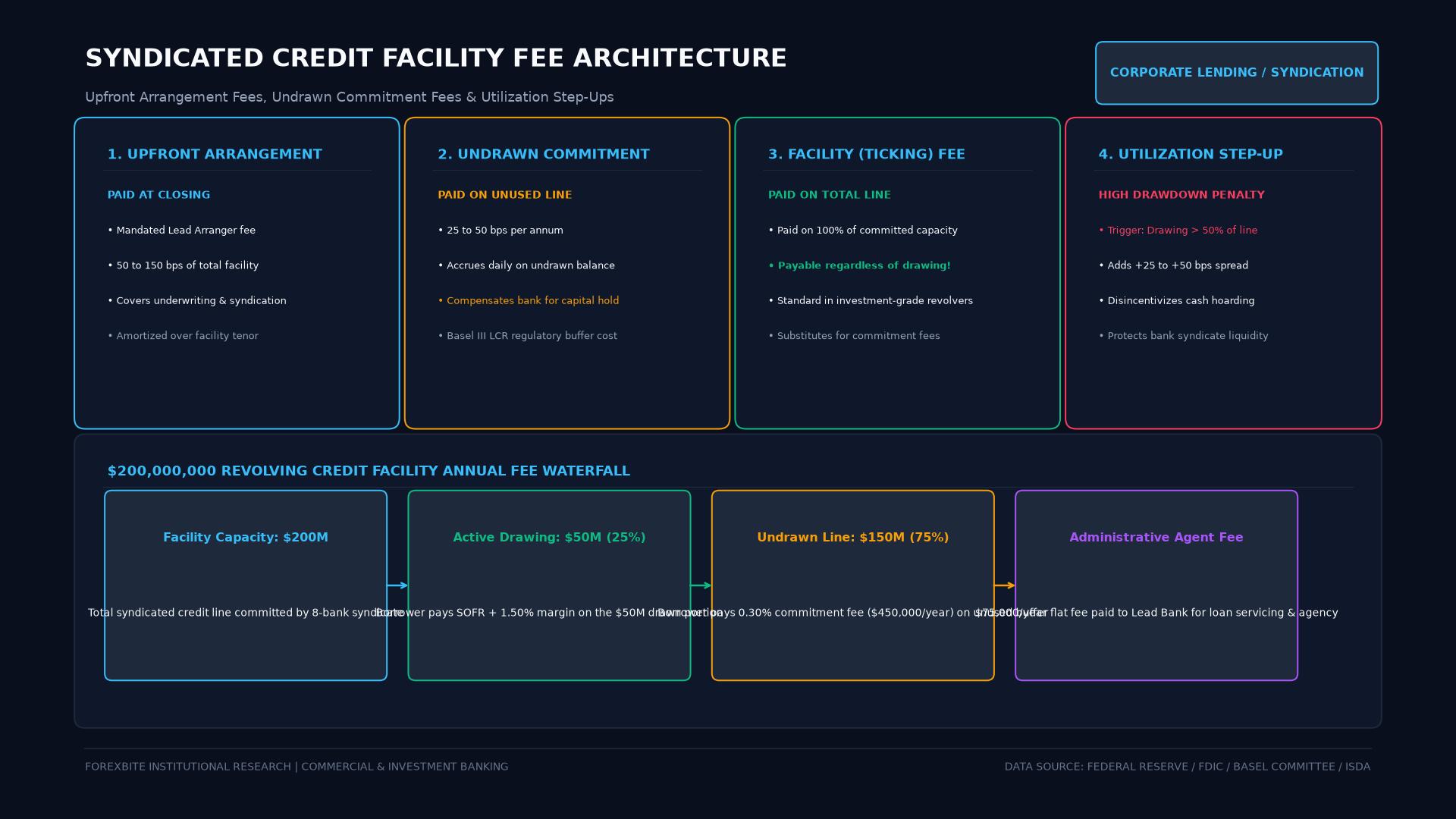 Figure: Commercial syndicated credit fee structures: annual facility fee charged on total committed line versus commitment fee assessed only on undrawn funds.
Technical Mechanics & Fee Accrual Formulations
Facility Fee vs. Commitment Fee Distinction
Practitioners must distinguish between the two common structures:
$$\text{Facility Fee (Full-Commitment)} = \text{Total Facility Commitment} \times r_{\text{facility}}$$
$$\text{Commitment Fee (Undrawn-Only)} = \left( \text{Total Commitment} - \text{Drawn Balance} \right) \times r_{\text{commitment}}$$
Where $r_{\text{facility}}$ and $r_{\text{commitment}}$ are the respective annual percentage rates (typically 0.10% to 0.50% for investment-grade borrowers; 0.375% to 1.00% for sub-investment-grade borrowers).
The All-In Cost of Revolving Credit
The true all-in borrowing cost for a corporate revolving credit user includes both the utilization interest and the facility fee:
$$\text{All-In Cost} = r_{\text{drawn}} \times U + r_{\text{facility}} \times (1 - U) + r_{\text{upfront arranger fees}} \times \frac{1}{n}$$
Where $U$ is the average utilization ratio of the credit facility and $n$ is the number of years of facility tenor.
Comparative Matrix: Corporate Credit Facility Fees
| Fee Type | Charged On | When Incurred | Typical Range | Negotiability |
|---|---|---|---|---|
| Facility Fee | Total committed amount | Quarterly, ongoing | 0.10% – 0.45% | Moderate |
| Commitment Fee | Undrawn portion only | Quarterly, ongoing | 0.125% – 0.50% | Moderate |
| Upfront Arrangement Fee | Total facility at closing | Paid at deal close | 0.25% – 2.00% | Lower |
| Utilization Fee | Drawn balance above threshold | When drawn >50% | +0.10% – +0.25% | Low |
| Agent Fee | Administrative per annum | Annually | $50K – $500K flat | Low |
Real-World Case Study: Investment-Grade Revolving Credit Syndication
The commercial importance of facility fees is illustrated by examining a typical Fortune 500 corporate revolving credit backstop:
The Boeing Company ($10 Billion Revolving Credit Facility):
1. The Structure: Boeing maintained a $10 billion multi-year revolving credit facility with a syndicate of 30+ global banks.
2. The Fee: Boeing was charged a facility fee of 0.10% per annum on the total $10 billion commitment.
3. The Annual Cost: $10,000,000,000 × 0.10% = $10,000,000 per year in facility fees alone.
4. The Strategic Value: In exchange for paying $10 million annually in facility fees (regardless of utilization), Boeing held the contractual right to borrow up to $10 billion within 2 business days at a pre-agreed interest rate spread — an essential liquidity backstop for emergency operational needs or bond market disruptions.
5. The COVID Test: When global commercial aviation collapsed in March 2020 and Boeing's bond market access temporarily froze, the company immediately drew down approximately $13.8 billion across multiple credit facilities, confirming the facility fee's true insurance value.
Frequently Asked Questions (FAQ)
What is the economic justification for charging a facility fee on undrawn credit?
When a bank commits to a revolving credit facility, it must hold regulatory capital (minimum 10% to 12.5% under Basel III) against the full committed exposure — including the undrawn portion — because regulators assume there is a non-zero probability the borrower draws down when in financial distress (exactly when the bank can least afford the exposure). The facility fee compensates lenders for this regulatory capital reservation, opportunity cost of foregone alternative lending, and administrative overhead of maintaining the committed line.
Can companies negotiate lower facility fees based on credit ratings?
Absolutely. Investment-grade corporations (rated BBB- or above by S&P and Baa3 or above by Moody’s) routinely negotiate grid-based pricing in revolving credit agreements, where facility fees and drawn-loan spreads automatically decrease as credit ratings improve. For example, an AAA-rated borrower might pay a 0.08% facility fee, while the same company at a BBB rating pays 0.20% — reflecting the bank’s risk-adjusted capital costs.
Do startup companies and small businesses pay facility fees on business credit lines?
While the term “facility fee” is most commonly associated with large syndicated corporate facilities, commercial banks also charge small business borrowers commitment fees on business lines of credit — typically called unused line fees or annual line fees. For small business revolving credit lines, these fees are commonly structured as a flat annual maintenance fee (e.g., $250 to $2,500 per year) rather than a percentage of total commitment.
Ready to trade forex?
Open a free demo account with a regulated broker. Practice with virtual funds before risking real money.